

A smiling woman in an ACLU baseball cap and sunglasses sits at the top of a yellow and blue inflatable slide, holding up an “I ❤ Democracy” ACLU bumper sticker.

When Will Tennessee Certify the 2026 Midterm Election Results?

After High Turnout, ACLU-TN Thanks Tennessee Voters, Poll Workers, and Partners, Looks Ahead to an Orderly Certification

By Cathryn Stout, PhD.

Latest Publication


Citizenship Rights Restoration in Tennessee

Restoring your voting rights in Tennessee got easier in 2026. State Sen. Raumesh Akbari and State Rep. Karen Camper led the charge in the legislature to remove some of the biggest barriers standing between formerly incarcerated Tennesseans and the ballot box.

The Campaign Legal Center and Free Hearts, a Tennessee nonprofit led by formerly incarcerated women, have been on the ground helping people navigate this process and pushing for a fairer system. For eligibility requirements and step-by-step petition instructions, read the guide from Free Hearts and the Campaign Legal Center.
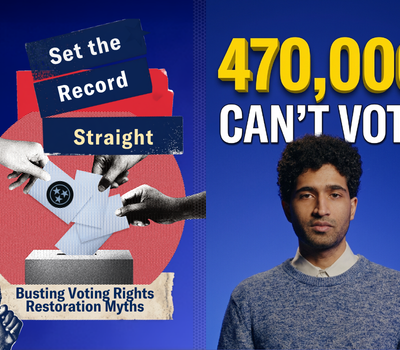

Thumbnail for the Set the Record Straight Series. Cover Reads: 470,000 Can't Vote

More from the Press


Placeholder image

Stay informed on civil rights issues. Discover our latest actions and updates in the Press Release section.

As the 115th Congress Ends, Here Are the Important Civil Rights Battles We’ve Won

The past two years have been challenging times, as we have witnessed attacks on our shared values and civil rights from the Trump White House and a Republican-dominated Congress. It can sometimes feel difficult to make change happen, but even in this hostile climate, ACLU activists helped drive key legislative victories to advance civil liberties during the 115th Congress, which ends tomorrow. As the new Congress is sworn in on Thursday, these victories should remind us that people power works in Washington, too, and should prepare us to take on emerging fights in the new year.   Following pressure from advocates, Congress approved a criminal justice reform package that will help reduce mass incarceration in the U.S., and

By aclutn

Placeholder image

How to Fund the Government Without Paying for Trump’s Border Wall

President Trump has followed through on his threat to shut down the government in order to feed his border wall obsession. In fact, he’s gone further, stating that he’ll loot his cabinet departments, including the military, if necessary. After Trump refused to sign a

By aclutn

Placeholder image

The Courts Consistently Brushed Back Trump’s Assaults on Immigrants in 2018

This article was originally published in The Los Angeles Times.  For immigrants, there’s no way to sugarcoat 2018. The Trump administration enacted a series of draconian policies targeting n

By aclutn

Placeholder image

The First Step Act Is a Small Step for Incarcerated Women

The enactment of the First Step Act earlier this month will bring some much-needed change to our criminal justice system. But the First Step Act remains just that, a first step — particularly with respect to the impact that mass incarceration has had on cisgender women and trans people. The legislation ends two gender-specific indignities of federal incarceration: the

By aclutn

Placeholder image

Amber Heard: I Spoke Up Against Sexual Violence and Faced Our Culture’s Wrath

This piece was originally published in the Washington Post. I was exposed to abuse at a very young age. I knew certain things ear

By aclutn

Placeholder image

In South Dakota, Police Officers Involved in Shootings Are Claiming They Have a Right to Privacy as Crime Victims

After a high-speed pursuit in South Dakota in September, a highway patrol trooper shot and wounded a man after he “ignored verbal commands” and “tackled” the trooper. One month later, the Department of Criminal Investigation cleared the trooper of any wrongdoing. Then in November, a South Dakota sheriff’s deputy shot and killed a suspect who had fled after reportedly firing at deputies during a pursuit. The people of South Dakota, however, do not know the names of these law enforcement officers. And the reason for this lack of transparency is Marsy

By aclutn

Placeholder image

The Battle to Stop Family Separation

In March 2017, John Kelly, then Secretary of Homeland Security, said in an interview with CNN that the Trump administration was considering a national policy to separate parents from their children to deter immigrants from crossing the border into the United States. The proposal triggered a backlash because it was so unpalatable, and the administration didn’t move forward with it. But six months later, in December 2017, The Washington Post and The New York Times reported that the administration was again considering the idea. At the same time, advocates who provide services to children in government custody told ACLU lawyers they were seeing children much younger than the teenagers they usually saw entering their facilities. As the stories began to multiply, the ACLU’s Immigrants’ Rights Project quickly realized that the administration wasn’t considering the separation of children from their parents—it was already doing it.  For at least six months before then Attorney General Jeff Sessions announced the zero-tolerance policy of prosecuting every adult who crossed into

By aclutn

Placeholder image

When Portland Tried to Dictate Favorable News Coverage of Its Protest Crackdowns

After months of facing criticism for how Portland has been policing protests, the city’s mayor and police bureau recently invited select reporters to the bureau’s command center to watch their policing in action. The only catch? Well, there were at least three. But first, some background: The Portland Police Bureau’s harsh crackdown on a recent wave of anti-Trump and anti-racist protests has been biased

By aclutn

Placeholder image

Single Moms Get Sucked Into the Cruelest Debtors’ Prison We’ve Ever Seen

Twanda Marshinda Brown is a single mom in South Carolina who was supporting her children by working at Burger King. In 2016, a court in Lexington County fined her around $2,300 for two traffic offenses. The judge ordered her to make monthly payments of $100, even though she explained she could only afford to pay $50 a month while taking care of her family. Brown managed to make five payments. But then her son was hospitalized and several paychecks from her employer bounced. Brown fell behind on payments, a

By aclutn

Placeholder image