
Court Cases
All Cases
83 Court Cases
Sep 4, 2026

OUTMemphis v. Skrmetti (formerly OUTMemphis v. Lee)
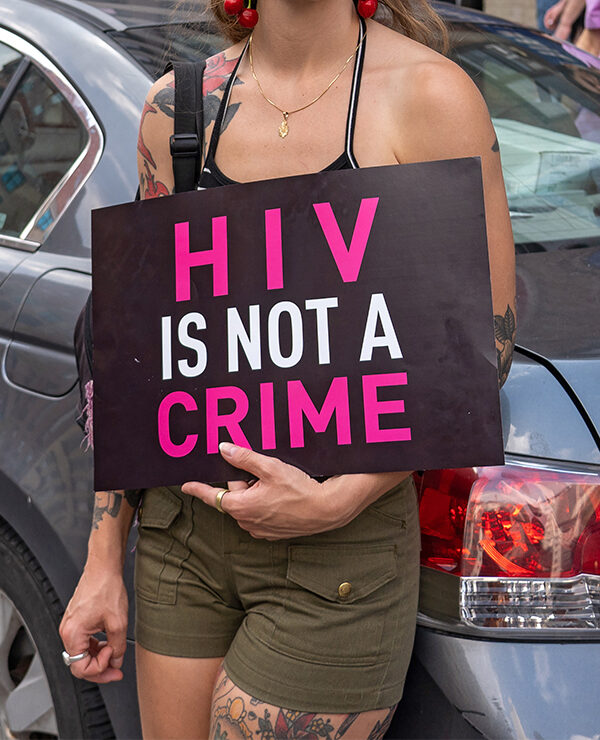
In Tennessee, an individual who is convicted under the generic Prostitution statute – which prohibits engaging in, or offering to engage in, sexual activity for compensation – faces a small fine and minimal jail time. While this is by no means inconsequential, Tennessee has also chosen to criminalize what it calls “Aggravated Prostitution.” Aggravated Prostitution is identical to Prostitution, with one key additional element: knowledge that one is living with HIV. Unlike Prostitution, Aggravated Prostitution is a felony that requires lifetime registration as a “violent sex offender.” The law ignores underlying circumstances; neither consent nor the use of mitigation (such as condoms, ART, or PrEP) are defenses. Indeed, the statute applies even when the alleged sexual activity poses no risk of HIV transmission whatsoever; and the registration requirement is automatic.
People charged with Aggravated Prostitution in Tennessee are most often cisgender and transgender women who engage in sex work to meet basic needs like food, shelter, or other necessities, the vast majority of whom are Black women. Indeed, in 2022, a Black woman in Tennessee was 290 times more likely to be on the sex offender registry for an HIV-related conviction than a white man.
Plaintiff OUTMemphis—a leading service provider of HIV testing, outreach and education in the Midsouth region—has joined four cisgender and transgender women forced to register for life as “sex offenders” due to their Aggravated Prostitution convictions to force Tennessee to abandon its illegal disability discrimination. The ADA is intended to address discrimination against people with disabilities in critical areas like employment and housing. Yet under Tennessee’s HIV laws, people convicted of Aggravated Prostitution are effectively barred from many employment opportunities, housing options, and public spaces as well as family and community life: they are, for example, forbidden from working, living, or even spending short amounts of time within 1,000 feet of a school, playground, park, or other area where children gather. In large cities like Memphis, finding work and housing outside these vast and ever-changing registry “Exclusion Zones” is nearly impossible.
Tennessee, and many other states, passed HIV-criminalization laws in the panicked early days of the AIDS epidemic. Over the last decade, many states have reformed their laws in recognition of the scientific consensus that such measures do not reduce the prevalence of HIV but rather risk doing the opposite: by criminalizing knowledge of one’s HIV status, states like Tennessee disincentivize at-risk individuals from seeking HIV testing and erode the trust in medical professionals that is needed to successfully access treatment and limit transmission. Despite clear evidence that HIV laws, and especially laws requiring sex offender registration, do not work, Tennessee stands alone in the harshness and arbitrariness of its statutory scheme.
Jun 24, 2026

Blount Pride, Inc. v. Desmond
Blount Pride, Inc. (“Blount Pride”) planned a Pride event that would feature drag performances, including a performance by drag queen Flamy Grant. The event was to occur on September 2, 2023 at Maryville College in Maryville, Tennessee. On August, 29, 2023, four days before the event, District Attorney for Tennessee’s Fifth Judicial District, Ryan Desmond, issued a letter to Blount Pride saying that he would enforce the anti-drag law that had been passed in 2022.
In an effort to protect the free speech rights of drag performers, ACLU-TN and attorneys Brice Timmons, Melissa Stewart, Daniel Horwitz, Melissa Dix, and Justin Gilbert filed a complaint and emergency motion for a temporary restraining order on August 30, 2023 on behalf of Blount Pride and Christian artist and drag performer Flamy Grant.
United States District Court Judge Ronnie Greer, in the Eastern District of Tennessee, granted the temporary restraining order and the Pride event proceeded as planned. Defendants then agreed to a preliminary injunction while a previously filed challenge to the anti-drag law, Friends of George’s v. Mulroy, continued on appeal in the Sixth Circuit.
Jun 4, 2026

Lucy v. Skrmetti
The American Civil Liberties Union, ACLU of Tennessee, and National Immigration Law Center filed a federal class-action lawsuit challenging a new Tennessee law, HB 1704, that unconstitutionally usurps federal immigration enforcement power by making it a crime for certain immigrants to remain in the state.
Courts across the country have repeatedly reaffirmed that immigration enforcement is a power that belongs exclusively to the federal government — not the states.
Tennessee’s law, however, creates a new crime for people with final removal orders who have not left the state. HB 1704 is part of a larger framework of new extreme anti-immigration state laws aimed at criminalizing noncitizens’ presence within a state either by punishing entry, or in this case, lack of departure.
May 15, 2026

Tony Von Carruthers v. State of Tennessee
Tony’s conviction was based on testimony from paid jailhouse informants, and there has never been physical evidence linking him to the crime. In 2011, Tony's co-defendant said that Tony was not involved, and pointed investigators to a different man.
There are unmatched fingerprints and DNA from the crime scene that we know don't match Tony. Those prints and DNA have never been compared to the alternative suspect. The ACLU filed a motion for DNA testing in the Tennessee Supreme Court asking the state to compare the unknown male DNA to the alternative suspect identified by Tony's co-defendant in 2011 and to do sampling of three additional items that have never been subject to testing.
On April 28, the ACLU filed a Section 1983 lawsuit in federal court challenging the state’s denial of a motion to test unidentified fingerprint evidence that does not match Tony. The complaint also challenges the court’s refusal to consider new evidence that the prosecutors hid the fact that its main witness was a paid confidential informant as well as the 2011 statement from the now-released co-defendant exonerating Tony and pointing to an alternate suspect.
Before the state carries out an execution, it should answer the most basic question: did they get the right person? In this case, Tennessee has the evidence to help answer that question and must test it before they execute the wrong man.
Read the clemency petition here.
Evidence at Trial
With no physical evidence linking Tony to the crime scene, the case against him is built on testimony from paid informants, which is widely known to be one of the leading causes of wrongful convictions. Alfredo Shaw, a career informant, testified to the Grand Jury that Tony confessed to him. That testimony was the main reason prosecutors were able to charge Tony at all. Shaw later recanted in a TV interview, saying the confession never happened.
At trial, prosecutors did not call Shaw as a witness. Tony, who had been denied counsel and forced to represent himself, called Shaw as part of his defense. Before Shaw testified, prosecutors threatened him with perjury charges if he contradicted his original Grand Jury testimony. Under that pressure, Shaw repeated the confession story to the jury.
The jury was not informed that Shaw had secretly been working as a paid informant for the state. During Shaw’s testimony, Tony directly asked him if he ever worked as a confidential informant. The prosecutor, knowing that Shaw was indeed a paid informant, objected to relevance, and the court sustained the objection. The State continued to deny that Shaw was a paid informant for the next three decades, until evidence uncovered in 2024 confirmed that the state had paid him. The sudden disclosure appeared to be due to the opening of a conviction integrity review unit within the state attorney’s office.
Tony's Self-Representation
Tony was forced to represent himself at trial after the trial court became frustrated with his repeated firing of appointed counsel. Tony never sought self-representation and repeatedly requested counsel.
Because Tony didn’t have a lawyer, key aspects of the prosecution’s case went unchallenged, including the circumstances surrounding Shaw's statements and his relationship with the state.
Tony's trial was so filled with errors due to his forced self-representation that on appeal the court found that his co-defendant, deserved a new trial. Tony's co-defendant ultimately took an Alford plea, received a 27-year sentence, and was released in 2015.
If Tony is executed, he would be the first person in nearly a century to be put to death after being forced to represent himself at trial.
Untested Fingerprint and DNA Evidence
In 1994, investigators collected fingerprint evidence from one of the victim's homes, where the victims were kidnapped from. They recovered multiple prints from the house in locations that the facts suggest the kidnapper would have touched: doorknobs and a phone receiver. None of the prints match Tony, and there is no other physical evidence tying him to the scene of the crime.
In 2011, Tony's co-defendant gave a statement to an investigator that Tony was not involved in the kidnapping or the murders and pointed them to a different man. That suspect's fingerprints have never been compared to the unidentified prints recovered from the crime scene.
The jury was never told about the unidentified prints, that Tony's prints weren’t found at the house, or that prints from the person who is most likely responsible for the kidnapping were never compared.
To this day, there are still 6 unmatched fingerprints from the scene. In September 2021, Tony filed a pro se motion for fingerprint testing. In January 2026, after his execution date had been set, Tony’s lawyers filed a supplemental pleading, which included his co-defendant's disclosure about the alternative suspect as well as the State’s decades-long concealment of Alfredo’s Shaw’s status as a paid informant. The state court denied his request on the grounds that the testing could not exclude Tony's participation. More troubling, the state court held that the new information about Alfredo Shaw as well as the statement implicating the alternative suspect could not be considered, finding that Tennessee law limits defendants to the universe of information that was available at the time of trial or arrest.
In addition to the unidentified fingerprint evidence, there is unknown male DNA on a piece of fabric used to bind the victims. When the state ran DNA testing, the results excluded Tony and his co-defendant.
The ACLU has active lawsuits in state and federal court, urging the state to stay the execution until they consider all the evidence and compare the DNA and fingerprints that do not match Tony to the alternative suspect identified by Tony’s co-defendant in 2011.
May 4, 2026

No Kings Memphis and the Kendrick Consent Decree
On April 1, 2026, the ACLU of Tennessee sent a letter to Independent Monitor Edward L. Stanton III urging him to investigate whether the Memphis Police Department’s conduct on March 28 during the No Kings rally violated the Kendrick Consent Decree. The decree is a landmark federal court order that places limits on how MPD can surveil, monitor, and intimidate people who are exercising their constitutional rights. During the rally, MPD officers grabbed protest marshals from behind, pepper-sprayed Memphians at close range, and arrested peaceful demonstrators.
In the letter, the ACLU-TN urged an investigation into whether: 1) MPD’s forcible intervention interfered with First Amendment activity and was intended to deter future protest; 2) MPD failed to seek required director authorization before intervening, as the decree stipulates; and 3) photographs, body-worn camera footage, or other intelligence gathered at the march were preserved or shared in ways that violate the decree’s strict restrictions on surveillance and information sharing.
The city responded on April 15 by confirming an independent investigation. That same day, the state dropped charges against the three peaceful demonstrators arrested during the march.
Dec 11, 2025
Young v. Lee
The American Civil Liberties Union of Tennessee (ACLU-TN), alongside the Education Law Center, Southern Poverty Law Center, and Southern Education Foundation, has filed a lawsuit challenging the constitutionality of Tennessee’s Universal Voucher Program. This lawsuit, Young v. Lee, represents public school parents and community members across Tennessee who argue that the law unlawfully diverts public funds to private schools, undermining the state's commitment to equitable public education.





Stay Informed
Sign up to be the first to hear about how to take action.
By completing this form, I agree to receive occasional emails per the terms of the ACLU’s privacy statement.
By completing this form, I agree to receive occasional emails per the terms of the ACLU’s privacy statement.