
A smiling woman in an ACLU baseball cap and sunglasses sits at the top of a yellow and blue inflatable slide, holding up an “I ❤ Democracy” ACLU bumper sticker.

When Will Tennessee Certify the 2026 Midterm Election Results?

After High Turnout, ACLU-TN Thanks Tennessee Voters, Poll Workers, and Partners, Looks Ahead to an Orderly Certification

By Cathryn Stout, PhD.

Latest Publication


Citizenship Rights Restoration in Tennessee

Restoring your voting rights in Tennessee got easier in 2026. State Sen. Raumesh Akbari and State Rep. Karen Camper led the charge in the legislature to remove some of the biggest barriers standing between formerly incarcerated Tennesseans and the ballot box.

The Campaign Legal Center and Free Hearts, a Tennessee nonprofit led by formerly incarcerated women, have been on the ground helping people navigate this process and pushing for a fairer system. For eligibility requirements and step-by-step petition instructions, read the guide from Free Hearts and the Campaign Legal Center.
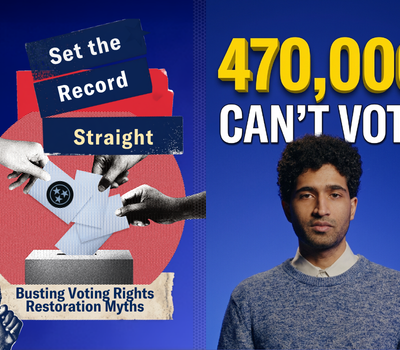

Thumbnail for the Set the Record Straight Series. Cover Reads: 470,000 Can't Vote

More from the Press


Placeholder image

Stay informed on civil rights issues. Discover our latest actions and updates in the Press Release section.

Public Trust in Artificial Intelligence Starts With Institutional Reform

Gaining the public’s trust in artificial intelligence (AI) will take more than just setting technical standards. It will require that institutions using this technology first prove they are worthy of our trust. Earlier this year, Congress passed its most significant law to date on AI. As part of this law, Congress tasked the National Institute of Standards and Technology (NIST) with creating a framework to manage risks associated with the use of AI. While this is a critical first step towards AI accountability, technical standards alone can’t guarantee trustworthiness in AI development and use. That’s why last week we sent a letter responding to NIST’s draft proposal on methods to manage bias in AI. A

By aclutn

Placeholder image

A Once-in-a-Lifetime Opportunity: Why the U.S. Should Keep its Promise to Diversity Visa Winners

Update 9/14/2021: This week, the House Judiciary Committee will begin markup of immigration provisions in the Build Back Better reconciliation bill. As of Monday morning, the language restores access to diversity visas for people who were selected in the diversity visa lottery but were denied visas due to Muslim, Africa, and immigrant travel bans and COVID-19 related disruption. Now the fight continues to ensure the language stays in the reconciliation bill and becomes law. I

By aclutn

Placeholder image

20 Years After 9/11, We Have a Roadmap Toward a More Just and Equitable Future

In the early days after 9/11, I hoped desperately — alongside so many others around the country and the world — that our government would make wise choices, that it would meet violence with justice, transparency, accountability, and a commitment to fundamental rights. We knew that too often in American history, political leaders respond to traumatic events by clamping down on our civil rights and liberties, and only come to regret it after terrible human costs. And we knew that those costs are borne primarily by Black and Brown people and immigrants, whom the government has always wrongly viewed through a security threat lens. S

By aclutn

Placeholder image

Drug Treatment is Infrastructure

COVID-19 was not the only deadly public health crisis of the past year and a half. The overdose epidemic killed a record 93,000 Americans in 2020, ravaging communities across the country, and may be on track to be worse in 2021. While the nation has combated COVID-19 by prioritizing medical research, vaccine production, treatment development, and implementation of common-sense public health measures, our response to the overdose epidemic has been tragically meager. In this moment of investment in our nation’s infrastructure, it is time for federal, state, and local governments to change course and invest in proven, life-saving public health tools to finally stem the tide of overdoses across the country. I

By aclutn

Placeholder image

A Conversation with Survivors of the CIA’s Post 9/11 Torture Program

In 2015, the ACLU sued psychologists James Elmer Mitchell and John “Bruce” Jessen, whom the CIA enlisted to design, implement, and oversee its post-9/11 torture program. Our clients were Suleiman Abdullah Salim and Mohamed Ahmed Ben Soud, who survived the torture, and the family of the late Gul Rahman, who was kidnapped, experimented on, and tortured to death in CIA custody. W

By aclutn

Placeholder image

The Watchlisting System Exemplifies the Government’s Post-9/11 Embrace of Biased Profiling

As a Harvard graduate student and mother of three children, Zainab Merchant was accustomed to traveling frequently from her home in Orlando to Boston for her studies. In 2016, that all changed. T

By aclutn

Placeholder image

10 Things to Know about Combating Violence in America

“With violent crime on the rise, we must invest in more police.” You’ve probably heard this recently from the media, elected officials, and some people directly impacted by gun violence. The pain of communities facing the threat of interpersonal gun violence demands that something be done to protect families, create safer streets, and save lives. If you combine that desperate need for solutions with a society where police have been legitimized as the first, last, and only resort, it’s easy to understand why people would clamor for more police right now. W

By aclutn

Placeholder image

The Privacy Lesson of 9/11: Mass Surveillance is Not the Way Forward

Twenty years after 9/11, the pervasive power of our government’s mass surveillance regime is clearer than ever — and it’s past time for change. Congress now has the opportunity to enact essential reforms, by looking to the lessons of the last two decades to impose restraints that will protect us in the face of even more powerful and invasive technologies going forward. T

By aclutn

Placeholder image

Six Children, One Mom, No Broadband Internet Connection

A total nightmare. That’s what life has felt like as a mother living with six children in virtual classes. For over a year, it’s been one challenge after another to get the tools my children need to continue their education. We needed space, so I got them folding tables for desks. We needed computers, so a local nonprofit helped supply each child with a laptop. But we learned quickly that all the space and supplies in the world didn’t mean much without a steady broadband internet connection. We could not afford it. W

By aclutn

Placeholder image