

A smiling woman in an ACLU baseball cap and sunglasses sits at the top of a yellow and blue inflatable slide, holding up an “I ❤ Democracy” ACLU bumper sticker.

When Will Tennessee Certify the 2026 Midterm Election Results?

After High Turnout, ACLU-TN Thanks Tennessee Voters, Poll Workers, and Partners, Looks Ahead to an Orderly Certification

By Cathryn Stout, PhD.

Latest Publication


Citizenship Rights Restoration in Tennessee

Restoring your voting rights in Tennessee got easier in 2026. State Sen. Raumesh Akbari and State Rep. Karen Camper led the charge in the legislature to remove some of the biggest barriers standing between formerly incarcerated Tennesseans and the ballot box.

The Campaign Legal Center and Free Hearts, a Tennessee nonprofit led by formerly incarcerated women, have been on the ground helping people navigate this process and pushing for a fairer system. For eligibility requirements and step-by-step petition instructions, read the guide from Free Hearts and the Campaign Legal Center.
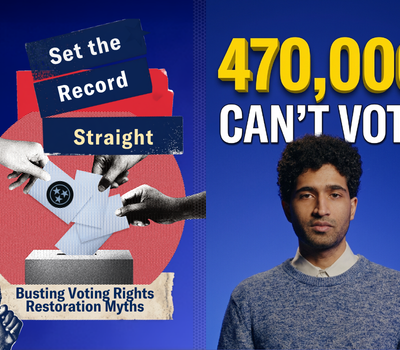

Thumbnail for the Set the Record Straight Series. Cover Reads: 470,000 Can't Vote

More from the Press


Placeholder image

Stay informed on civil rights issues. Discover our latest actions and updates in the Press Release section.

The Trump Administration Is Hiding a Crucial Report on NSA Spying Practices

Despite requests from a senator and the European Union, the Trump administration is refusing to make public an important report by a federal privacy watchdog about how the U.S. government handles personal information swept up by its surveillance. The public has a right to know what the government does with the vas

By aclutn

Placeholder image

‘Back Up, Motherfuckers,’ A Cop Yells at Kids With His Gun Drawn

Learn about what’s happening across the most pressing civil liberties issues of our time, and what you can do.

By aclutn

Placeholder image

When Your Constitutional Rights Are Violated but You Lose Anyway

Beginning in 2010, a Connecticut man, Almighty Supreme Born Allah, spent over six months in solitary confinement. He was alone for 23 hours a day, allowed to shower just three times a week in underwear and leg shackles, and permitted only one 30-minute visit each week with a family member, whom he was not allowed to embrace, let alone touch. Studies have shown that this kind of isolation can result in clinical outcomes similar to those of physical torture, which is why numerous international human rights bodies have condemned the prolonged use of solitary confinement.The twist on this twisted set of punishments?Allah had not been convicted of a crime when he was put in solitary confinement. He sued, and four federal judges agreed with Allah that this treatment during pretrial detention violated his constitutional rights. And yet, he lost his case because of a rule called qualified immunity that the U.S. Supreme Court created in the 1980s. As William Baude, a constitutional law professor from the University of Chicago, explains, “[t]he doctrine of qualified immunity prevents government agents from being held personally liable for constitutional violations unless the violation was of ‘clearly established’ law.”To understand how this works you have to start with a federal law called section 1983, which holds state and local government officials liable for money damages in federal court if they have violated constitutional rights. This law has been on the books since 1871, and it was originally enacted to stop law enforcement from ignoring the lynching of newly freed Black citizens.But while section 1983 was intended to increase accountability for government officials who break the law, the Supreme Court created a giant loophole that undermines that goal, making it virtually impossible for government officials to be held personally liable for wrongdoing. That loophole is qualified immunity, which either the Supreme Court or Congress could fix to ensure constitutional misconduct does not go unpunished.Since the creation of qualified immunity, the rule has snowballed out of control. As the judges on Allah’s case explained, the rule now allows “all but the plainly incompetent or those who knowingly violate the law” to defeat lawsuits brought by the victims of government overreach. The result, as Justice Sotomayor recently argued in a dissent, is that “palpably unreason­able conduct will go unpunished.”That’s exactly what happened in Allah’s case. In 1979, the Supreme Court held in Bell v. Wolfish that under the Constitution’s Due Process Clause, pr

By aclutn

Placeholder image

Nevada Plans to Execute Prisoner Using a Risky and Experimental Drug Cocktail

On July 11, the state of Nevada will execute death-row prisoner Scott Dozier. To do so, the state has decided to use an experimental protocol that incorporates a drug — Midazolam — that has been associated with multiple botched executions across the United States. Allowing the government to execute a person using a protocol that risks torture would be a grave injustice. Nevadans must demand better.  The road to this upcoming execution has been a tumultuous one.  The state previously planned to exe

By aclutn

Placeholder image

It’s Not Just Roe: How the Future Supreme Court Could Gut Abortion Rights

Now that President Donald Trump has nominated Brett Kavanaugh to replace Justice Anthony Kennedy on the Supreme Court, it will be up to the Senate to fully vet him so that the American people can determine whether he will uphold the basic civil rights and liberties relied on by everyone in this country. This is particularly true when it comes to abortion rights, where Kavanaugh’s prior opinions on the subject, coupled with the fact that Donald Trump vowed to only nominate justices who would overturn Roe v. Wade, give rise to serious concern about women’s continued ability to access abortion if Kavanaugh is confirmed.  The ACLU as a matter of policy does not endorse or oppose nominees to the Supreme Court. But we do think it’s

By aclutn

Placeholder image

The Supreme Court Doesn’t Have to Overturn Roe to Eviscerate Abortion Rights

Now that President Donald Trump has nominated Brett Kavanaugh to replace Justice Anthony Kennedy on the Supreme Court, it will be up to the Senate to fully vet him so that the American people can determine whether he will uphold the basic civil rights and liberties relied on by everyone in this country. This is particularly true when it comes to abortion rights, where Kavanaugh’s prior opinions on the subject, coupled with the fact that Donald Trump vowed to only nominate justices who would overturn Roe v. Wade, give rise to serious concern about women’s continued ability to access abortion if Kavanaugh is confirmed.  The ACLU as a matter of policy does not endorse or oppose nominees to the Supreme Court. But we do think it’s

By aclutn

Placeholder image

The Supreme Court Doesn’t Have to Overturn Roe to Decimate Abortion Rights

Now that President Donald Trump has nominated Brett Kavanaugh to replace Justice Anthony Kennedy on the Supreme Court, it will be up to the Senate to fully vet him so that the American people can determine whether he will uphold the basic civil rights and liberties relied on by everyone in this country. This is particularly true when it comes to abortion rights, where Kavanaugh’s prior opinions on the subject, coupled with the fact that Donald Trump vowed to only nominate justices who would overturn Roe v. Wade, give rise to serious concern about women’s continued ability to access abortion if Kavanaugh is confirmed.  The ACLU as a matter of policy does not endorse or oppose nominees to the Supreme Court. But we do think it’s

By aclutn

Placeholder image

Family Separation in Court: What You Need to Know

On June 26, a federal judge issued a national injunction in the ACLU’s class action lawsuit against the Trump administration’s policy of separating children and parents at the border. He ordered the government to reunite all children under five with their parents by Tuesday, July 10, and all remaining children by July 26.  Since then, the administration has been scrambling to create a plan and process to meet the court’s deadlines

By aclutn

Placeholder image

The 14th Amendment Was Intended to Achieve Racial Justice — And We Must Keep It That Way

Few times in recent memory have demanded a more careful examination of our nation’s history than now — the year we celebrate the 150th anniversary of the 14th Amendment’s passage. At a time when the Trump administration is throwing asylum seekers in jail without due process and undermining efforts to desegregate schools, it is critical to remember that the “pervading purpose” of the 14th Amendment was to eliminate the oppression of historically subjugated minorities and to provide equality of opportunity.  The amendment’s ratification in 1868, shortly after African-Americans were emancipated from slavery, repr

By aclutn

Placeholder image