
A smiling woman in an ACLU baseball cap and sunglasses sits at the top of a yellow and blue inflatable slide, holding up an “I ❤ Democracy” ACLU bumper sticker.

When Will Tennessee Certify the 2026 Midterm Election Results?

After High Turnout, ACLU-TN Thanks Tennessee Voters, Poll Workers, and Partners, Looks Ahead to an Orderly Certification

By Cathryn Stout, PhD.

Latest Publication


Citizenship Rights Restoration in Tennessee

Restoring your voting rights in Tennessee got easier in 2026. State Sen. Raumesh Akbari and State Rep. Karen Camper led the charge in the legislature to remove some of the biggest barriers standing between formerly incarcerated Tennesseans and the ballot box.

The Campaign Legal Center and Free Hearts, a Tennessee nonprofit led by formerly incarcerated women, have been on the ground helping people navigate this process and pushing for a fairer system. For eligibility requirements and step-by-step petition instructions, read the guide from Free Hearts and the Campaign Legal Center.
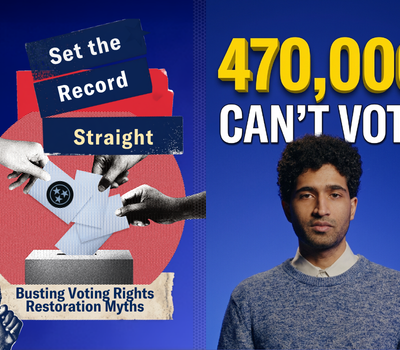

Thumbnail for the Set the Record Straight Series. Cover Reads: 470,000 Can't Vote

More from the Press


Placeholder image

Stay informed on civil rights issues. Discover our latest actions and updates in the Press Release section.

It’s Past Time to End the Federal Militarization of Police

You’ve probably seen it by now, on B-roll if not in real life: Police and sheriff’s deputies spraying protesters with a water cannon mounted on a mine resistant vehicle. Combat vehicles rolling down American streets. Police — some with combat helmets and night vision goggles — touting military-grade rifles. These are America’s militarized police forces, brought to your community in no small part by billions of dollars in federal spending. No federal program is more emblematic of America’s police militarization problem than 1033, named for a section of law that allows the U.S. military to directly distribute weapons of war to police and sheriff’s departments. R

By aclutn

Placeholder image

Federal Militarization of Law Enforcement Must End

The federal government arms local police forces in the United States with weapons of war. A program called “1033,” for the section of the act that created it, allows the Department of Defense to give state, local, and federal law enforcement agencies military hardware. Since its inception in 1996, nearly 10,000 jurisdictions have received more than $7 billion of equipment. This includes combat vehicles, rifles, military helmets, and misleadingly named “non-” or less-lethal weapons, some of which have featured in police raids and police violence against

By aclutn

Placeholder image

International Accountability is Critical to Dismantling Systemic Racism and Police Brutality Domestically

This month marks a year since George Floyd’s murder at the hands of police, which outraged the world and sparked unprecedented domestic and global protests calling for racial justice and transformative change. Minneapolis police officer Derek Chauvin’s guilty verdict should have been an inevitable accountability measure, yet even though the horrible display of brutality was caught on camera in broad daylight, the outcome was far from guaranteed. The uncertainty leading up to the verdict illustrates the normalization of impunity for police in the criminal legal system. C

By aclutn

Placeholder image

Your Friendly Neighborhood Bank: The Post Office

One in four Americans are unbanked or underbanked. This is in part because because banks across the country are closing branches, or penalizing those who don’t have large savings. This means that 64 million Americans — disproportionately Black and Brown people — can’t easily access basic financial services and are forced to pay thousands a year in fees for alternatives. B

By aclutn

Placeholder image

The Oversight Board’s Trump Decision Highlights Problems with Facebook’s Practices

The ACLU condemns the bald-faced lies that President Trump repeatedly propounded after decisively losing the Nov. 4 election, and we called for his impeachment for his concerted effort to subvert our democratic process, leading to the Jan. 6 assault on the U.S. Capitol. We also recognize that Facebook is a private entity with its own First Amendment rights to control the content it publishes. But Facebook’s decision to ban Trump nonetheless illustrates serious shortcomings in its content-related decision making — as its own Oversight Board (OB) properly declared yesterday in reviewing the decision. Facebook exercises quasi-monopoly power over a critical forum in our marketplace of ideas, and for many of the same reasons that we would be suspicious of a central government authority controlling what can and cannot be said, we have concerns with Facebook exercising such unchecked power. T

By aclutn

Placeholder image

Cast An Informed Vote for Philadelphia District Attorney on May 18

In the election for Philadelphia District Attorney, make sure you’re informed about a name that isn’t on the ballot —- the Philadelphia Fraternal Order of Police. T

By aclutn

Placeholder image

Trump’s Secret Rules for Drone Strikes and Presidents’ Unchecked License to Kill

This article was first published on Just Security. O

By aclutn

Placeholder image

A Federal Appeals Court Will Decide if Trans Students Can Continue to Play School Sports

This year, more than 30 states introduced laws banning trans students from participating in school sports. This is part of an ongoing assault on trans youth — particularly transgender girls — that has been brewing for years. In 2020, Idaho became the first state to pass such a law and the ACLU quickly filed suit along with Legal Voice and Cooley LLP. Yesterday, my colleague Chase Strangio argued in the first case about a law banning trans women and girls from sports to reach an appeals court. The decision in this case will be pivotal as other states adopt similarly discriminatory laws. S

By aclutn

Placeholder image

To Address Systemic Racism, We Must Dismantle Housing Discrimination and Segregation

Equal access to housing is a civil right, but systemic racism within our housing institutions has long kept communities of color from accessing fair housing opportunities. The Fair Housing Act with its Affirmatively Furthering Fair Housing provision (AFFH) is a critical piece of legislation that aims to address our country’s legacy of systemic racism, by dismantling housing discrimination and segregation. But during Trump’s presidency, they came under attack. Now, the Biden administration must work to restore important housing protections to ensure all people have equal access to fair housing. T

By aclutn

Placeholder image