A smiling woman in an ACLU baseball cap and sunglasses sits at the top of a yellow and blue inflatable slide, holding up an “I ❤ Democracy” ACLU bumper sticker.

When Will Tennessee Certify the 2026 Midterm Election Results?

After High Turnout, ACLU-TN Thanks Tennessee Voters, Poll Workers, and Partners, Looks Ahead to an Orderly Certification

By Cathryn Stout, PhD.

Latest Publication


Citizenship Rights Restoration in Tennessee

Restoring your voting rights in Tennessee got easier in 2026. State Sen. Raumesh Akbari and State Rep. Karen Camper led the charge in the legislature to remove some of the biggest barriers standing between formerly incarcerated Tennesseans and the ballot box.

The Campaign Legal Center and Free Hearts, a Tennessee nonprofit led by formerly incarcerated women, have been on the ground helping people navigate this process and pushing for a fairer system. For eligibility requirements and step-by-step petition instructions, read the guide from Free Hearts and the Campaign Legal Center.

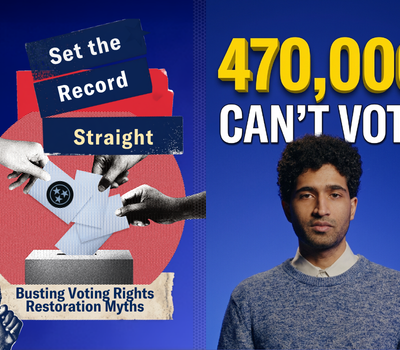
Thumbnail for the Set the Record Straight Series. Cover Reads: 470,000 Can't Vote

More from the Press


Placeholder image

Stay informed on civil rights issues. Discover our latest actions and updates in the Press Release section.

Supreme Court Says Firing Workers Because They Are LGBTQ Is Unlawful Discrimination

In a landmark win for LGBTQ people, the Supreme Court today ruled that firing employees because of their sexual orientation or gender identity is sex discrimination that violates federal law. Today’s decision clarifies for the first time that LGBTQ people are protected from employment discrimination from coast to coast, including in states and cities that have no express protection for LGBTQ people in their own laws.   While this ruling is a groundbreaking advance for LGBTQ people, there are still significant gaps in federal civil rights law that Congress must fill by passing the Equality Act. 

By aclutn

Placeholder image

Congress Can Lead the Charge on Divesting From Law Enforcement

As a former Hill staffer, I know how the sausage gets made: the backroom deals, the pet projects, and the extreme partisanship. Our current moment requires far more than the ego, moderation, and compromise that is typically reflected in federal legislation. This country’s recognition — finally — of the devastation and destruction that comes from the over-policing and over-criminalization of Black bodies and communities warrants real, meaningful change. The acknowledgment that Black Lives Matter — finally — demands bold and visionary leadership at the national level. That audacious vision is divestment. We must stop investing in racist and brutal policing systems. Instead, we must start resourcing the Black and Brown communities that have been harmed by these “law and order” institutions. Elected officials must dramatically reduce law enforcement budgets and put that savings into systems that could enfranchise Black and Brown people — housing, education, employment, and health care. And providing full access to these segments of our society means removing police from them. School discipline, mental health crises, and homelessness should not be met with a police response. Divesting from police must happen at all levels of government. At the federal level, divestment looks like an end to the Department of Defense’s 1033 program, which gives law enforcement military weapons and equipment that are used against communities and protestors. It is an end to COPS grants that put police in schools and fuel the school to prison pipeline. Divestment is prohibiting Byrne JAG dollars from being used to continue low-level arrests, the failed drug war, and the destruction of Black and Brown communities. These dollars can and need to be better spent. We know what policies and practices will not work because we have been here before. Michael Brown. Eric Garner. Breonna Taylor. George Floyd. The list of names does not stop here. Their lives deserve more than hashtags and slogans. They deserve much more than what elected officials have done to date. Members of Congress cannot continue to throw taxpayer money at another commission or study to determine the failings of law enforcement. Federal dollars cannot support more training, more technical assistance, more “checking the box” in the name of reforming the police. The federal government must invest in state and local communities differently. It must get out of the business of funding arrests and incarceration. And in the limited instances in which there would be law enforcement and community encounters, there must be measures to protect against police violence and ensure accountability when there is misconduct. Congress must model a national use of force standard that makes deadly force a rare, last resort. This respect for the sanctity of life must also be reflected in federal laws that prohibit the use of chokeholds and carotid holds. And if these laws are violated, there must be transparent and certain policies with which to hold police responsible.    As we mourn and protest the Black lives lost, 21st Century policing should look dramatically different than the current status quo. If federal lawmakers are truly up for taking on the country’s entrenched, racist, and violent policing systems, born out of slave patrols, they have the vocal and organized backing of constituents to get this done. Now is not the time to dust off old bills and offer them as the way forward. Now is the time for divestment.  

By aclutn

Placeholder image

Policing the Press: A Journalist on the Frontlines

Journalists covering protests against police brutality across the country are facing an influx of violence, suppression efforts, and arrests by police. Since the George Floyd protests began, there have been more than 400 claims of aggressions against the press, according to the U.S. Press Freedom tracker. Violations include being assaulted with pepper spray and rubber bullets, dealing with damaged equipment, and even facing arrest. This week, At Liberty is joined by Jared Goyette, a freelance reporter who was hit in the eye with a police projectile while covering a protest in Minneapolis.  “There’s always been a degree of tension between police, protesters, and media,” said Goyette of the protest at which he was attacked. “They are tense environments…But based on my experience in these types of events, this was markedly different than anything I’d seen before. It was different by the degree of the lack of clear communication. And it was different in the degree to which the projectiles coming from police seemed continuous, and to some degree arbitrary.” Goyette is now the named plaintiff in a lawsuit the ACLU of Minnesota filed last week against the City of Minneapolis, seeking justice for the violence he and other journalists experienced covering the protests. “There’s a feeling of just being in a historic and important moment and wanting to do as good a job as possible to document it,” Goyette told At Liberty. “And there’s just so much happening at once. As journalists, we’re doing the best we can.”

By aclutn

Placeholder image

My Abortion Allowed Me to Control My Own Destiny. Millions of Others Deserve The Same Chance.

I never expected to get an abortion. But I knew I could tell my mother. I grew up in New York and abortion was still illegal when I was born. One of my earliest memories is being in the car with my mother when she turned to me and told me that if I ever needed an abortion, I should let her know, because she “knew a lot of doctors.” My mother survived the Holocaust by hiding in a Catholic boarding school in the South of France. Her parents were active in the Jewish French resistance, and my grandmother helped my grandfather escape from Beaune-la-Rolande, a French-run Nazi transit camp which fed Jews to Auschwitz. My mother knew a thing or two about defying unjust laws.    Any day now, the U.S. Supreme Court is due to hand down its decision on an unjust law in Louisiana. The Court’s decision in June Medical v. Russo could drastically alter the ability of people in the United States to access abortion. June Medical involves a law in Louisiana that requires doctors at abortion clinics to have admitting privileges at a local hospital. This is so even though abortion is one of the safest medical procedures and admitting privileges for abortion providers have no correlation to women’s safety. If left in place, Louisiana will be left with one doctor in the entire state permitted to perform abortions. One doctor to serve the 1 million women of reproductive age in Louisiana. The politicians in Louisiana justify this law as “protecting women’s health,” even while Louisiana has the highest maternal death rate in the country. The politicians also ignore that autonomy is intrinsic to health. Women cannot be healthy if we cannot control our destiny. And the Supreme Court does not need to overturn Roe v. Wade to make abortion an impossibility for millions of women. Already, abortion access is dying the death of a thousand cuts. As of 2017, 89 percent of counties in the U.S. lacked an abortion provider, and 38 percent of women of reproductive age lived in a county without a clinic.   If I had not been able to control my reproductive life, I do not think I would have been able to craft my resulting career. When I unexpectedly became pregnant in my twenties, I was just starting out in my legal career, and not ready personally or professionally to be a parent. When I was more settled, I did have two wonderful children. I dedicated my professional life to fighting gender-based violence. I worked for more than 20 years as a legal aid lawyer representing low-income domestic violence survivors (some of whom were prevented by their partners from getting abortions), and then joined the local government in my city to improve policies on intimate partner violence and human trafficking. And now I get to fight for reproductive rights at the mothership — the ACLU of Southern California.    Even though I had my abortion over 25 years ago, and I have never hidden it from friends and family, this past year is the first time that I have spoken publicly about it. I feel obligated to normalize this experience — to add my story to the multitude of others that show how many people have exercised their right to have an abortion, and how our lives were saved by this ability. I am privileged to be able to share my story with support from my personal and work families, and I recognize that not all people enjoy this option. I feel impelled to speak out since I can, particularly since so many others cannot. One in four women in the United States will get an abortion in their lifetime, but many don’t feel they can talk about it.   Access to abortion enables us to control our destiny, to be truly free. I was privileged from a young age to know that I would always be able to control that destiny — because my parents knew doctors; because I had a job that gave me health insurance; because I lived in a state that protected my rights. But it shouldn’t matter where you work, what your ZIP code is, or whom your parents know, to be free. Let’s hope the Supreme Court doesn’t leave freedom to the states.

By aclutn

Placeholder image

The fight of our life.

Over

By Claire Gardner

Placeholder image

Defunding the Police Will Actually Make Us Safer

This OpEd first appeared on Cosmopolitan. Almost exactly six years after NYPD officers murdered Eric Garner in New York City, Minneapolis police officers murdered George Floyd. Activists, advocates, and protestors are still screaming “I can’t breathe” and begging government officials for police reform that will end police violence in Black communities. But today’s demands are bigger and bolder: Now, protesters are advocating for systemic changes that require a complete reimagining of law enforcement in the United States. American policing has never been a neutral institution. The first U.S. city police department was a slave patrol, and modern police forces have directed oppression and violence at Black people to enforce Jim Crow, wage the War on Drugs, and crack down on protests. When people ask for police reform, many are actually asking for this oppressive system to be dismantled and to invest in institutions, resources, and services that help communities grow and thrive. That’s why many protestors and activists, following in the footsteps of Black-led grassroots groups, are demanding immediate defunding of police departments. The idea of defunding, or divestment, is new to some folks, but the basic premise is simple: We must cut the astronomical amount of money that our governments spend on law enforcement and give that money to more helpful services like job training, counseling, and violence-prevention programs. Each year, state and local governments spend upward of $100 billion dollars on law enforcement—and that’s excluding billions more in federal grants and resources.   Budgets are not created in a vacuum. They can be changed through targeted advocacy and organizing. We can demand that our local officials (including city council members and mayors) stop allocating funds for the police to acquire more militarized equipment and instead ask for that money to go toward community-run violence-prevention programs. We can demand that our federal government redirect the money that funds police presence in schools to putting counselors in schools instead. Funneling so many resources into law enforcement instead of education, affordable housing, and accessible health care has caused significant harm to communities. Police violence is actually a leading cause of death for Black men: A recent study found that 1 in 1,000 Black men can expect to be killed by police, and public health experts have described police violence as a serious public health issue. For a country like ours, which considers itself a modern democracy that pushes ideals of freedom and justice for all, that number should be truly shocking. We can demand that our federal government redirect the money that funds police presence in schools to putting counselors in schools instead. Funneling so many resources into law enforcement instead of education, affordable housing, and accessible health care has caused significant harm to communities. Police violence is actually a leading cause of death for Black men: A recent study found that 1 in 1,000 Black men can expect to be killed by police, and public health experts have described police violence as a serious public health issue. For a country like ours, which considers itself a modern democracy that pushes ideals of freedom and justice for all, that number should be truly shocking. We have little evidence, if any, to show that more police surveillance results in fewer crimes and greater public safety. Indeed, funneling police into communities of color and pushing officers to make arrests just perpetuates harm and trauma. Yet since the 1980s, spending on law enforcement and our criminal legal system has dramatically outpaced that in community services such as housing, education, and violence prevention programs. Those are the institutions that help build stable, safe, and healthy communities.   For example, Los Angeles’s budget gives police $3.14 billion out of the city’s $10.5 billion. Spending on community services such as economic development ($30 million) and housing ($81 million) pale in comparison to the massive LAPD budget. (On Wednesday night, after years of Black Lives Matter grassroots activists demanding a cut in LAPD’s budget, Los Angeles Mayor Eric Garcetti announced he would cut $100 million to $150 million from the LAPD budget and reinvest those funds in communities of color.) Similarly, in New York City, the government spends almost $6 billion on policing, which is more than it does on the Department of Health, Homeless Services, Housing Preservation and Development, and Youth and Community development combined.   By shrinking their massive budgets, we can help end decades of racially driven social control and oppression as well as address social problems at their root instead of investing in an institution that further oppresses and terrorizes communities. In addition to divesting from police and reinvesting the savings in nonpunitive programs that benefit public safety and health, there are other critical steps we need to take to foster the systemic change people across the country are calling for:

By aclutn

Placeholder image

Microsoft Says it Supports Racial Justice. Will it Refuse to Power Discriminatory Police Surveillance?

As major tech companies rush to claim solidarity with the Black Lives Matter movement, they’re being rightfully called out for the ways their products and workplace conditions actively undermine the rights and safety of Black people. IBM has listened and stopped development of face recognition, a technology that supercharges police surveillance and has repeatedly been shown to disproportionately misidentify Black and Brown people. Amazon announced today that it would stop selling the technology to police for one year, following sustained demands from an ACLU-led civil rights coalition that begin with our May 2018 investigation. But these aren’t the only tech companies that deserve our scrutiny. Microsoft, which has issued a number of statements in support of Black Lives Matter, has not prohibited the sale of its face recognition system to police departments — institutions with a long record of systemic racism and disproportionate targeting of Black and Brown communities. Face surveillance threatens the privacy rights of all, but the harms of this technology are not experienced equally. A recent comprehensive government study conducted by the National Institute of Science and Technology found that African American and Asian people were up to 100 times more likely to be misidentified than white men, depending on the algorithm and type of use. Even one wrong match can lead to false arrests, lengthy interrogations, or even deadly police encounters — all too common racist police abuses that people of color already experience on a daily basis. This technology is a threat to civil rights even if the algorithms are cured of issues that currently make many systems less accurate for Black faces. Police have already deployed these systems against people protesting the police killing of Freddie Gray in Baltimore. Florida police have used facial recognition to charge and convict people under racist drug laws, even when the results may be wrong. Facial recognition — by making the tracking and scrutiny of people automatic and easy — grants police unprecedented and dangerous power to expand intrusive patrols and the enforcement of racist laws and policies. Not only does Microsoft build and sell face surveillance technology, it is also on a mission to enact laws to protect that business. This year in California, Microsoft supported a pro-surveillance bill that would have legitimized the use of these systems by both cops and private companies. The ACLU of California and a coalition of 65 groups — including those fighting for racial justice, immigrants’ rights, and economic justice — fought for months to stop Microsoft’s bill. That bill, AB 2261, failed last week because of our coalition’s efforts. But we have no reason to believe Microsoft will stop trying to write rules that support its surveillance technology business. In fact, similar legislation was recently signed into law in Washington state. The world Microsoft seems to want is one where police have an invisible but inescapable surveillance presence in our communities. Where an infrastructure exists to scan your face and identify you as you walk down the street, go to a protest, attend a place of worship, and participate in public life. Building a surveillance apparatus this big would have severe consequences — chilling demonstrations, fueling a for-profit surveillance industry, and creating racist watchlists that governments and businesses will use for discriminatory ends. Microsoft’s legislative efforts are also deeply anti-activist and anti-democratic. The bill introduced in California sought to erase local bans on government facial recognition championed and secured by grassroots racial justice organizations in partnership with the ACLU. These bans have now become law in half a dozen U.S. cities. Microsoft may say it is ready to champion racial justice — but the truth is that some of its business practices risk perpetuating police abuse. Microsoft has reportedly sold its facial recognition software to at least one American prison and funded an Israeli facial recognition firm that surveils Palestinians in the West Bank. It is no surprise that 250 Microsoft employees just called on Microsoft to cut off its contracts with police. Technology companies with face surveillance products should follow the first steps taken by IBM, which in addition to ceasing development of its facial recognition product, is reconsidering police sales altogether. This decision follows groundbreaking research by Joy Buolamwini and Timnit Gebru to uncover the racial bias in facial recognition systems sold by IBM and others. The ACLU and our civil rights allies will stay vigilant and focused on what companies like Microsoft do, not just what they say. We continue our calls on Microsoft and other companies selling this technology to demonstrate a commitment to racial justice by divesting from facial recognition that fuels the over-policing of communities of color. If these companies believe that Black Lives Matter, the least they can do is announce that they will refuse to perpetuate and profit off our racist criminal justice system.

By aclutn

Placeholder image

Sex Work is Real Work, and it’s Time to Treat it That Way

Sex workers aren’t always a part of the conversation about police brutality, but they should be. Police regularly target, harass, and assault sex workers or people they think are sex workers, such as trans women of color. The police usually get away with the abuse because sex workers fear being arrested if they report. If we lived in a world that didn’t criminalize sex work, sex workers could better protect themselves and seek justice when they are harmed.  Protecting sex workers from police violence is just one of the reasons we need to decriminalize sex work. It would also help sex workers access health care, lower the risk of violence from clients, reduce mass incarceration, and advance equality in the LGBTQ community, especially for trans women of color, who are often profiled and harassed whether or not we are actually sex workers. In 2020 the call for decriminalization has made progress, but there are still widespread misconceptions about sex work and sex workers that are holding us back. Some even think that decriminalization would harm sex workers. That isn’t true.  Here are five reasons to decriminalize sex work that would protect sex workers, help hold police accountable, and ensure equality for all members of society, including those who choose to make a living based by self-governing their own bodies.

By aclutn

Placeholder image

Three Missouri Voters Explain Why Everyone Should be Able to Vote by Mail in 2020

The COVID-19 pandemic has changed the way the world operates, but as the presidential election approaches, many states have failed to respond when it comes to voting. The safest way to vote during the pandemic is to

By aclutn

Placeholder image