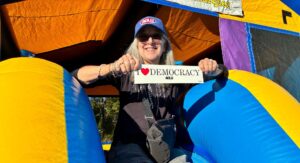
A smiling woman in an ACLU baseball cap and sunglasses sits at the top of a yellow and blue inflatable slide, holding up an “I ❤ Democracy” ACLU bumper sticker.

When Will Tennessee Certify the 2026 Midterm Election Results?

After High Turnout, ACLU-TN Thanks Tennessee Voters, Poll Workers, and Partners, Looks Ahead to an Orderly Certification

By Cathryn Stout, PhD.

Latest Publication


Citizenship Rights Restoration in Tennessee

Restoring your voting rights in Tennessee got easier in 2026. State Sen. Raumesh Akbari and State Rep. Karen Camper led the charge in the legislature to remove some of the biggest barriers standing between formerly incarcerated Tennesseans and the ballot box.

The Campaign Legal Center and Free Hearts, a Tennessee nonprofit led by formerly incarcerated women, have been on the ground helping people navigate this process and pushing for a fairer system. For eligibility requirements and step-by-step petition instructions, read the guide from Free Hearts and the Campaign Legal Center.

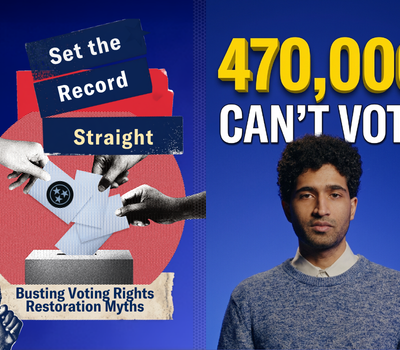
Thumbnail for the Set the Record Straight Series. Cover Reads: 470,000 Can't Vote

More from the Press


Placeholder image

Stay informed on civil rights issues. Discover our latest actions and updates in the Press Release section.

This Law Makes Voting Nearly Impossible for Native Americans in Montana

Voting has never been easy for Native Americans living on rural reservations in Montana, which are often geographically isolated, with limited access to postal service and transportation. The passage of the Montana Ballot Interference Prevention Act (BIPA) has made these obstacles even greater, severely inhibiting Native Americans’ access to the ballot. That’s why we’re suing.

By aclutn

Placeholder image

The Government Has a Secret Plan to Track Everyone’s Faces at Airports. We’re Suing.

U.S. Customs and Border Protection and the Transportation Security Administration are putting us on an extraordinarily dangerous path toward the normalization of face surveillance. But because key facts about this surveillance are still secret, the public lacks the information it needs to hold these agencies to account. We’re suing to bring some much-needed transparency. Over the past few years, CBP and the TSA have dramatically expanded their use of facial recognition technology at the airport and other U.S. ports of entry. As of June 2019, CBP had scanned the faces of more than 20 million travelers entering and exiting the country. Several major airlines, including Delta, JetBlue, and United Airlines, have already partnered with CBP to build this surveillance infrastructure, and more than 20 other airlines and airports have committed to using CBP’s face-matching technology. The TSA has also partnered with CBP on face surveillance initiatives, with plans to further expand face surveillance to domestic travelers. Unlike other forms of identity verification, facial recognition technology can enable undetectable, persistent government surveillance on a massive scale. As this technology becomes increasingly widespread, the government can use it to grab unprecedented power to track individuals’ movements and associations, posing grave risks to privacy and civil liberties. When such a technology is placed in the hands of agencies like CBP and the TSA — which have been caught tracking and spying on journalists, subjecting innocent travelers to excessive and humiliating searches, and doesn’t always hold — DHS recently floated the possibility of mandating face surveillance on all U.S. citizens traveling internationally. After members of Congress and civil liberties groups sounded the alarm, the agency quickly retreated. The full set of reasons for this reversal, however, remain unclear, and the government has left open the possibility that it will in the future make face surveillance mandatory for U.S. citizens entering and exiting the country. Moreover, non-citizens are currently unable to opt out of CBP’s face surveillance — leaving the Trump administration with yet another tool for targeting, harassing, and violating the rights of non-citizens. We should also be concerned about mission creep. If this technology is normalized at the airport, it’s only a matter of time before the government cites its use at airports as a basis for deploying it elsewhere. Another problem is the technology itself. Several recent studies have shown that facial recognition technology results in a higher rate of false identifications for people of color. For example, a December 2019 report by the National Institute of Standards and Technology found a higher rate of incorrect facial matches for photos of Black and Asian people, relative to white people. One false match can lead to missed flights, lengthy interrogations, tense immigration enforcement encounters, or worse. But even if facial recognition technology worked, its use at airports is a dangerous step toward its further deployment in society at large and raises profound civil liberties concerns. The public urgently needs more information about how the government and airlines are using this information, what privacy protections exist, and the extent to which CBP’s and TSA’s use of the technology discriminates on the basis of race or other characteristics. That we even need to go to court to pry out this information further demonstrates why lawmakers urgently need to halt law- and immigration-enforcement use of this technology. There can be no meaningful oversight or accountability with such excessive, undemocratic secrecy.

By aclutn

Placeholder image

Keep Calm and Carry on Voting: How to Vote By Mail During the Coronavirus Outbreak

Coronavirus should not be a political issue, but with presidential primaries and the general election coming up, it could soon directly impact our politics. We should protect not only our health, but our civil liberties at this time — and one of those civil liberties is our fundamental right to vote.  For many, the best way to vote while safeguarding your health during this time may be to vote by mail. It’s easy to request an absentee ballot and there’s still enough time to do so for most states with upcoming primaries. While some states limit who can vote absentee — for example, to people with health issues, disabilities, or other circumstances that may prevent them from voting in person — most states allow anyone to vote this way. If you live in a state with an upcoming primary where it is still possible to apply to vote absentee, find the date by which your application for an absentee ballot must be received and other requirements below.*  Remember that public health officials recommend that you not lick absentee ballot envelopes, but instead use a wet sponge or cloth to seal them.

By aclutn

Placeholder image

Police Need a Warrant to Collect DNA We Inevitably Leave Behind

Every two minutes, we shed enough skin cells to cover nearly an entire football field. With a single sneeze, we can spew 3,000 cell-containing droplets into the world. And, on average, we leave behind between 40 and 100 hairs per day. As long as we live in the world and leave our homes each day, we can’t avoid leaving a trail of our DNA in our wake. Every strand of DNA holds a treasure trove of deeply personal information, from our propensity for medical conditions to our ancestry to our biological family relationships. And increasingly, police are accessing and testing the DNA contained in our unavoidably shed genetic material without judicial oversight. That’s why we’re asking a court to require police to get a warrant before collecting the DNA we unavoidably leave behind.

By aclutn

Placeholder image

San Diego Police Stop Black People at a Rate 219 Percent Higher Than White People.

“They did what human beings looking for freedom, throughout history, have often done. They left.”

By aclutn

Placeholder image

Are Our Prisons and Jails Ready for COVID-19?

The country and the world face a public health emergency in the new coronavirus causing COVID-19. The media is filled with concerns about how we will respond. Will we close schools? Cancel sporting events and other large gatherings? Work from home? Avoid public transportation?

By aclutn

Placeholder image

Will SCOTUS Protect the Right to Protest?

Since this country’s founding, when we’ve had something to say, we have taken to the streets. We’ve come together to celebrate our identities, to protect our land and our communities — and to push for change following injustice and tragedy. But if a recent decision from the Fifth Circuit Court of Appeals involving a Black Lives Matter protest is left standing, the right to protest will be in serious jeopardy.

By aclutn

Placeholder image

Trump is Sending Special Forces-style Agents into Pro-Immigrant Cities

As part of its

By aclutn

Placeholder image

Trans People Belong

Across the country, politicians are attacking the fundamental rights of transgender and non-binary people — shutting people out of public spaces, basic services, educational institutions, and ultimately compromising the ability of trans people to survive. Trans people of all ages and backgrounds are targets, from kids in schools to incarcerated people to elderly patients in the health care system. But the weight of these attacks disproportionately falls on Black trans women and other trans people of color. Simply put, lawmakers want to stop people from being transgender — and they’re willing to put lives at risk to achieve their aims. 

By aclutn

Placeholder image