
A smiling woman in an ACLU baseball cap and sunglasses sits at the top of a yellow and blue inflatable slide, holding up an “I ❤ Democracy” ACLU bumper sticker.

When Will Tennessee Certify the 2026 Midterm Election Results?

After High Turnout, ACLU-TN Thanks Tennessee Voters, Poll Workers, and Partners, Looks Ahead to an Orderly Certification

By Cathryn Stout, PhD.

Latest Publication


Citizenship Rights Restoration in Tennessee

Restoring your voting rights in Tennessee got easier in 2026. State Sen. Raumesh Akbari and State Rep. Karen Camper led the charge in the legislature to remove some of the biggest barriers standing between formerly incarcerated Tennesseans and the ballot box.

The Campaign Legal Center and Free Hearts, a Tennessee nonprofit led by formerly incarcerated women, have been on the ground helping people navigate this process and pushing for a fairer system. For eligibility requirements and step-by-step petition instructions, read the guide from Free Hearts and the Campaign Legal Center.
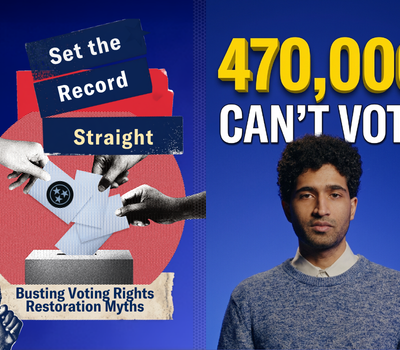

Thumbnail for the Set the Record Straight Series. Cover Reads: 470,000 Can't Vote

More from the Press


Placeholder image

Stay informed on civil rights issues. Discover our latest actions and updates in the Press Release section.

It’s Time to End Forced Arbitration

If you own a credit card or a bank account, use a ride-sharing service, made an online purchase, or work in corporate America, chances are you have signed a forced arbitration agreement: a promise that, if any disputes arise between you and your employer or the business, you won’t sue. Hidden in the fine-print of a contract you may not even remember signing is language that says you’ve agreed, in advance, to give up your right go to court. But today, the House of Representatives passed the

By aclutn

Placeholder image

The Supreme Court Considers Mandatory Government Funding of Religious Education

In Espinoza v. Montana Department of Revenue, the Supreme Court will address a question that would have been unthinkable to ask even until quite recently: Can a state be forced to underwrite religious education with taxpayer dollars? Although the court has previously allowed the government to adopt school-voucher programs that provide indirect government aid to religious schools, it has never suggested that the U.S. Constitution somehow requires them to do so — and certainly not in the face of state constitutional rules barring taxpayer funding of religious education. Yet that is essentially what the petitioners are seeking in Espinoza, the latest in a disturbing line of cases attacking the very foundations of the separation of church and state.At issue in Espinoza is a voucher-type program in Montana designed to divert millions in government dollars to private schools, the overwhelming majority of which are religiously affiliated. The program, enacted in 2015, allows taxpayers to receive dollar-for-dollar tax credits for donations to Student Scholarship Organizations, which then award scholarships to students attending private elementary and secondary schools. In other words, if a taxpayer owes the state, say, $100 in taxes, she can decide instead to send that money directly to an SSO, which will then spend it on private-school scholarships. In practice, the tax-credit program has served its unmistakable goal of funneling government dollars to religious education: The only SSO operating in the state supports 13 private schools, 12 of which are religiously affiliated, and over 94 percent of program scholarships have gone to finance religious education. Such religious funding, even though indirect, violates the Montana constitution, which inc

By aclutn

Placeholder image

California Is Ready to Ensure Every Public College Student Has Access to Abortion

In a year when we’ve seen states throughout the South and Midwest move to ban abortion and restrict access to reproductive health, California could soon cement its reputation as a leader in reproductive freedom. This past week, the state legislature passed SB 24 to ensure that medication abortion is available to college students in public universities. Jessy Rosales, a UC student, struggled with paying for care and dealing with the complexities of insurance plans when she ne

By aclutn

Placeholder image

AmeriCorps Adopts Health Screening Process That’s Fair to Candidates with Disabilities

Susie Balcom was overjoyed when she received a conditional offer to serve as a support team leader in Mississippi with AmeriCorps National Civilian Community Corps (NCCC), a national, residential service program for young adults. After graduating from college with a 4.0 GPA and spending two terms in the AmeriCorps state program, Susie was ready, willing, and able to fulfill her dream of serving in the national program. However, a few weeks later, AmeriCorps NCCC told Susie that she was disqualified from the program. As part of the application process, S

By aclutn

Placeholder image

Memphis Mayoral Candidate Questionnaire: Tami Sawyer’s Answers

By

sawyer-tamil-200x279.png

Memphis Mayoral Candidate Questionnaire: Lemichael D. Wilson’s Answers

By

Wilson-Lemichael-200x279.png

Memphis Mayoral Candidate Questionnaire: Terrence T. B. Boyce’s Answers

By

Terrence-Boycel-200x279.png

Memphis Council Candidate Questionnaire: Cat Allen’s Answers

By

allen-cat-200x279.png

Memphis Council Candidate Questionnaire: Martavius D. Jones’ Answers

By

Jones-Martavius-200x279.png