
A smiling woman in an ACLU baseball cap and sunglasses sits at the top of a yellow and blue inflatable slide, holding up an “I ❤ Democracy” ACLU bumper sticker.

When Will Tennessee Certify the 2026 Midterm Election Results?

After High Turnout, ACLU-TN Thanks Tennessee Voters, Poll Workers, and Partners, Looks Ahead to an Orderly Certification

By Cathryn Stout, PhD.

Latest Publication


Citizenship Rights Restoration in Tennessee

Restoring your voting rights in Tennessee got easier in 2026. State Sen. Raumesh Akbari and State Rep. Karen Camper led the charge in the legislature to remove some of the biggest barriers standing between formerly incarcerated Tennesseans and the ballot box.

The Campaign Legal Center and Free Hearts, a Tennessee nonprofit led by formerly incarcerated women, have been on the ground helping people navigate this process and pushing for a fairer system. For eligibility requirements and step-by-step petition instructions, read the guide from Free Hearts and the Campaign Legal Center.
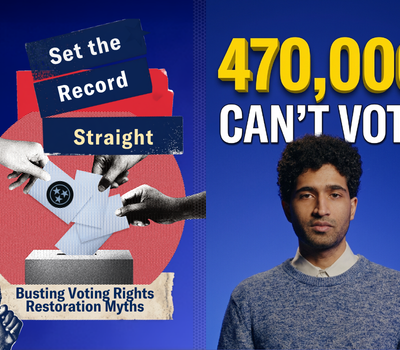

Thumbnail for the Set the Record Straight Series. Cover Reads: 470,000 Can't Vote

More from the Press


Placeholder image

Stay informed on civil rights issues. Discover our latest actions and updates in the Press Release section.

Will North Carolina’s Supreme Court Allow Racism to Remain a Persistent Factor in its Death Penalty?

In 2009, North Carolina passed the Racial Justice Act (RJA), which allowed defendants to strike the death penalty from their cases if they could show that racial discrimination was a factor in their prosecution. The law came as a response to a series of exonerations of Black people who were falsely convicted of crimes they did not commit by all-white or nearly all-white juries. The legislature took a bold step to address was what suspected to be deeply troubling evidence of racism infecting the death penalty—but no one knew for sure what evidence uncovered by the RJA would find. In 2010, people on death row began filing RJA claims. Four had hearings, and the evidence uncovered was indeed stark, troubli

By aclutn

Placeholder image

A Louisiana Parish Jailed a U.S. Citizen for Being Latinx. We’re Suing.

Ramon Torres had been a U.S. citizen for nearly ten years when he was detained for four days on an immigration hold – despite having a U.S. passport, a Louisiana driver’s license, and a Social Security card, and despite that fact that a court ordered his release.  Torres’ ordeal began in August 2018, when he was pulled over and arrested on suspicion of driving while intoxicated. Torres

By aclutn

Placeholder image

An Arizona Law Requires Surveillance of People Who Are Presumed Innocent

A pillar of our democracy is the presumption of innocence: before a person has been convicted of a crime, they are considered completely innocent under the law. Yet across the country, people who have not been convicted are punished—both explicitly and implicitly—based on the mistaken assumption that they are dangerous, purely on the basis of an accusation. We do not live in a society where you can be incarcerated or monitored simply because you have been accused of a crime. Doing so violates constitutional rights, fuels mass incarceration, and impedes a fair and functioning justice system.   Arguably, the most important moment in one’s case is the dec

By aclutn

Placeholder image

Trump is Taking More Money for Raids and Detention. Congress Should Stop Him.

The budget for Trump’s turbo-charged immigration enforcement and border militarization is now larger than ever. And just last week, we learned that ICE plans to redirect even more money to further expand immigration detention and enforcement. The request is currently pending approval by congressional appropriators. This comes on the heels of the Mississippi ICE raid — the largest single-state raid in history. Children were separated from their families on the first day of school and nearly 700 people were detained by ICE.  Worse still, Senate Appropriations Committee Chairman Richard

By aclutn

Placeholder image

Corrections Officer Who Struck Rhode Island Protesters with Pickup Truck Resigns

A senior corrections officer at the Wyatt Detention Facility in Rhode Island has resigned after being placed on administrative leave for driving his pickup truck into a crowd of peaceful protestors on Wednesday night. The attack left one man, 64-year-old Jerry Belair, with a broken leg and internal bleeding, and four others were hospitalized after the officer’s colleagues used pepper spray to disburse the crowd. In an interview with the ACLU, Matt Harvey, a spokesperson for the Jewish-led civic group that coordinated the

By aclutn

Placeholder image

The Challenges of Breastfeeding as a Black Person

The fight to protect individual choices about reproductive care, including breastfeeding, is an ongoing battle. The central lesson of the reproductive justice movement is that choice means little without access. That lesson applies equally to breastfeeding. Though laws, in the

By aclutn

Placeholder image

William Barr is Stuck in the ’90s — But Americans Have Moved Forward When it Comes to Criminal Justice Reform

Almost five years to the day of the fatal police shooting of Michael Brown in Ferguson, Missouri, Attorney General William Barr descended on New Orleans to deliver a major policy address. His speech dismissed police violence and espoused a dangerous vision for America — one in which ‘90s era tough-on-crime politics shape policies and pro-civil rights attitudes are derided as “anti-police.”

By aclutn

Placeholder image

Expanding Involuntary Confinement is Not the Answer to Solve Gun Violence

In the wake of last weekend’s tragic shootings, President Trump did what he does best: stoked fear and cast blame. He proclaimed that  “we must reform our mental health laws to better identify mentally disturbed individuals who may commit acts of violence and make sure those people, not only get treatment, but when necessary, involuntary confinement.” There are two things wrong with the idea of involuntary commitm

By aclutn

Placeholder image

Say No to the “Cashless Future” — and to Cashless Stores

I went to a counter-serve restaurant recently, and when the time came to pay for my order, took out my wallet, presented a $20 bill, and was told, “Sorry, we don’t accept cash.” I was flabbergasted. What happened to “legal tender for all debts public and private,” as it says right there on the bill? This has now happened to me at three separate establishments in recent months. The rise of cashless establishments is happening amid continuing hype over the supposed dawn of a “cashless future” and agitation by some very powerful interests that would love to see cash disappear. The credit card companies love it, naturally, and tech industry associations have also pushed for the concept. Meanwhile, a backlash has prom

By aclutn

Placeholder image