A smiling woman in an ACLU baseball cap and sunglasses sits at the top of a yellow and blue inflatable slide, holding up an “I ❤ Democracy” ACLU bumper sticker.

When Will Tennessee Certify the 2026 Midterm Election Results?

After High Turnout, ACLU-TN Thanks Tennessee Voters, Poll Workers, and Partners, Looks Ahead to an Orderly Certification

By Cathryn Stout, PhD.

Latest Publication


Citizenship Rights Restoration in Tennessee

Restoring your voting rights in Tennessee got easier in 2026. State Sen. Raumesh Akbari and State Rep. Karen Camper led the charge in the legislature to remove some of the biggest barriers standing between formerly incarcerated Tennesseans and the ballot box.

The Campaign Legal Center and Free Hearts, a Tennessee nonprofit led by formerly incarcerated women, have been on the ground helping people navigate this process and pushing for a fairer system. For eligibility requirements and step-by-step petition instructions, read the guide from Free Hearts and the Campaign Legal Center.

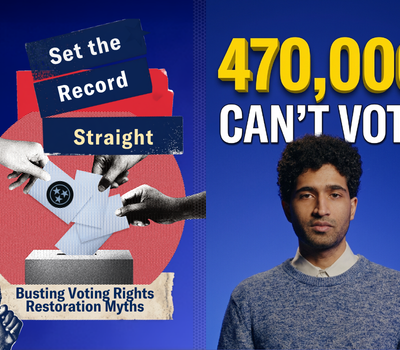
Thumbnail for the Set the Record Straight Series. Cover Reads: 470,000 Can't Vote

More from the Press


Placeholder image

Stay informed on civil rights issues. Discover our latest actions and updates in the Press Release section.

I’ve Lived on the Border My Entire Life. The Courts Must Shut Down Trump’s Border Wall

The ecological destruction of Arizona, New Mexico, and California hangs in the balance as courts decide whether to block President Trump’s abuse of emergency powers to secure funds for a border wall Congress denied. On Feb. 15, 2019, President Trump declared a national emergency so that he could raid the milita

By aclutn

Placeholder image

Equity Must Be at the Heart of Marijuana Legalization

Illinois just passed what may be the most progressive marijuana legalization bill in America. Gov. Pritzker’s didn’t surprise anyone by signing the bill yesterday (he campaigned on the issue), and with the work of the state legislature Illinois is the 11th state to legalize marijuana for adult recreational use. This is a deceptively momentous criminal justice reform whose nuances show just why there cannot be justice in drug laws without equity. While a single bill cannot undo the damage rained by the war on drugs, and it cannot halt mass incarceration in a given state, in these 439 pages Illinois legislators not only called out the havoc of counter-productive drug enforcement but promised that the benefits of this important reform will be felt by the individuals and communities most harmed by the war on drugs, namely people of color and people with low incomes. Marijuana legalization will touch thousands upon thousands of people. In Illinois alone, almost half of all drug arrests were for cannabis-related offenses. In 2010, two years before Chicago City Council decriminalized pot, over 33,000 arrests were made for marijuana possession. That’s 91 arrests for pot per day – the highest in the country, and most of these were for 10 grams or less. And while arrests rates for folks smoking weed has plummeted in Chicago (Illinois’ largest city) during the last few years, the rates of the disproportionate application of enforcement has remained atrocious. In fact, despite constituting 36 percent of the population of Chicago, in 2016 78 percent of all marijuana arrests were of Black people and less than 5 percent were of white people. Unfortunately, this is par for the course in America;

By aclutn

Placeholder image

Raising our Voices for Equality at Stonewall and the Supreme Court

It’s been half a century since the Stonewall uprising began on June 28, 1969, the reason we celebrate Pride each June. But there’s another fitting date to commemorate this month, and it falls just two days before the 50th anniversary of Stonewall. June 26 marks the anniversary of the Supreme Court’s landmark decision in 2003 striking down

By aclutn

Placeholder image

Governors Can Succeed in Criminal Justice Reform Where Legislatures Fail

With legislative sessions winding down across the country, states have an opportunity to explore an often untapped resource for ending mass incarceration and addressing racism in the criminal justice system: the power of Governors. The power of the executive presents significant and often untapped opportunities to shrink the jail a

By aclutn

Placeholder image

Children Continue to Die in Government Custody, and DHS is Dodging Accountability

In recent months, at least seven children have either died in custody or died after being detained by federal immigration agencies at the border. These children came to the United States desperate for shelter and safety, but found inhumanity and suffering, under our government’s care, instead. Their deaths reveal just how dire the

By aclutn

Placeholder image

Immigrant Kids Keep Dying in CBP Detention Centers, and DHS Won’t Take Accountability

In recent months, at least seven children have either died in custody or after being detained by federal immigration agencies at the border. These children came to the United States desperate for shelter and safety, but found inhumanity and suffering, under our government’s care, instead. Their deaths reveal just how dire the

By aclutn

Placeholder image

As Trump Tweets Hateful Threats, States are Protecting Immigrant Rights

This week, President Trump kicked off his re-election campaign by tweeting a threat to deport millions of immigrants, apparently referring to his administration’s plans for mass raids on families across the country. Meanwhile, news continues to break about what his administration is already doing, as dizzying as it is horrifying: A six-year-old girl dying in the Arizona desert on the way to seek asylum, a premature baby languishing at a border holding site, a trans woman dying from pneumonia after asking to be deported rather than remain in Immigration and Customs Enforcement (ICE) detention without proper medical care. What’s remarkable is that in the midst of the extreme rhetoric and reality, people across the country are finding common ground on immigr

By aclutn

Placeholder image

Supreme Court Undermines Religious Neutrality In Permitting Giant Governmental Cross

Today, the Supreme Court announced that a governmental display of a 40-foot-tall Latin cross as a war memorial for all veterans does not violate the Establishment Clause of the First Amendment. The decision ignores our constitutional commitment to official religious neutrality and is a slap in the face to non-Christian veterans. There is, however, a small silver lining: The opinion itself was narrow, making clear that the ruling is not an invitation for government officials to erect new religious displays.In American Legion v. American Humanist Association, the court concluded that the Bladensburg Cross — originally built to honor a Maryland county’s World War I dead — is constitutional for a combination of reasons, including its nearly hundred-year history and the court’s belief that the cross has somehow taken on an “added secular meaning when used in World War I memorials.” But there are several flaws in the court’s reasoning.First, in his opinion for the majority, Justice Alito cites the rows of white crosses that memorialize fallen American service members in World War I cemeteries overseas. Yet those crosses are tied to the individual faith of each soldier. Notably, the graves of Jewish service members in those cemeteries are marked with the Star of David, not a Latin cross. That’s because the Latin cross is inextricably linked to the Christian belief in the crucifixion of Jesus, the resurrection, and the promise of eternal life—a point emphasized in friend-of-the-court briefs filed by both the Baptist Joint Committee and the American Jewish War Veterans for the United States of America. As Justice Ginsburg explains in her dissent, the Latin cross is an “exclusively Christian symbol.” It is “not emblematic of any other faith,” and it certainly has “never shed its Christian character.”Second, the Bladensburg Cross does not stand as a memorial to fallen World War I soldiers alone. Although the cross was erected in the 1920s on private land as a World War I memorial, the Maryland-National Capital Park and Planning Commission went out of its way in 1961 to acquire the cross and the land on which it sits — for the purpose of preserving the monument and, purportedly, to address traffic-safety concerns. But the Commission wasn’t satisfied with merely maintaining the cross’s connection to World War I; instead, it spent $100,000 renovating the monument, and then, in 1985, held a religious ceremony featuring prayer by a Catholic priest to rededicate the cross to veterans of all wars.Finally, a constitutional violation shouldn’t be granted safe harbor merely because it has endured over time. The Bladensburg Cross was privately built and owned, and could have stood forever, undisturbed and without controversy. When individuals express religious beliefs or display religious symbols on private property — however prominently — it is perfectly constitutional. That changes, though, once the government decides to meddle with private religious expression by taking ownership over it. Here, the cross became a symbol of official religious preference for Christians when the Commission got involved. That the Bladensburg Cross has remained in place for so long, displayed and maintained by the government, only compounds and amplifies this message of religious exclusion.Nevertheless, the court’s misguided focus on the monument’s age and the meaning of the cross as it relates to World War I necessarily limits the reach of today’s ruling. The decision merely permits the display of this specific monument given the unique circumstances surrounding it. It is not a license for government officials to put up religious symbols whenever and wherever they want. As the court’s majority emphasized, “retaining established, religiously expressive monuments, symbols, and practices is quite different from erecting or adopting new ones.”Those who value the separation of church and state must remain vigilant. In rewriting the meaning of the Latin cross and treating it as a secular icon, even in these limited circumstances, the court has eroded fundamental constitutional principles. If the government can redefine the most recognizable and sacred of religious symbols and practices, and then co-opt them for official purposes, the Establishment Clause’s ban on government promotion of religion — and government preference for one faith — could soon become a relic of the past.

By aclutn

Placeholder image

Waking the Sleeping Giant: After Some States Pass Abortion Bans, Other States Pass New Protections

After seeing states like Alabama and Georgia pass one extreme abortion ban after another, other states are starting to push back. Last week, governors in Illinois, Maine, and Vermont signed historic bills to protect abortion rights or expand access to abortion care in their states. This follows action last month in Nevada; other states, including California, Massachusetts, and Rhode Island, may not be far behind.

By aclutn

Placeholder image