
Federal Court Hears Arguments in Challenge to Tennessee’s Unconstitutional Congressional Map
June 18, 2026 6:00 pm
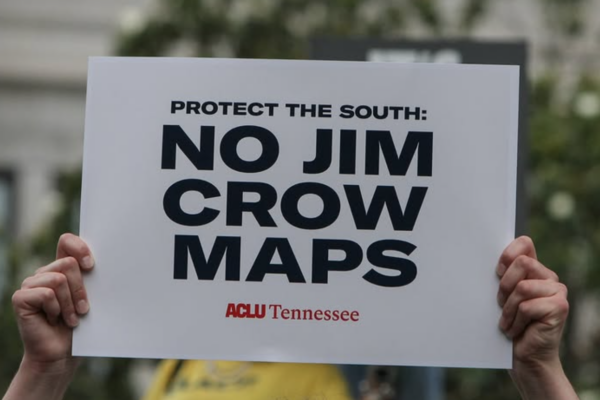
NASHVILLE, Tenn. — A federal three-judge panel in the Middle District of Tennessee heard arguments today in Sherman v. Hargett, the American Civil Liberties Union and ACLU of Tennessee’s challenge to Tennessee’s newly redistricted congressional map. Plaintiffs are seeking a preliminary injunction to block the map from taking effect before the August primary election.
Earlier this month, a single judge denied a temporary restraining order, which was a tentative, procedural ruling that did not extensively consider the merits of the constitutional claims. Today’s preliminary injunction hearing before the full three-judge panel focused squarely on whether the May 2026 map violates the U.S. Constitution.
The lawsuit was filed on behalf of three individual Black Memphis voters, Amber Sherman, Rachael Spriggs, and Kermit Moore, as well as the Black Clergy Collaborative of Memphis, the Memphis A. Philip Randolph Institute, and the Equity Alliance. The plaintiffs argue that the Tennessee General Assembly’s map, enacted in a hastily called special session in May, unconstitutionally cracks the majority-Black city of Memphis and Shelby County into three congressional districts. Each of these new districts stretches hundreds of miles into central Tennessee, systematically diluting the political power Black Memphians have built over decades.
“The general principle that resolves this motion in our favor is very simple, and it is true: government action that is taken with racial discrimination as a motivating factor is invalid,” said Ari Savitzky, senior staff attorney with the ACLU’s Voting Rights Project, the attorney for the plaintiffs, arguing before the panel.
“The general assembly mistook [the legal landscape] as open season to attack an existing, naturally occurring, long-standing Black-majority district and dilute the voting power of Black voters,” Savitzky argued.
In today’s hearing, ACLU attorneys argued that the map cannot be explained by partisanship alone. For instance, statistical analysis submitted by plaintiffs’ experts shows that in a set of 5,001 race-blind redistricting simulations using traditional criteria, virtually 100 percent produced at least one district where Black voters had the opportunity to elect a candidate of choice. Yet the May 2026 map had none.
“The only possible explanations for this map are dividing Black voters to dilute their political power, getting some type of partisan benefit, or both,” Savitzky said. “We have shown that racial discrimination was a motivating factor.”
Plaintiffs also pressed the court on the unprecedented process that produced the map, a three-day special session in which Black lawmakers were not shown the proposed maps until the second day. During this frantic session, the legislature repealed a 50-year-old ban on mid-decade redistricting, and map sponsors refused to disclose who drew the map or what data was used.
“As we stand here in the courtroom today, we don’t know who drew the map. We don’t know what specific data was used to configure it. And that’s not normal,” Savitzky told the panel. “Nothing remotely like this has happened before.”
Plaintiffs laid out the full body of evidence supporting their claim: the map’s harmful effects on Black voters, a legislative context marked by racial division and repeated attacks on Memphis—a majority Black city—and the timing of the decision, which came in the hours and days after the Voting Rights Act ruling in Louisiana v. Callais. They also pointed to the extreme speed and irregularity of the redistricting process itself, and to statements made by legislators during the special session, including one redistricting committee member who claimed that cracking apart Black Memphians would somehow “reduce crime.” Taken together, plaintiffs argued, the evidence shows that discrimination and a desire to harm Black voters were present in the enactment of the May 2026 map, and that judicial intervention is required.
“That right to be free from racial discrimination by the government is sacred. The right to be treated equal before the law in matters of public life is one of those fundamental, inalienable rights with which we are endowed by our creator. And our Constitution guarantees this,” Savitzky argued before the panel.
Plaintiffs’ clients, including Kermit Moore of the Memphis A. Philip Randolph Institute and Rev. Dr. J. Lawrence Turner, president and founder of the Black Clergy Collaborative of Memphis, traveled to Nashville to be present in the courtroom today.
“These are citizens who traveled all the way from Memphis to stand up for their rights in that courtroom today,” said Miriam R. Nemeth, ACLU-TN executive director, after the hearing.
“They have spent years building political power in their communities, doing exactly what the Constitution empowers every American to do. Our case argues that their vital work cannot be erased overnight.”
The ACLU-TN, ACLU, and its partners remain committed to playing the long game. We will continue to press for relief to ensure fair, lawful, and constitutional representation in all elections.
The three-judge panel took the matter under advisement at the conclusion of today’s arguments and is expected to issue a ruling swiftly.
The American Civil Liberties Union of Tennessee (ACLU-TN) is an affiliate of the national ACLU. For more than 50 years, ACLU-TN has worked to defend the principles of liberty, equality, and justice guaranteed in the U.S. Constitution. Learn more at www.aclu-tn.org.

Stay Informed
Sign up to be the first to hear about how to take action.
By completing this form, I agree to receive occasional emails per the terms of the ACLU’s privacy statement.
By completing this form, I agree to receive occasional emails per the terms of the ACLU’s privacy statement.