
A smiling woman in an ACLU baseball cap and sunglasses sits at the top of a yellow and blue inflatable slide, holding up an “I ❤ Democracy” ACLU bumper sticker.

When Will Tennessee Certify the 2026 Midterm Election Results?

After High Turnout, ACLU-TN Thanks Tennessee Voters, Poll Workers, and Partners, Looks Ahead to an Orderly Certification

By Cathryn Stout, PhD.

Latest Publication


Citizenship Rights Restoration in Tennessee

Restoring your voting rights in Tennessee got easier in 2026. State Sen. Raumesh Akbari and State Rep. Karen Camper led the charge in the legislature to remove some of the biggest barriers standing between formerly incarcerated Tennesseans and the ballot box.

The Campaign Legal Center and Free Hearts, a Tennessee nonprofit led by formerly incarcerated women, have been on the ground helping people navigate this process and pushing for a fairer system. For eligibility requirements and step-by-step petition instructions, read the guide from Free Hearts and the Campaign Legal Center.
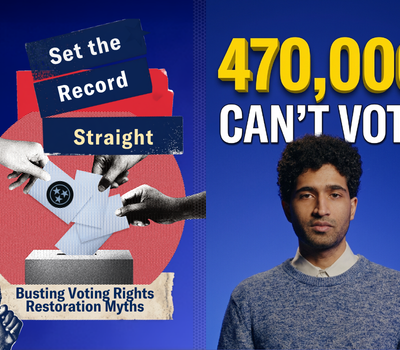

Thumbnail for the Set the Record Straight Series. Cover Reads: 470,000 Can't Vote

More from the Press


Placeholder image

Stay informed on civil rights issues. Discover our latest actions and updates in the Press Release section.

ICE’s Detention Oversight System Needs an Overhaul

Every day, ICE locks up over 20,000 people in a sprawling nationwide network of more than 200 detention facilities. The ACLU believes that this system of mass incarceration of immigrants should be dismantled — it’s unnecessary and inhumane. For as long as ICE maintains its detention network, though, it has a responsibility to create an oversight system that is actually effective at detecting, addressing, and deterring abuse of detained people. Our analysis of recent ICE inspection documents shows that ICE’s inspection system remains ineffective at identifying violations by detention facilities and ensuring compliance with detention standards, allowing facilities with clear records of poor conditions, including some of the deadliest facilities, such as the Stewart Detention Facility in Georgia, to evade accountability. V

By aclutn

Placeholder image

Stop-and-Fingerprint Can’t Become the Next Stop-and-Frisk

Two cases being heard today by the Michigan Supreme Court deserve close attention because of the widespread impact their outcomes could have on policing, the right to privacy, and the ever-expanding technological capability of law enforcement to collect, store, and use our personal data. The cases also highlight an issue that has plagued America for as long as police have existed: Black people being disproportionately stopped and searched by authorities with badges and guns, creating a climate of fear, instilling trauma, and poisoning relationships between law enforcement and the communities they are sworn to protect. T

By aclutn

Placeholder image

Congress Can’t Discriminate Against Puerto Rico Residents Just Because They Live There

In 2012, José Vaello-Madero, a U.S. citizen born in Puerto Rico but living in New York, applied for and received Supplemental Security Income (SSI) benefits because severe health problems left him unable to support himself. A year later, he moved to Puerto Rico to rejoin his family and care for his ailing wife. He continued to receive SSI benefits, unaware that federal law excludes Puerto Rico residents from the program, simply because they live in a U.S. territory rather than a state. In 2016, the federal government sued Vaello-Madero to collect over $28,000 it claimed it “overpaid.” On Tuesday, the Supreme Court will hear his case in United States v Vaello-Madero, a case that could help put an end to unconstitutional discrimination against residents of Puerto Rico and other U.S. territories. S

By aclutn

Placeholder image

The Final Religious Request of a Man on Death Row is in the Supreme Court’s Hands

Texas plans to execute John H. Ramirez, but state officials are not satisfied with merely taking his life. They are also intent on denying him the right to practice his faith when it matters most—in his final moments. Mr. Ramirez, a Christian, has asked that his longtime pastor be able to touch him and pray aloud over him as he dies. When the state refused this modest religious accommodation, the Supreme Court stepped in, delaying the execution and agreeing to hear Mr. Ramirez’s case. Oral argument is set for November 9. I

By aclutn

Placeholder image

How the FBI Spied on Orange County Muslims – And Attempted to Get Away With It | American Civil Liberties Union

In 2006, the FBI ordered an informant to pose as a Muslim convert and spy on the congregants of several large, diverse mosques in Orange County, California. The agent, Craig Monteilh, professed his conversion before hundreds of congregants during the month of Ramadan. Renaming himself “Farouk,” the informant quickly made friends and impressed members of the community with his seeming devotion. The whole time, he was secretly recording conversations and filming inside people’s homes, mosques, and businesses using devices hidden in everyday objects, like the keychain fob of his car keys. A

By aclutn

Placeholder image

I Want to Play Golf with Other Boys. I’m Suing Tennessee for That Chance.

In March, Gov. Bill Little signed into law a bill (SB 228/HB 3) that bans trans students from participating in school sports. Two federal courts have blocked similar laws in Idaho and West Virginia, while a federal court in Connecticut has dismissed a challenge to that state’s policies that supports participation for trans students. Luc, along with his parents, have sued Tennessee because he is now denied the opportunity to try out for the boy’s golf team. I

By aclutn

Placeholder image

A Mississippi City Blocked a Proposed Mosque Due to Anti-Muslim Prejudice, We’re Suing.

There are 13 churches in Horn Lake, Mississippi. But there are no mosques, and there never will be if city officials get their way. Earlier this year, the city’s Planning Commission and Board of Aldermen denied site-plan approval for the Abraham House of God mosque, even though the property for the proposed mosque is zoned for houses of worship and the city’s own staff determined that the application met or exceeded all requirements. One Alderman ominously warned, “if you let them build it, they will come,” exhorting his fellow board members to “stop it before it gets here.” T

By aclutn

Placeholder image

CVS Wants the Supreme Court to Gut Non-Discrimination Protections for People with Disabilities. It Could Set Us Back Decades.

“I’m sorry, we don’t serve people with disabilities.” “That’s okay, I don’t eat them.” T

By aclutn

Placeholder image

ICE Makes It Impossible for Immigrants in Detention to Contact Lawyers

“Ben G.” is a 35-year-old veterinarian from Nicaragua who fled to the United States after he was beaten and tortured by police. When he crossed the border into the U.S., he requested asylum. U.S. Immigration and Customs Enforcement (ICE) eventually transferred Ben to the Winn County Correctional Center, an ICE detention facility in rural Louisiana located four hours away from the nearest metropolitan area. It is also the facility with the fewest immigration attorneys available in the entire country. D

By aclutn

Placeholder image