
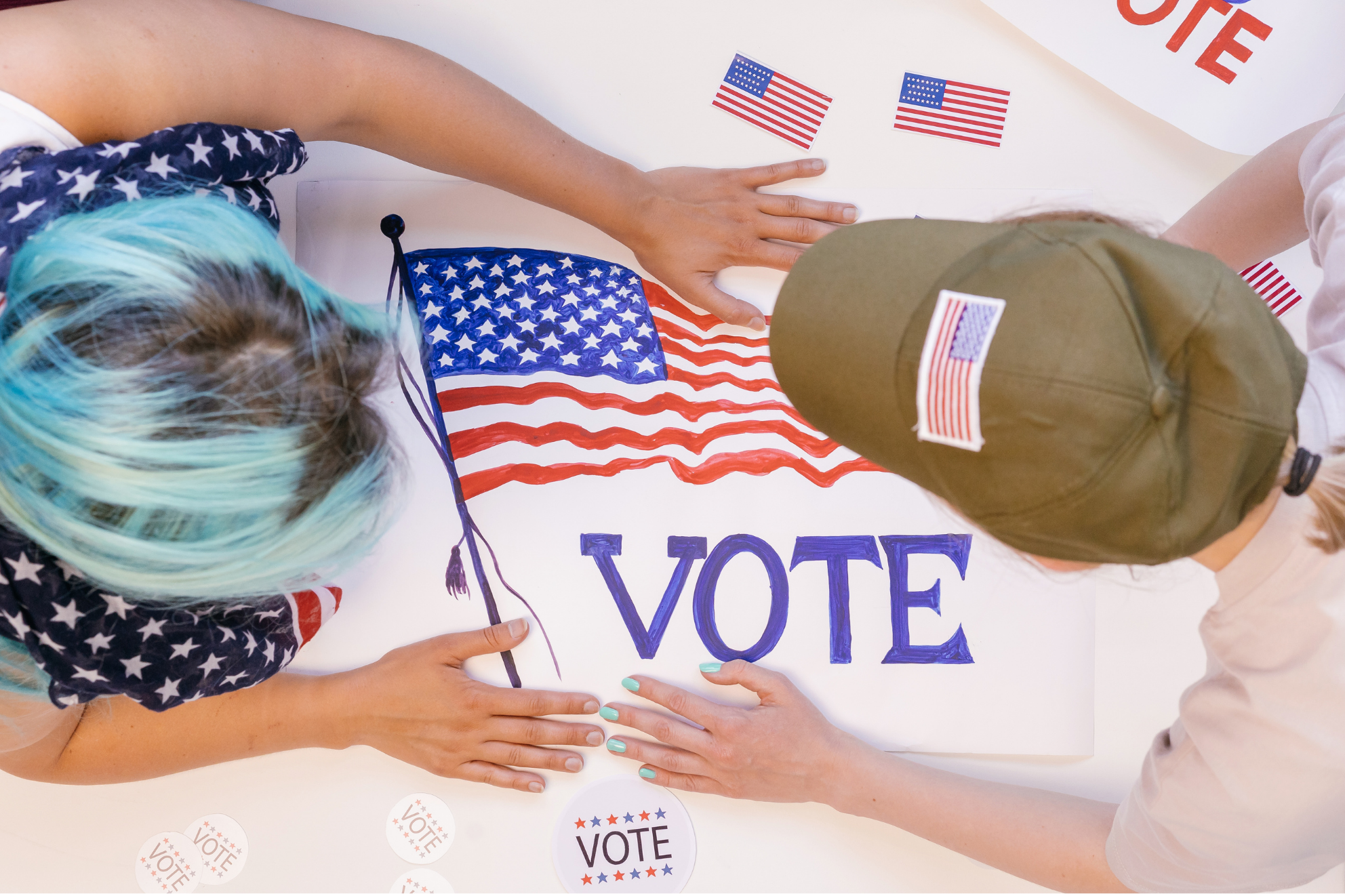
Image of a two hands reaching across the table with a patriotic sign that says VOTE in the middle.

What's on the ballot in Tennessee?

Three constitutional amendments on bail, property taxes, and victims' rights are on Tennessee's November ballot. See where we stand.

Latest Publication


Citizenship Rights Restoration in Tennessee

Restoring your voting rights in Tennessee got easier in 2026. State Sen. Raumesh Akbari and State Rep. Karen Camper led the charge in the legislature to remove some of the biggest barriers standing between formerly incarcerated Tennesseans and the ballot box.

The Campaign Legal Center and Free Hearts, a Tennessee nonprofit led by formerly incarcerated women, have been on the ground helping people navigate this process and pushing for a fairer system. For eligibility requirements and step-by-step petition instructions, read the guide from Free Hearts and the Campaign Legal Center.

Thumbnail for the Set the Record Straight Series. Cover Reads: 470,000 Can't Vote

More from the Press


Placeholder image

Stay informed on civil rights issues. Discover our latest actions and updates in the Press Release section.

Livestreaming Police is a Critical First Amendment Right

In 2018, Dijon Sharpe, a Black civil rights activist in North Carolina, was the passenger in a car that got pulled over by two police officers. Having previously experienced a violent beating by police officers during a traffic stop, he began livestreaming the interaction on social media. The officers on the scene told him he wasn’t allowed to livestream, and tried to physically obstruct the stream by seizing his phone from his hand. Mr. Sharpe filed a lawsuit arguing that the officers had violated his First Amendment right to record and livestream the police. T

By aclutn

Placeholder image

Congressional Drunk Driver Detection Mandate Raises Privacy Questions

Congress has mandated that starting later this decade, all cars must have a built-in ability to detect drunk drivers and to disable their cars. However, Congress left the Department of Transportation wide latitude to figure out how best to implement such a technology, creating a very real potential that we’ll end up with a system that could be a privacy disaster. T

By aclutn

Placeholder image

Kyle Rittenhouse Didn’t Act Alone: Law Enforcement Must Be Held Accountable

For two weeks, we’ve heard trial testimony and seen evidence of the events that occurred on August 25, 2020 — the night that Kyle Rittenhouse shot and killed two people and injured another during a Black Lives Matter protest in Kenosha, Wisconsin. While Rittenhouse was not held accountable, he was not the only one whose conduct on that deadly night should be scrutinized. The actions — and inaction — of the Kenosha Police Department and the Kenosha County Sheriff’s Department in the preceding 72 hours played a critical part in the tragic events that took place. A

By aclutn

Placeholder image

School is For Learning – Including Learning About Race and Gender

Learning about dynamics of race and gender is an integral part of any student’s education and necessary to understand U.S. history. But instead of fostering an open and honest dialogue, a handful of states — including Texas, Tennessee, Idaho, and Oklahoma, among others — are passing censorship bills that ban conversations about race and gender in public schools. These bills chill students’ and educators’ First Amendment right to learn and talk about the issues that impact their everyday lives. They further marginalize communities, create an unsafe learning environment, and shortchange students of their right to receive an inclusive education, free from censorship or discrimination.An

By aclutn

Placeholder image

We are Holding Arizona Accountable for the Needless Suffering and Deaths of Incarcerated People

A prison sentence should not mean people lose fundamental human rights such as access to health care or humane conditions of confinement. In Arizona, after almost a decade of broken promises, the ACLU, the Prison Law Office, and their co-counsel are in court proving that state prison officials continue to disregard their constitutional obligations to incarcerated people. I

By aclutn

Placeholder image

We Must Get Racism Out of Automated Decision-Making

In 1956, the Eisenhower administration launched the multibillion-dollar Interstate Highway System, creating a transportation network that indisputably paved the way for immense economic growth. But it also exacted a devastating cost: The new highways were often routed through older, thriving communities, displacing more than 1 million Americans – the vast majority of whom were Black and low-income. In some cities, they cut off Black neighborhoods from quality jobs, schools and housing, solidifying racial and economic segregation. The impact of this disruption is still felt today. N

By aclutn

Placeholder image

Alabama’s New Electoral Lines are Racially Gerrymandered — Here’s Why

The state of Alabama recently adopted new congressional and state legislative districts as the result of its once-in-a-decade redistricting process. These new maps are unconstitutional and grossly gerrymandered in a way that harms Black Alabamians, communities of color, and all Alabamians who care about fair representation. That’s why the ACLU and our partners filed two federal lawsuits today challenging Alabama’s newly drawn state legislative and congressional districts. R

By aclutn

Placeholder image

ICE’s Detention Oversight System Needs an Overhaul

Every day, ICE locks up over 20,000 people in a sprawling nationwide network of more than 200 detention facilities. The ACLU believes that this system of mass incarceration of immigrants should be dismantled — it’s unnecessary and inhumane. For as long as ICE maintains its detention network, though, it has a responsibility to create an oversight system that is actually effective at detecting, addressing, and deterring abuse of detained people. Our analysis of recent ICE inspection documents shows that ICE’s inspection system remains ineffective at identifying violations by detention facilities and ensuring compliance with detention standards, allowing facilities with clear records of poor conditions, including some of the deadliest facilities, such as the Stewart Detention Facility in Georgia, to evade accountability. V

By aclutn

Placeholder image

Stop-and-Fingerprint Can’t Become the Next Stop-and-Frisk

Two cases being heard today by the Michigan Supreme Court deserve close attention because of the widespread impact their outcomes could have on policing, the right to privacy, and the ever-expanding technological capability of law enforcement to collect, store, and use our personal data. The cases also highlight an issue that has plagued America for as long as police have existed: Black people being disproportionately stopped and searched by authorities with badges and guns, creating a climate of fear, instilling trauma, and poisoning relationships between law enforcement and the communities they are sworn to protect. T

By aclutn

Placeholder image