
A smiling woman in an ACLU baseball cap and sunglasses sits at the top of a yellow and blue inflatable slide, holding up an “I ❤ Democracy” ACLU bumper sticker.

When Will Tennessee Certify the 2026 Midterm Election Results?

After High Turnout, ACLU-TN Thanks Tennessee Voters, Poll Workers, and Partners, Looks Ahead to an Orderly Certification

By Cathryn Stout, PhD.

Latest Publication


Citizenship Rights Restoration in Tennessee

Restoring your voting rights in Tennessee got easier in 2026. State Sen. Raumesh Akbari and State Rep. Karen Camper led the charge in the legislature to remove some of the biggest barriers standing between formerly incarcerated Tennesseans and the ballot box.

The Campaign Legal Center and Free Hearts, a Tennessee nonprofit led by formerly incarcerated women, have been on the ground helping people navigate this process and pushing for a fairer system. For eligibility requirements and step-by-step petition instructions, read the guide from Free Hearts and the Campaign Legal Center.
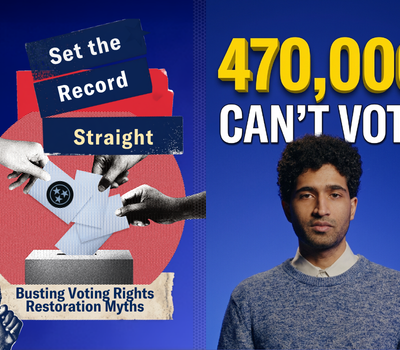

Thumbnail for the Set the Record Straight Series. Cover Reads: 470,000 Can't Vote

More from the Press


Placeholder image

Stay informed on civil rights issues. Discover our latest actions and updates in the Press Release section.

Sheriff Kristin Graziano and the New Movement for Public Safety

Sheriff Kristin Graziano’s historic election showed widespread community support for the need to reimagine public safety in Charleston County, South Carolina — including the need to invest in people and communities instead of police and incarceration. Sheriff Graziano is moving forward with her commitments to reduce the size, scope, and role of the Charleston County Sheriff’s Department, starting with ending the department’s

By aclutn

Placeholder image

Lack of Full Statehood Rights Continues to Cause Harm to D.C. Residents

Today, the House Committee on Oversight and Reform is holding a hearing on a bill to establish statehood for Washington, D.C. Since the last congressional hearing on statehood in September 2019, the COVID-19 pandemic, protests in D.C. after the killing of George Floyd, and the insurrection attempt at the U.S. Capitol building have all highlighted how the lack of full statehood rights continues to cause serious harm to the health and safety of D.C. residents. These events underscore the urgency with which our country must grant full and equal rights to the 712,000 residents of D.C. H

By aclutn

Placeholder image

Is There a New Era for Human Rights on the Horizon?

This piece originally appeared in Just Security. I

By aclutn

Placeholder image

We Must Abolish Qualified Immunity to Prevent Further Police Harm — Especially for People in Mental Health Crises

On July 10, 2017, Gabriel Eduardo Olivas was having a mental health crisis in his home. His son called 911 to ask for help. Instead of sending mental health workers with the tools and experience to help Mr. Olivas, the 911 dispatcher sent armed law enforcement. The officers who arrived did not treat Mr. Olivas — instead, they killed him. Mr. Olivas was soaked in gasoline when the two officers tased him, even though another officer warned them seconds earlier that tasing him would ignite the gasoline. In other words, to prevent the mere possibility of Mr. Olivas setting himself on fire, Arlington police did it for him. 

By aclutn

Placeholder image

North Carolina Has Spent Decades Attacking Abortion Access. We’re Fighting Back.

For years, North Carolina has restricted whether, when, and under what circumstances someone may obtain an abortion through a web of onerous and medically unnecessary laws. People with lower incomes seeking abortion care in North Carolina are frequently caught in a vicious cycle where delays in accessing care increase costs associated with the procedure, and increases in costs cause further, unnecessary delays. This burden is most acutely experienced by North Carolinians of color: 1 in 5 Black people, 1 in 5 Latinx people, and 1 in 4 Native American people in North Carolina living in poverty. T

By aclutn

Placeholder image

Why We Need the Post Office to Close the Racial Wealth Gap

Across America, banks are disappearing, leaving behind their most vulnerable customers, many of whom are Black and low-income. Since 2013, more than 11,000 additional bank branches have shuttered. And the trend is only accelerating. Some analysts expect as many as 20,000 additional branch closures in the immediate aftermath of the COVID pandemic. Branches in majority-Black areas, in particular, were roughly 50 percent more likely to close than those in the rest of America. As a result, 63 percent of majority-Black census tracts do not have an active bank branch; 17 percent of Black Americans are unbanked; and 30 percent of Black Americans are underbanked.

By aclutn

Placeholder image

Racial Justice and Civil Liberties: An Inseparable History at the ACLU

After World War I, it quickly became clear that the war to make the world “safe for democracy” had not made America safe for equality. Anti-Black race riots ripped through Chicago, New York, Washington D.C., and even Elaine, Arkansas. In October 1919, after Black sharecroppers in Elaine convened a union meeting, newspapers labeled the effort a “Negro uprising.” The state mobilized troops and mobs to quell the rebellion. The result was “possibly the bloodiest racial conflict in the history of the United States,” concluded the Encyclopedia of Arkansas History & Culture. T

By aclutn

Placeholder image

How the Stimulus Can Help Decriminalize Poverty

With the passage of the $1.9 trillion American Rescue Plan Act, we may be witnessing a turning point in the way this country thinks about poverty.

By aclutn

Placeholder image

Major Hack of Camera Company Offers Four Key Lessons on Surveillance

We learned last week that a group of hackers gained access to cameras installed by a surveillance camera company, and said they were able to access live feeds from 150,000 cameras inside schools, hospitals, gyms, police stations, prisons, offices, and women’s health clinics. Some of the video footage — showing patients in their hospital rooms, for example — was extremely privacy-violating. T

By aclutn

Placeholder image