A smiling woman in an ACLU baseball cap and sunglasses sits at the top of a yellow and blue inflatable slide, holding up an “I ❤ Democracy” ACLU bumper sticker.

When Will Tennessee Certify the 2026 Midterm Election Results?

After High Turnout, ACLU-TN Thanks Tennessee Voters, Poll Workers, and Partners, Looks Ahead to an Orderly Certification

By Cathryn Stout, PhD.

Latest Publication


Citizenship Rights Restoration in Tennessee

Restoring your voting rights in Tennessee got easier in 2026. State Sen. Raumesh Akbari and State Rep. Karen Camper led the charge in the legislature to remove some of the biggest barriers standing between formerly incarcerated Tennesseans and the ballot box.

The Campaign Legal Center and Free Hearts, a Tennessee nonprofit led by formerly incarcerated women, have been on the ground helping people navigate this process and pushing for a fairer system. For eligibility requirements and step-by-step petition instructions, read the guide from Free Hearts and the Campaign Legal Center.
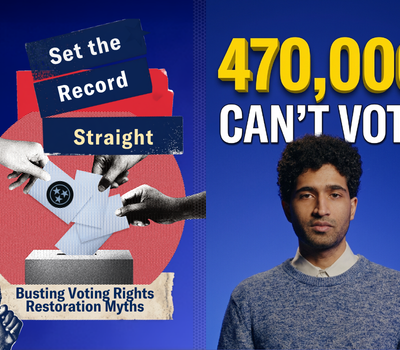

Thumbnail for the Set the Record Straight Series. Cover Reads: 470,000 Can't Vote

More from the Press


Placeholder image

Stay informed on civil rights issues. Discover our latest actions and updates in the Press Release section.

Behind Closed Doors: The Traumas of Domestic Work in the U.S.

Like other essential workers, domestic workers are bearing the brunt of the COVID-19 pandemic without the luxury of being able to telework, social distance, or even take a sick day. They also face unique and challenging circumstances due to the nature of their work, which is undervalued and under-regulated by the U.S. government. As a result, domestic workers often endure horrific abuses that go unchecked. Many are brought to the U.S. by employers promising a better life, only to find themselves subjected to forced labor, denied wages, and threatened with deportation. 

By aclutn

Placeholder image

Unless Biden Acts, Trump’s Assault on Human Rights will Continue

Last year, then-President Trump imposed unprecedented sanctions against the world’s only permanent international criminal court and my work to support justice for the victims and survivors of human rights atrocities ground to a halt. Since 2012, I have served as the special adviser on crimes against humanity to the prosecutor of the International Criminal Court (ICC), Fatou Bensouda. In this role, I provide Bensouda and her staff with legal advice and assistance in their investigation and prosecution of crimes against humanity around the world. 

By aclutn

Placeholder image

State Senator Sarah McBride on Making History and Affirming Trans Lives

The 2020 election was a historic year for lawmakers who identify as transgender: Voters across the country elected six trans lawmakers to state office. Sarah McBride was one of those lawmakers. Elected as a State Senator for Delaware’s first district, Sen. McBride is now the highest ranking trans lawmaker in the U.S. Her candidacy and her voice in trans advocacy have shown how trans people can become powerful leaders in public life. S

By aclutn

Placeholder image

Beyond the Bans: State Attacks on Abortion in 2021

Despite being a year into a global pandemic that has caused a staggering half a million deaths in the U.S, many state legislatures still have their sights trained on a favorite target: decimating access to abortion care. I

By aclutn

Placeholder image

The Racial Wealth Gap is a Civil Liberties Issue

As far back as the 1930s, the ACLU affirmed that economic justice was essential to achieving racial justice. In its 1931 Black Justice report, the organization’s first on the civil liberties of Black Americans, the ACLU reported that more than 3,555 Negroes had been lynched since 1882, averaging 74 per year or more than one per week. According to the forward, written by Broadus Mitchell of Maryland, Black Justice’s purpose was to answer “Why these gross discriminations against the Negro?” Mitchell replied to that crucial question with remarkable clarity: “The Negro has been oppressed because he has a low standard of living and little economic independence. And the other way around, he is economically servile because he has been oppressed.” 

By aclutn

Placeholder image

A New String of State Bills Could Give Religious Organizations Blanket Immunity from Any Wrongdoing

Religious exemptions on steroids: That’s the only way to describe legislation being considered this week by lawmakers in Arizona, South Carolina, and Montana. Under the guise of protecting the ability to worship during emergency disasters, these bills could give religious organizations blanket immunity from all civil and criminal liability — as long as they claim to be exercising their faith while engaging in the unlawful conduct. G

By aclutn

Placeholder image

One Key Reform Can Fight Voter Suppression

This was originally published on Democracy Docket. T

By aclutn

Placeholder image

Meet the Activists Fighting to Free People from LA Jails

Over the last year, the criminal legal system’s many injustices dominated mainstream discourse as people took to the streets to grieve and protest the murders of George Floyd and Breonna Taylor by police, and COVID-19 took a devastating toll on people in jails and prisons. These events galvanized many people into action — in the streets, at statehouses, and online — inspiring them to join activists who have challenged the criminal legal system’s disproportionate and often tragic impact on communities of color. One of the organizations at the forefront of this movement is the Youth Justice Coalition (YJC), a grassroots organization based in Los Angeles led by activists who have been incarcerated or otherwise entangled with the criminal legal system. The ACLU is part of a coalition representing YJC and impacted individuals in a lawsuit against LA County for its failure to adequately address the COVID-19 crisis in jails and prisons, and in protecting the health of incarcerated people. 

By aclutn

Placeholder image

Congress Shouldn’t Be Fenced Off to the People it Represents

The Capitol buildings and grounds are quintessential places for free speech and protest, accessible by people from all walks of life who gather there to express their views, demonstrate, picket, and hold vigils. But if those places are permanently fenced off, the public and our constitutional right to assemble and protest will be in jeopardy. 

By aclutn

Placeholder image