A smiling woman in an ACLU baseball cap and sunglasses sits at the top of a yellow and blue inflatable slide, holding up an “I ❤ Democracy” ACLU bumper sticker.

When Will Tennessee Certify the 2026 Midterm Election Results?

After High Turnout, ACLU-TN Thanks Tennessee Voters, Poll Workers, and Partners, Looks Ahead to an Orderly Certification

By Cathryn Stout, PhD.

Latest Publication


Citizenship Rights Restoration in Tennessee

Restoring your voting rights in Tennessee got easier in 2026. State Sen. Raumesh Akbari and State Rep. Karen Camper led the charge in the legislature to remove some of the biggest barriers standing between formerly incarcerated Tennesseans and the ballot box.

The Campaign Legal Center and Free Hearts, a Tennessee nonprofit led by formerly incarcerated women, have been on the ground helping people navigate this process and pushing for a fairer system. For eligibility requirements and step-by-step petition instructions, read the guide from Free Hearts and the Campaign Legal Center.

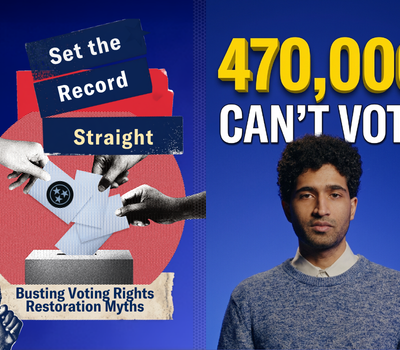
Thumbnail for the Set the Record Straight Series. Cover Reads: 470,000 Can't Vote

More from the Press


Placeholder image

Stay informed on civil rights issues. Discover our latest actions and updates in the Press Release section.

What Does Free Speech Mean Online?

Nearly three weeks ago, former President Donald Trump was banned from nearly every social media platform because of his role in the Jan. 6 attack on the Capitol. Just before Congress was set to certify Joe Biden as the next president of the United States, Trump instructed his supporters to, “fight much harder” against “bad people” and “show strength” at the Capitol.

By aclutn

Placeholder image

The Unique Obstacles to Abortion Access in Guam

Yesterday, I joined the ACLU in filing a lawsuit to restore abortion access to Guam. More than two years ago, the last known abortion provider in Guam retired, and thanks to outdated and medically unnecessary restrictions, island residents cannot use telemedicine — which over a decade of evidence and experience has shown to be a safe and effective means of providing medication abortion — to access legal abortion. In effect, these laws are operating as an abortion ban. U

By aclutn

Placeholder image

We’re Suing to Restore Abortion Access to People in Guam

Last week, we marked Roe Day, the 48th anniversary of the Supreme Court decision that legalized abortion throughout the United States. We celebrate this milestone while at the same time recognizing that legality alone has never been enough to secure real access to abortion. Indeed, we don’t need to wait for the Supreme Court to act to see a post-Roe world here in the United States. Guamanians are already living it. Y

By aclutn

Placeholder image

I’m Nonbinary. My Passport Should Show That.

My driver’s license is just like yours. It has my photo, date of birth, and other standard descriptors. Under gender, however, you’ll find not M or F, but X.   In 2017, I became the first person in the country to obtain an official nonbinary, gender-neutral X-marker on my driver’s license. I live in Washington D.C., which was among the first jurisdictions in the U.S. to officially offer an X marker to recognize nonbinary people as well as those who simply want a gender-neutral form of ID. At the same time, D.C. also removed requirements for a medical or third-party certification of gender to correct a gender marker. I’m proud to have joined LGBTQ+ activists in D.C. in making these policies happen.

By aclutn

Placeholder image

President Biden: The Time To Restore Net Neutrality Is Now

Just over four years ago, Donald Trump’s Federal Communications Commission eliminated net neutrality rules that ensured a free and open internet. Without these critical protections, internet service providers, or ISPs, were no longer required to provide equal access to all lawful content on the internet. That means ISPs were free to speed up customer access to information they like — either because they agreed with the content politically, the opinion advanced their corporate interests, or a business partner was paying them to give its content preferential treatment. At the same time, ISPs were likewise free to deliberately slow down customer access to content they didn’t like, or to block it entirely.  Through almost every political lens, getting rid of net neutrality was viewed as a terrible move. It turns out, Americans love a free and open internet. They want to have access to receive and communicate information free of corporate censorship. Even in Trump’s divided states of America, people from every background and political philosophy were united in their desire to bring net neutrality back. According to a 2018 University of Maryland poll, 82 percent of Republicans, 90 percent of Democrats, and 85 percent of independents favor restoring net neutrality.  Proponents of net neutrality put up a fight. In 2018, the Republican-controlled Senate voted 52-47, via the Congressional Review Act, to reject the FCC’s elimination of net neutrality protections (the House never got the chance to vote on the CRA). Throughout the nation, governors and state legislatures adopted laws and executive orders seeking to preserve net neutrality in their states. And the ACLU may have permanently harmed several of its staff members by filming them eating dangerously hot chicken wings while pleading with the federal government to save net neutrality.

By aclutn

Placeholder image

An End to the Muslim Ban is Just the Beginning

This week, Joe Biden was inaugurated as President of the United States. As part of his day one agenda, he rescinded one of the Trump administration’s most noxious orders. The Muslim ban, enacted within Trump’s first days in office, blocked virtually all immigration from countries with substantial Muslim populations, including Syria, Iraq, Sudan, Libya, Somalia, and Yemen. The order sent people across the world scrambling to avoid permanent separation from their families, their jobs, and their education. Amidst a national outcry and protests in airports and on the streets across the country, the ACLU was able to secure an early victory in the courts. But, over the years, fighting the Muslim ban became like a game of Whac-a-Mole. The administration would concoct superficial language tweaks to dodge judicial scrutiny, and the ACLU and others would fight anew. In the end, we were left with a ban, rubber stamped by the Supreme Court, that blocked entry to people from 13 countries around the world, mostly in Africa and the Middle East.  This week on At Liberty, we share the stories of three people directly impacted by the Muslim ban, and discuss what ending it will and won’t do for the future of Muslims in America with Manar Waheed, senior legislative and advocacy counsel at the ACLU. 

By aclutn

Placeholder image

The First Amendment Protects Scabby, the 12-Foot Inflatable Rat, Too

Living in New York City, there are some things you just know. You know that if you see a gigantic rat in the subway station you look the other way and pretend it doesn’t exist. And you know that if you see a gigantic inflatable rat in front of a business it means that workers are protesting unfair employer practices. Scabby the Rat, a 12-foot inflatable rat balloon, is a familiar sight not just in New York but around the country. But the government is now trying to deflate him. Luckily for Scabby, the First Amendment is on his side. Under existing precedent, unions have a legal right to display Scabby. They cannot be held liable under the National Labor Relations Act (NLRA), the law that governs most private sector employees’ collective bargaining rights, for simply standing with Scabby on a public street. But Peter Robb, the now-fired general counsel of the National Labor Relations Board (NLRB), a government agency, has been on an anti-Scabby mission for years. He has succeeded in bringing the question of whether Scabby is protected by the First Amendment back before the NLRB, prompting the board to invite the public to weigh in. Specifically, the NLRB asked whether it could find that displaying Scabby violates the NLRA without also violating the First Amendment. It cannot. Since speech about labor disputes is constitutionally protected, particularly when it occurs in public spaces, we filed a brief explaining why the First Amendment protects the giant rat balloon. Scabby is fully protected symbolic speech. We use symbols all the time to express ourselves, from

By aclutn

Placeholder image

What President Biden’s LGBTQ Executive Order Does and Doesn’t Do

Yesterday, as part of a slate of executive orders signed by President Biden on his first day in office, he issued an “Executive Order on Preventing and Combating Discrimination on the Basis of Gender Identity or Sexual Orientation.” It is now the policy of this administration that “[e]very person should be treated with respect and dignity and should be able to live without fear, no matter who they are or whom they love.” These opening lines were a salve after four years of relentless attacks by the Trump administration on LGBTQ people in all aspects of life. This new administration is willing to recognize and work to combat the sobering reality that “transgender Black Americans face unconscionably high levels of workplace discrimination, homelessness, and violence, including fatal violence.” And we now have a president who is planning to follow the Supreme Court’s landmark decision in Bostock v. Clayton County and who has instructed the applicable federal agencies to do the same. Contrary to a trending hashtag on social media and the polemics of a few loud voices, President Biden most certainly did not “erase women” — whatever that means. By stating the administration’s intention to follow Supreme Court precedent and federal law, at core all the newly-elected president did was lay out what the law is and agree, unlike his predecessor, to follow it. That includes, as the order makes clear, ensuring that “[c]hildren should be able to learn without worrying about whether they will be denied access to the restroom, the locker room, or school sports.” If only we lived in a world where this would go without saying; a world where it would be uncontroversial to merely affirm that every young person deserves a chance to learn and thrive and participate in school. Sadly, that is not the world we live in. Predictably, powerful individuals and organizations immediately objected to the idea that trans people might actually be protected in schools and began circulating the insidious lie that trans people are inherently a threat to non-transgender women. This is not true in the context of restrooms and locker rooms and it is likewise untrue in the

By aclutn

Placeholder image

Turning the Page on Trump to the Work Ahead

Picture it: The United States is riven by social unrest and political polarization. Millions of Americans feel unwelcome in the only home they’ve ever known. Thousands of immigrants are being rounded up, denied due process, and even deported. A rise in hateful, nationalist rhetoric is fueling anxiety over our borders, ​and stoking the flames of white supremacy and racial violence within them. Women — and even members of the LGBTQ community — are reaching new heights of visibility, political power, and personal autonomy,​ but also enduring violent backlash. As our democratic principles​ — ​from freedom of religion to freedom of the press — are under siege, masses of people, young and old, are taking to the streets to protest and demand their rights.    The year is 1920.    In response to this​ ​massive suppression of free speech and civil liberties, 101 years ago today, the American Civil Liberties Union was born. At the time, many of the rights outlined in the constitution were theoretical, untested by the courts, and of little practical meaning to most people, especially women and people of color. The founders of the ACLU set out to change that: ​to amplify the voices of the marginalized and secure civil rights, liberty, and justice for all. Decidedly intersectional, our founders included Helen Keller, Crystal Eastman, James Weldon Johnson, and of course, Roger Baldwin.   It’s deliciously fitting that the ACLU’s 101st birthday coincides with the very day Donald Trump leaves office. The ACLU has seen presidents come and go. As we know, some have tested this country’s dedication to democratic values more than others. Since Donald Trump took the oath of office, we’ve filed 413 legal actions, turned out thousands of people to airports, courthouses, and mass mobilizations. We filed our last legal action against the Trump administration on Friday. We stood watch until the minute Trump left office, and our watch continues.    These past four years, we won victories to stop LGBTQ employment discrimination, protected and expanded voting rights, blocked state-level abortion bans, worked to reunite families needlessly separated at our Southern border, and battled Trump’s Muslim ban in court numerous times.   With his policies and rhetoric, President Trump tried to divide us. He tried to make us a nation of us versus them. He pitted immigrants against citizens, and fanned the flames of white supremacy while Black people were murdered by police. He called certain cities and states more deserving than others. He waged war against our free press.   After 101 years, we at ACLU are not surprised when presidents disappoint us. To be clear, we never believed that we were living in Donald Trump’s America. Rather, he lives in our America. In our United States of America, we the people means all of us. So rest assured that the ACLU will keep fighting to advance freedoms where we can, and defend them where we must. We are committed to working with but also holding President Biden and Vice President Harris accountable to the promise of our constitution. With our help, they will be the transformational leaders that our country needs and deserves right now. And thanks to people like you, we now have the strongest ACLU our nation has ever known.    There is work to do to create a more perfect union. We know there are battles just around the corner to preserve the rights many have fought and won. We will work to forge an inclusive pathway to citizenship for the estimated 11 million undocumented and stateless people living in the United States — without caveats or tradeoffs. We join the chorus calling for this nation’s long overdue racial reckoning.    The ACLU won’t rest until we live in an America where equality and justice are a lived reality for all of us. We never lost hope, and we are not only more resolute than ever. We are certain that our ACLU values and principles will continue to prevail for the next 101 years. “We the people” deserve — and will accept — nothing less.

By aclutn

Placeholder image