A smiling woman in an ACLU baseball cap and sunglasses sits at the top of a yellow and blue inflatable slide, holding up an “I ❤ Democracy” ACLU bumper sticker.

When Will Tennessee Certify the 2026 Midterm Election Results?

After High Turnout, ACLU-TN Thanks Tennessee Voters, Poll Workers, and Partners, Looks Ahead to an Orderly Certification

By Cathryn Stout, PhD.

Latest Publication


Citizenship Rights Restoration in Tennessee

Restoring your voting rights in Tennessee got easier in 2026. State Sen. Raumesh Akbari and State Rep. Karen Camper led the charge in the legislature to remove some of the biggest barriers standing between formerly incarcerated Tennesseans and the ballot box.

The Campaign Legal Center and Free Hearts, a Tennessee nonprofit led by formerly incarcerated women, have been on the ground helping people navigate this process and pushing for a fairer system. For eligibility requirements and step-by-step petition instructions, read the guide from Free Hearts and the Campaign Legal Center.

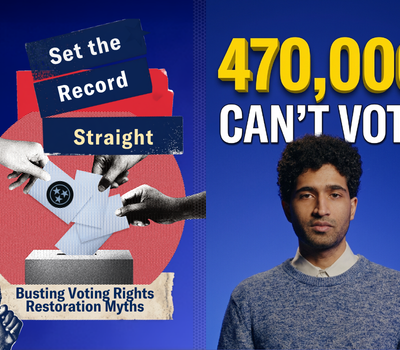
Thumbnail for the Set the Record Straight Series. Cover Reads: 470,000 Can't Vote

More from the Press


Placeholder image

Stay informed on civil rights issues. Discover our latest actions and updates in the Press Release section.

The Moral Imperative to Eliminate the Historic Stain of Family Separation

In 2018, the ACLU brought a successful lawsuit, Ms. L. v. ICE, against the Trump administration’s barbaric practice of forcibly separating migrant families. At the time, we had no idea of the scale and depravity of the injustice, but now know that thousands of children were deliberately ripped from their parents, including toddlers and babies.   This fall, we reported that hundreds of these families had still not been located, triggering a promise by President-elect Biden to create a task force to address family separation. We welcome all assistance the Biden administration can provide to help us find these families. But, critically, the new administration must do more than that if it is going to fully address the family separation tragedy it inherited.   Understandably, many are asking why hundreds of families remain missing after so many years and what has happened to the thousands of other families who were located.     The reason so many families have not been located is because the Trump administration withheld their names and then failed to disclose information that could have helped us find them. Indeed, it was not until 2019 that we even received the supposedly final list of children, and by then some of the children had been without their parents for nearly two years.    Making matters worse, the contact information for the families frequently was stale, too vague, or non-existent. While an ACLU-convened steering committee (consisting of the Paul Weiss law firm, KIND, WRC, and Justice in Motion) has nonetheless managed to find most of the families even with this limited information, the parents of 611 children have yet to be located.     We repeatedly asked the Trump administration whether it had additional contact information, and, over and over, the administration told us it did not. But last month, in response to the international outcry over the still-missing families, the administration suddenly gave us phone numbers and addresses, claiming it was an oversight. Beyond any additional assistance the Biden administration can give us to find the still-missing families, it must do four things.   First, it must permit deported families to reunite in the United States. Many mistakenly assume that only the missing 611 remain separated. But the Trump administration deported hundreds of other parents without their children (often telling the parent that their child would meet them on the plane only to have the plane take off without the child). We have found many of these still-separated families, but the Trump administration gave them only two brutal choices: remain separated from their children or bring their children back to the very danger they fled in the first place. The Biden administration has the power to immediately “parole” these families into the United States, allowing them to reunite in safety here.   Second, the Biden administration must use its executive power to protect these families from deportation once reunited in the U.S. The Trump administration has been deporting them, but given what these families have endured, that is unconscionable. And once their deportations are deferred, the Biden administration must explore all available means to confer permanent legal status. Importantly, this will also help us locate the missing 611, because families will be more willing to come forward if they know they will be safe.   Third, the Biden task force must create a fund to provide basic necessities, including trauma-informed care for both the children and parents. Without this help, these families stand little chance. As the American Academy of Pediatrics has concluded, the Trump administration engaged in “child abuse” that has caused lasting trauma. Physicians for Human Rights has gone further and called it torture.   Finally, the task force must ensure there are no more family separations so we do not repeat this tragedy.   The Biden administration is inheriting tremendous challenges. But addressing family separation should be a no-brainer. In 2018, when the country learned that babies and toddlers were being ripped from their parents’ arms, the public revulsion spanned the ideological spectrum. The sentiment was uniform: our government should not take babies from their parents and use them as political pawns.    Ultimately, it is a moral imperative to eliminate the historic stain on this country. I have been doing this work at the ACLU for nearly 30 years and have never seen a more inhumane practice or one that received such widespread, swift, and unequivocal condemnation. I still worry, though, that all the talk of aggregate statistics and abstract policy prescriptions will blur the human dimension, and the fact that the trauma caused to each of these children by family separation is its own tragic story.     I hope the Biden administration will remember stories like that of one of the first reunited families in our case, whose mother told us that her 4-year-old son kept asking if they were going to take him away again. Or the little boy with glasses whose mother said that he was unable to get his glasses case before he was taken away screaming, and that she worried every day whether the government would get him a new pair if they broke.   Or the parents who knew their children would be taken and asked, but were denied, the opportunity for a moment to brace the children for what was about to happen. Or the mother who was forced to watch as agents drove away with her 18-month-old baby while the baby craned his neck to get one last glimpse of her. Or all the other mothers and fathers who were not even told where their children had been taken or given the chance even to say goodbye, left only to wave through a glass window.

By aclutn

Placeholder image

The Supreme Court’s One-Two Punch Against Women

With two swift actions last week, the Supreme Court proved it is alarmingly disinterested in protecting women’s lives.    The first action by the court involved mifepristone, a drug used for medication abortion and miscarriage care. The Supreme Court

By aclutn

Placeholder image

The Enduring Harms of Trump’s Muslim Ban

As the Trump presidency draws to an end, we near the 4-year anniversary of the birth of one of its defining and most damning legacies: the Muslim ban. When Trump implemented his first Muslim ban, the public response was immediate. Crowds of protesters flooded airports in support of Muslims and other impacted communities who were immediately being detained or turned away all over the country. Lawyers and immigrants’ rights organizations nationwide, including the ACLU, filed a series of lawsuits as court after court ruled to block the ban. Despite the backlash, Trump issued new iterations of the ban to circumvent the law and conceal its real purpose, which in his own words was to block Muslims from entering the United States. Ultimately, the Supreme Court allowed the third iteration of the ban to be implemented. The Trump administration then rescinds the ban. 

By aclutn

Placeholder image

What Does the ACLU Say About the Right to March While Armed?

The nation stands alert, anxious about armed actions planned for Jan. 17 and Jan. 20 to contest the election of Joe Biden and Kamala Harris. The FBI has warned of the potential for armed demonstrators targeting legislatures, and extremist groups have made their intentions clear on message boards. Last week we witnessed an insurrection, with white supremacists storming our nation’s capital, some ready to take whatever actions they thought necessary to ensure their leader remained in power, despite decisive Electoral College and popular votes against him. The insurrectionists killed a police officer, brutally beat news reporters and other police officers, and chanted, “Hang Pence.” The Capitol was breached, leadership were rushed to secret secure locations, congressional offices were stormed, and bombs were planted outside the offices of the Democratic and Republican National Conventions. Many members of Congress and staff and those charged with securing their safety feared for their lives. After a long summer of protesting to affirm to the nation that Black Lives Matter, we saw the Confederate flag on parade in the U.S. Capitol. As the nation steels itself for the threat of repeat performances across the country, some have asked what states can do to protect their people and representatives. In particular, can weapons be banned at protests? In the ACLU’s view, the answer is yes — so long as the ban is applied neutrally to all, without regard to the viewpoints of a march. To be clear, what happened at the Capitol on Jan. 6 was not a protest, but a violent insurrection that left five dead and many more injured and endangered. Violence, threats, and intimidation have no place in the exchange of ideas and are not protected by the First Amendment. But where the issue is a protest and one that is peaceful, can states nonetheless ban protesters from carrying guns? Yes. The U.S. Supreme Court has held that the Second Amendment protects a right to possess a gun in one’s home, but that right is not absolute. As the Supreme Court stated, it is not a “right to keep and carry any weapon whatsoever in any manner whatsoever and for whatever purpose.” The Second Amendment permits “reasonable regulations” of arms. Indeed, the court was explicit that nothing in its opinion recognizing a right of individuals to bear arms “should be taken to cast doubt on … laws forbidding the carrying of firearms in sensitive places such as schools and government buildings.” We have longstanding laws to keep guns out of sensitive places like government buildings and airports. Visitors can’t bring guns into the U.S. Capitol or the Supreme Court. In other jurisdictions, people can’t bring a gun to polling sites during voting. Police confiscate any weapons that revelers bring to the National Mall on the Fourth of July every year. The rationale for these constraints is clear: Guns create safety risks that the state has a right to regulate. While some regulations of the possession and use of guns raise Second Amendment concerns, a ban on carrying weapons at a protest does not. The result is the same under the First Amendment. To be sure, openly carrying a gun can send a message, but the government has long had the power to set limits on the time, place, and manner of assemblies. Such restrictions need only be reasonable and content-neutral, meaning that they apply equally to all, regardless of ideology, political affiliation, or message. The government can limit the hours and volume of protests held outside hospitals or schools, for example — as long as the rule applies without regard to the content of the speech. Similarly, a ban on guns is a reasonable time, place, and manner restriction on a protest — provided that it is applied uniformly to all protests and all protesters. It’s about safety, not expression. Importantly, barring weapons at a protest doesn’t stop gun owners from speaking about any topic. It doesn’t stop speech in protest of the restriction, nor does it stop speech however odious or hateful. Those who seek to protest Donald Trump’s loss in the November election are free to do so — as long as they do so peacefully. And states and local governments also have the authority to bar weapons at protests. Our right to speech is about words, not weapons.

By aclutn

Placeholder image

Why the ACLU Called for Trump’s Impeachment

This past weekend, the national board of the ACLU convened an emergency meeting to respond to the events at the Capitol building on January 6. After hours of deliberation, the board voted unanimously to

By aclutn

Placeholder image

The Unspoken Agreement Between Prosecutors and Law Enforcement

Last week’s physical and civic violence at the U.S. Capitol has raised a terrifying set of questions about American democracy, including the potential complicity of law enforcement in insurrection. The president-elect joined the entire freethinking world in noticing that, if Trump’s mob had been Black, it would not have received the same concierge service. But Trump’s coup attempt was not the only law enforcement catastrophe last week: We cannot forget that, two days earlier, Kenosha County, Wisconsin District Attorney Mike Graveley chose not to charge police officer Rusten Shesky for shooting Jacob Blake seven times at close range, in front of his children, paralyzing him for life.    Last Tuesday, in what was already the prosecutorial equivalent of a Friday news dump — the day of a double-feature Senate runoff and the day before a contested Presidential certification — Graveley announced the non-charges and gave a press conference defending his decision. Graveley’s presentation was a master class in white aloofness and Black victim blaming. Graveley spent slide after slide on Blake’s thin criminal history, implying strongly that this justified his fate. He relied on tired tropes of untamable Black male aggression, including using the fact that Blake dared to remove the taser cables that were electrocuting his body as proof of the need to shoot that body over and over. And in playbook fashion, the good DA urged the Kenosha community to heal at the very moment he was twisting the knife.    To be fair, Graveley approached this case in a moderately more defensible fashion than most. Back in September, Graveley asked the feds to open a parallel civil rights investigation into the shooting, asserting that Kenoshans “deserved a second opinion.” He also invited the appointment of Noble Wray, a former Milwaukee police chief and self-proclaimed police reform proponent, to serve as an “independent” use-of-force expert. He even exhibited the barest modicum of racial humility, admitting yesterday, “I have never in my life had a moment where I had to contend with explicit or implicit bias based on my race.”    Our movement for racial justice and law enforcement accountability, which has steadily built steam in recent years, clearly influenced Graveley’s approach to the case. This is a good thing. However, Graveley’s efforts can also fairly be viewed as elaborate hide-covering. The parallel investigations by the DOJ and Wray could not force Graveley to charge these officers, but they sure made it easier for him not to. Wray’s report in particular was the rubberiest of stamps, and a missed opportunity to address not only Shesky’s tactical errors — namely, unnecessarily re-engaging with Blake — but the systemic issues that allowed a man like Shesky to do that with impunity. Graveley cannot take credit for bringing in an outside “reformer” if that person’s report doesn’t say a word about reform.   And Graveley’s concession regarding race is the coldest of comfort. The decision not to charge, buttressed by racialized victim shaming and unaccompanied by any concrete suggestions for reform, makes clear that he still hasn’t meaningfully “contended” with the bias within himself or the law enforcement infrastructure he leads. And for all his words and PowerPoints, he did nothing to heal a battered community — one simultaneously dealing with Kyle Rittenhouse’s not-guilty plea and the white nationalist protests that accompanied it. And he did nothing to ensure that this never happens to them again.   At the end of the day, prosecutors like Graveley depend on the police for leads and testimony, and are typically elected on tough-on-crime platforms. Hence, protecting their friends in blue is almost always the self-interested move for prosecutors, particularly in places like Kenosha. Graveley ultimately caved to that deeply ingrained incentive structure, and no amount of procedural window-dressing can change that.   More broadly, this is yet more proof of America’s debilitating obsession with criminal law as panacea. Consider this: In Breonna Taylor’s case, law enforcement grossly over-enforced a meaningless drug investigation, killing an innocent young woman. In the Nashville bombing case on Christmas morning, police likely under-investigated a dangerous situation, glibly claiming that their failure was only clear in hindsight. In Kenosha, as in countless communities across the country, a district attorney yet again over-protected his police benefactors and under-valued the pain of the Black community. And then, of course, came the grotesque failures in D.C. The common thread: Each time we relied primarily on law enforcement to address a real or perceived societal problem, and each time law enforcement failed. The obvious takeaway should be to stop using law enforcement as the primary solution to so many of our problems. Instead, we need a far more holistic, far less punitive approach to harm reduction than we’re currently employing — one that values public health over incarceration and prevention over post-hoc prosecution.    In this context that means, at the very least, more stringent use-of-force standards; better understanding of and counterprogramming to anti-democratic extremism, particularly deep online; non-police responses to a wider swath of calls for service; eliminating immunity doctrines to better deter misconduct by both police and prosecutors; and building upon Graveley’s laudable but ultimately insufficient attempts to create independence between those institutional actors, when more foundational reforms are still unable to prevent tragic situations like Jacob Blake’s. And it does not mean creating new criminal laws or expanding investigative powers for law enforcement, even in the wake of tragedy — these would only entrench the prosecution-forward approach that allowed these disasters in the first place.   This rethinking of our national approach to justice won’t eliminate all criminal activity overnight. The criminal law will and should persist. But if we can’t right-size and refocus it on true public health and public safety, we’re doomed to continue watching prosecutors and police serve and protect each other instead of us.  

By aclutn

Placeholder image

The Supreme Court Let the Trump Administration Endanger Abortion Patients During a Pandemic. The Biden-Harris Administration Can Fix it Right Away.

In its first decision on abortion since Justice Barrett’s confirmation, the Supreme Court granted the Trump administration’s request

By aclutn

Placeholder image

Tenants’ Right to Counsel is Critical to Fight Mass Evictions and Advance Race Equity During the Pandemic and Beyond

As the COVID-19 pandemic stretches on and worsens, people across the country face the devastation left in its wake. The public health and economic consequences of the pandemic have cost millions of people their jobs and the ability to pay rent — leaving far too many renters facing the added threat of eviction and losing their homes. The patchwork of responses has yet to slow down the eviction crisis thus far. Congress first responded through the CARES Act by putting a halt on evictions with a moratorium for a fraction of tenants across the country, but this expired in July 2020. In September, the Centers for Disease Control and Prevention adopted another moratorium protecting more renters until the new year. Congress then extended that moratorium for one month. Despite this, heading into January, up to 14 million households were at risk of eviction, and the rental assistance provided by Congress in the stimulus bill will reach some too late and others not at all. And come Jan. 31, 2021, the federal moratorium — as well as many of the remaining local and state moratoria on evictions — is set to expire. This will leave millions of families and communities unprotected from the threat of eviction. Once these tenant protections end, landlords will not hesitate to pursue mass evictions. Data from the Eviction Lab shows that landlords have filed evictions in droves the moment federal, state, and local moratoria have ended, and in some jurisdictions, eviction filings are actually increasing despite the moratoria that are still in place.  Eviction court proceedings are skewed to favor landlords and evict people from their homes. Eviction proceedings historically have been unfair and imbalanced. In the courts, the odds are stacked against tenants: 90 percent of landlords are represented by legal counsel in evictions, but fewer than 10 percent of tenants have representation.  This isn’t surprising considering many tenants are facing eviction because of unforeseen circumstances or financial stress that prevents them from being able to afford their rent, let alone counsel. Others lack the ability to go to court due to employment, child care, or transportation restrictions. On top of this, tenants have few options for legal aid and legal services programs, and legal aid has always been underfunded. Any defenses that are available to a tenant are virtually impossible to prove without a lawyer. As a result, tenants default at high rates, and landlords count on this imbalance to file meritless eviction cases. This systematically sets up tenants to fail, forcing them to leave their homes and leaving them to deal with the devastating, long-lasting impacts of eviction.  Black tenants — especially Black women — disproportionately face the threat of eviction.  Due to decades of inequalities in our housing system, communities of color and low-income women feel the impacts of eviction the most — Black women in particular. Boulder, Colo. and Baltimore. And these measures actually work. 86 percent of tenants who had representation as a result of New York City’s right to counsel legislation were able to remain in their homes. In San Francisco, the eviction filing rate decreased by 10 percent between 2018 and 2019, and of those receiving full representation, 67 percent stayed in their homes. Providing a right to counsel allows people and families to keep their homes and communities, and in the time of a pandemic, promotes public health.  Federal and state governments need to take action to protect tenants from mass evictions.  With the federal eviction moratorium set to end on Jan. 31 and no additional federal emergency rent relief in sight, it is paramount for Congress, states, and cities to act — and supporting right to counsel measures must be key to addressing mass evictions. The emergency package that passed Congress and was signed into law on Dec. 28 fell far short, extending the moratorium only until the end of January, providing a fraction of what is needed in rent relief, and allocating only $20 million in total for tenant representation while failing to explicitly address right to counsel. The ACLU and National Coalition for a Civil Right to Counsel call on the federal government to provide funding support for cities and states that implement a right to counsel for tenants in eviction proceedings, as well as to implement a fully effective moratorium on evictions and additional rental assistance for tenants.  We need meaningful action to stop mass evictions during the pandemic and beyond. All people — regardless of their circumstances or background — should have access to safe and stable housing.

By aclutn

Placeholder image

Biden Must Restore and Rebuild Asylum

The United States has made a commitment — by law and by treaty — to protect people who come to this country fleeing persecution. But the Trump administration relentlessly attacked people seeking protection and the very concept of asylum. It is now nearly impossible for anyone to secure asylum, no matter how strong their claim or fear. President-elect Biden has the opportunity to restore our asylum system, as he has promised to do. Unwinding Trump’s harmful and unlawful policies will be just the start to making our system more efficient, fair, and humane. A reversal is simply not enough — we must build our asylum system back better.     The asylum system Trump unilaterally destroyed was in place since 1980 when Congress to cloak the order in public health justifications, numerous public health experts denounced the policy and explained why it does not protect this country’s health. CDC’s own experts reportedly objected to the policy and refused to support it in court; it was implemented only after the White House pressured the CDC to accept it. As public health experts have explained, the government has the means to safely process people seeking protection while safeguarding the health of U.S. residents. Third, President-elect Biden must act quickly to end Trump’s two illegal asylum bans. The first bans anyone who entered the U.S. between ports of entry, even though U.S. laws state that it does not matter how a person enters if they are fleeing danger. The second bans anyone who travels through a third country to reach the U.S., unless they first apply for and are denied asylum in a third country — impacting nearly every non-Mexican asylum seeker. It is a naked attempt to deny as many people as possible, regardless of their need for protection under our laws. While the ACLU and partners quickly blocked the first asylum ban, the second ban had disastrous consequences for people seeking asylum before a judge vacated it in June 2020. But, the Trump administration has doubled down, issuing a new version of the second ban at the eleventh hour that takes effect just a day before inauguration. Biden must quickly rescind both bans. These are just the tip of the iceberg. There are numerous disastrous anti-asylum policies that Biden must promptly stop, including:

By aclutn

Placeholder image