A smiling woman in an ACLU baseball cap and sunglasses sits at the top of a yellow and blue inflatable slide, holding up an “I ❤ Democracy” ACLU bumper sticker.

When Will Tennessee Certify the 2026 Midterm Election Results?

After High Turnout, ACLU-TN Thanks Tennessee Voters, Poll Workers, and Partners, Looks Ahead to an Orderly Certification

By Cathryn Stout, PhD.

Latest Publication


Citizenship Rights Restoration in Tennessee

Restoring your voting rights in Tennessee got easier in 2026. State Sen. Raumesh Akbari and State Rep. Karen Camper led the charge in the legislature to remove some of the biggest barriers standing between formerly incarcerated Tennesseans and the ballot box.

The Campaign Legal Center and Free Hearts, a Tennessee nonprofit led by formerly incarcerated women, have been on the ground helping people navigate this process and pushing for a fairer system. For eligibility requirements and step-by-step petition instructions, read the guide from Free Hearts and the Campaign Legal Center.

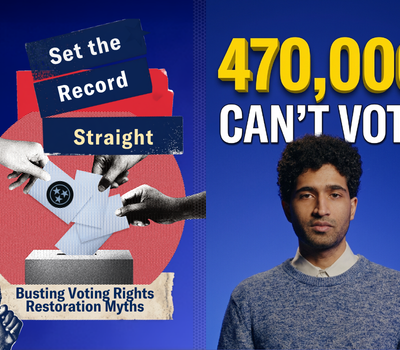
Thumbnail for the Set the Record Straight Series. Cover Reads: 470,000 Can't Vote

More from the Press


Placeholder image

Stay informed on civil rights issues. Discover our latest actions and updates in the Press Release section.

As Sheriffs Quit ICE, Joe Biden Can Lead the Way in Restoring Trust

This month, two newly-elected sheriffs canceled contracts with Immigration and Customs Enforcement (ICE). The sheriffs in Gwinnett County, Georgia and Charleston County, South Carolina were elected in November in part due to their campaign pledges to stop doing ICE’s bidding under a program known as 287(g). Voters in Cobb County, Georgia, also replaced a sheriff who conspired with ICE with an opponent of the 287(g) program. These election results came after a multiracial coalition of organizations worked to build community power, elevate the voices of immigrants, and publicize the harms of a program that leads to civil rights violations, including racial profiling, and puts immigrant families at risk. The 287(g) program compels local law enforcement agencies to conduct federal immigration enforcement, including interrogating people in jails about their immigration status and initiating the deportation process. But all too often it ends up  creating a chilling effect that dissuades immigrants from reporting crimes, seeking protection, or serving as witnesses for fear that the very agencies meant to protect them may instead try to deport them. Law enforcement agencies with 287(g) agreements waste millions of local tax dollars on federal enforcement all while undercutting their safety mission by destroying community-law enforcement relationships and diverting attention from local priorities. As Mecklenburg County, North Carolina, Sheriff Garry McFadden noted when he ended the county’s agreement, 287(g) “erodes trust with our community and ties up critical resources that should be used to ensure public safety,” and Charleston County Sheriff Kristin Graziano criticized the program as “legal racial profiling.” The program has created a climate of fear, as immigrants who live in 287(g) jurisdictions could end up in deportation proceedings for such “offenses” as failing to yield while turning or eating lunch outdoors. Many residents also report that they have been profiled while driving because of their race or appearance, pulled over by police pretextually — for traffic violations or no reason at all — so that police can question their immigration status. All too often, they are left in the custody of sheriffs with egregious track records. Gwinnett County, which had the most active 287(g) program in the country, had to pay millions in settlements after a pattern of sheriff deputies wantonly assaulting detained people was revealed. The previous sheriff of Cobb County, who was the first in Georgia to sign a 287(g) agreement, oversaw over 50 jail deaths while in office; meanwhile, the former sheriff of Charleston County, the largest county in South Carolina to have a 287(g) agreement, was once arrested for assaulting a detained individual. Sheriffs rarely face election challengers, but these sheriffs or their hand-picked successors all lost running on a pro-ICE platform, with voters resoundingly rejecting their anti-immigrant policies. Other jurisdictions that ended their contracts in recent years include Mecklenburg and Wake counties, North Carolina; Las Vegas, Nevada; Harris County, Texas; Anne Arundel County, Maryland; and Prince William County, Virginia. While this program preceded Donald Trump, it exploded under his leadership, as former

By aclutn

Placeholder image

We Can Uphold Free Speech and Hold President Trump Accountable

Some dyed in the wool civil libertarians have criticized the ACLU for supporting Donald Trump’s impeachment. These critics maintain that our commitment to the First Amendment should solely trigger a defense of the president’s “free speech.” But freedom of speech poses no bar to holding a president responsible for his unfounded, bad-faith effort to subvert the results of a free and fair election. Our board — comprised of leading lawyers and activists from every state and the District of Columbia — is a thoughtful, deliberative body of committed civil libertarians. After meetings on both Saturday and Sunday, the ACLU board unanimously passed a resolution again calling for President Trump’s impeachment, which can be found here. We discussed at length the free speech implications of this impeachment process. We concluded that President Trump’s remarks on Jan. 6 can be considered part of a pattern of efforts to upend an election he lost. If a president’s repeated lies, illegal political pressure, and the stoking of a mob to subvert the democratic process are not an abuse of power warranting impeachment, it is difficult to know what would be. Holding the president accountable for his words on Jan. 6, as part of that pattern, does not run afoul of the First Amendment. The House impeachment resolution reflects this. It does not single out Trump’s speech on Jan. 6 inciting a mob, but rather identifies it as part of a pattern of “efforts to subvert and obstruct the certification results of the 2020 presidential election,” including the improper pressure placed on Georgia Secretary of State Brad Raffensperger “to ‘find’ enough votes to overturn the Georgia presidential election results and threatened Mr. Raffensperger if he failed to do so.” The ACLU believes a president can be impeached for speech that a private citizen could not be prosecuted for. First, proceedings to impeach and remove a president are not criminal proceedings. They specifically seek to remove the president from office. While the First Amendment would likely bar the criminal conviction of a private citizen for the president’s Jan. 6 speech, impeachment is a political remedy: to remove an executive official who has abused his office, not to convict them of a criminal offense. The Supreme Court has long held that public employees can be fired for on-the-job speech that would be fully protected from criminal prosecution. Whether the president has any First Amendment rights when speaking in his capacity as president has never been established. At a minimum, because of his role and authority, the president does not have the same freedom of speech as an ordinary citizen. The First Amendment doesn’t protect the rights of public employees to say whatever they want when speaking in their official capacity. As a matter of law, public employees are regularly sanctioned for speech that fosters a hostile work environment. Their public position imbues their speech with more influence than the average citizen — as the saying goes, with great power comes great responsibility. It follows that President Trump doesn’t have unfettered free speech rights to subvert the results of a fair and free election. In short, a president who recklessly urged his followers to violate the law could be impeached even if an ordinary citizen could not be convicted for the same words, absent proof that his speech was intended and likely to produce imminent lawless action. Second, impeachment proceedings do not require conviction of a crime, but a determination by the House and Senate that the president has abused his office in such a serious manner that he should be removed. “High crimes and misdemeanors” don’t have to be actual crimes or misdemeanors, and surely recklessly urging an unruly mob to intimidate members of Congress performing their constitutional duties, in order to undercut the results of a free and fair election, is sufficient. No organization or individual has more consistently stood up for the free speech rights of individuals than the ACLU. From our defense of labor activists’ speech in the 1920s and 1930s, to Skokie, to Charlottesville, to our defense of BLM protesters, to the student free speech case the Supreme Court agreed to hear just last week, my organization steadfastly defends the First Amendment rights of individuals, no matter the popularity of their speech. Part of that legacy is our landmark Supreme Court case, Brandenburg v. Ohio, which established First Amendment protections in the context of criminal prosecution for incitement of violence. That case ruled that even explicit advocacy of criminal activity is protected unless the individual’s speech is intended and likely to produce imminent lawless action. As proud (and protective) as we are of our Brandenburg precedent, we don’t believe that case should stand in the way of impeaching Donald Trump. This civil libertarian can sleep well at night knowing that the First Amendment can be preserved, and Donald Trump can be impeached. In these hyper-partisan times, it is no surprise that leading critics of the ACLU might wish to deride us for allegedly sacrificing our commitment to the First Amendment in favor of punching down at an increasingly unpopular president. But as is reflected in our board’s thoughtful second call for Trump’s impeachment, our allegiance has always been, and remains, with the Constitution. I also sleep soundly because I fundamentally believe that our society is finally grappling with complicated issues of race, rights, and freedoms that it long overlooked or took for granted. Recent debates about Twitter’s barring of Trump permanently, the racially disparate treatment of BLM protestors and white supremacist insurrectionists by law enforcement, and the impeachment of President Trump have led to a soul-searching debate that will make this country better and stronger in the long run. Indeed, Donald Trump’s most lasting legacy may be that he catalyzed a “resistance” movement that will transform into a deeper commitment to social justice and constitutional norms. It is this invigorated movement that will shape the work of the next administration. Good night and good bye, President Trump.

By aclutn

Placeholder image

The ACLU Responds to January 6 Events at U.S. Capitol

By Lindsay Kee

Placeholder image

For Muslims, Even Prayers Aren’t Private

We generate droves of personal data every time we use the apps on our phones, make a call, or make an online purchase. While we might hope that our data is kept private, hidden away from people or entities that may want to surveil our usage or capitalize on these private choices, it often isn’t. In November, news reports revealed that the federal government had purchased location data mined from apps used by Muslims. One of those apps is Muslim Pro, a GPS-reliant app that signals prayer times to its users, which has been downloaded by millions. It’s not yet clear exactly how the data is being used, but many users of the app have already reported deleting it to avoid being surveilled. “I think I was both shocked and not surprised at the same time,” NowThis journalist Aliya Karim told At Liberty of the moment she learned about the data sale. “Shocked because something as personal as a prayer app kind of felt like it should have been safe from this type of intrusion. But then on the other hand, I wasn’t surprised because it feels like we Muslims are being watched by the government all the time anyway.” Karim joined At Liberty alongside Tarek Ismail, a senior staff attorney at the CUNY School of Law’s Creating Law Enforcement Accountability and Responsibility (CLEAR) Project. Listen as they discuss the repercussions of this breach of privacy, and what steps organizations like CLEAR and the ACLU are taking to keep private data safe and hold the government accountable.

By aclutn

Placeholder image

Requiring Men but not Women to Register for the Draft is Sex Discrimination

The requirement that only men — but not women — register for the draft is one of the last examples of overt sex discrimination written into our federal law. Today, we joined two young men and the National Coalition For Men (NCFM) to urge the U.S. Supreme Court to put an end to it.   Under the 1948 Military Selective Service Act, men in this country are required to mark their 18th birthdays by registering for the Selective Service System, the list of people who could be called up for military service if the government authorized a draft. Although there hasn’t been a draft since 1973, young men are still required to register or they may face severe penalties.   As long as the government requires young people to register for the draft, requiring men but not women to do so is sex discrimination. That’s why we’re asking the Supreme Court to declare men-only registration unconstitutional.   The ACLU joined two young men and the NCFM, who initially brought a challenge to men-only registration in 2013, to help bring their case to the Supreme Court. Representing an organization called the “National Coalition For Men” may seem like an unlikely way to advance women’s rights, and to be clear, the ACLU firmly opposes some of NCFM’s positions and activities. In this case, however, we share the common goal of ending an antiquated federal law that harms both men and women. And if the Supreme Court agrees, it could be one of the most significant constitutional advances in sex discrimination law in 25 years. Like many laws that appear to benefit women, men-only registration actually impedes women’s full participation in civic life. Limiting registration to men sends a message that women are unqualified to serve in the military, regardless of individual capabilities and preferences. It reflects an outmoded view that, in the event of a draft, women’s primary duty would be to the home front — and, on the flip side, that men are unqualified to be caregivers. The Military Selective Service Act not only perpetuates these stereotypes, it enshrines them in federal law.   Limiting draft registration to men also devalues the contributions of women who serve in the military. That’s why military women’s organizations like the Service Women’s Action Network support extending registration to women. National experts agree: A congressional commission formed to study the Selective Service System recommended that Congress update the Military Selective Service Act to allow women to be registered, too, and the Department of Defense has advised Congress that doing so would promote military preparedness — as well as fairness.   But, to be clear, this case isn’t about whether women should ultimately be required to register alongside men. If the Supreme Court declares men-only registration unconstitutional, it would be up to Congress to choose an appropriate path by extending registration to everyone regardless of gender or eliminating registration for anyone. What Congress may not do is design a registration system that discriminates on the basis of sex.   Men-only registration was first challenged more than 40 years ago, when several young people — represented by the ACLU — asked the Supreme Court to strike the Military Selective Service Act as unconstitutional sex discrimination. But the Supreme Court upheld the law in Rostker v. Goldberg. The Supreme Court reasoned that Congress could choose to require only men to register since the draft was aimed at replacing combat troops, and military women at that time were categorically ineligible to serve in combat roles. In other words, instead of examining whether the ban on women in combat was itself discriminatory, the court relied on one form of sex discrimination to justify another — and let both forms of discrimination stand.    In 2012, the ACLU filed a lawsuit challenging the ban on women in combat, one of two cases that led the Department of Defense to lift the ban. Now that women are eligible to serve in combat roles, the sole justification for men-only registration has evaporated into thin air. It’s time for the Supreme Court to revisit — and overturn — its previous decision and end this antiquated law.   Justice Thurgood Marshall, the first civil rights lawyer to sit on the Supreme Court bench, called men-only registration “one of the most potent remaining expressions of ancient canards about the proper role of women.” That was in 1981. It’s long past time for the Supreme Court to call men-only registration what it is: unlawful sex discrimination.

By aclutn

Placeholder image

Clearview’s Dangerous Misreading of the First Amendment Could Spell the End of Privacy Laws

Secretly, and without consent, a company called Clearview AI has captured billions of faceprints from people’s online photos, amassing what it claims to be the world’s largest face recognition database. Much like our fingerprints and DNA profiles, our faceprints rely on permanent, unique facts about our bodies — like the distance between our eyes and noses or the shape of our cheekbones — to identify us. Using our faceprints, Clearview offers its customers the ability to secretly target and identify any of us, and then to track us — whether we’re going to a protest, a religious service, a doctor, or all of the above — and even to reach back in time to find us in old selfies, school and college photos, and videos. In other words, it might end privacy as we know it. It also threatens our security and puts us at greater risk of identity theft by maintaining a massive biometric database, akin to a secret warehouse of housekeys. Clearview’s nonconsensual capture of our faceprints is dangerous. It is also illegal in at least one state. In May of last year,

By aclutn

Placeholder image

Pamela Winn Fights the Shackling of Pregnant People

Pamela Winn was sent to federal prison when she was six weeks pregnant. In prison, she fell down attempting to step into a van while shackled. She was not given prenatal care and she miscarried a little over three months later, shackled to a prison bed.   Winn, who was released from prison in 2013, is now an activist for the rights of incarcerated women. She helped enact a law to prevent the shackling of pregnant people in Georgia and is leading a mission to end prison birth altogether  But her story is not unique. There are currently thousands of pregnant people in prison. Many are not given proper medical attention, some are shackled even while giving birth, others miscarry — some have even birthed their children, alone in a cell.

By aclutn

Placeholder image

50 Years Into the War on Drugs, Biden-Harris can Fix the Harm It Created

An earlier version of this blog appeared in The Hill. This year marks 50 years since President Richard Nixon declared drugs “public enemy number one,” launching a war on drugs that has pumped hundreds of billions of dollars into law enforcement, led to the incarceration of millions of people — disproportionately Black — and has done nothing to prevent drug overdoses.   As President-elect Joe Biden and Vice President-elect Kamala Harris prepare to take office, they have an opportunity to begin to put an end to this failed war. And it is abundantly clear that they have a mandate from the electorate to tackle this issue.   Today there are more than 1.35 million arrests per year for drug possession, with 500,000 arrests for marijuana alone. Every 25 seconds a person is arrested for possessing drugs for personal use, and on average, a Black person is 3.64 times more likely to be arrested for marijuana possession than a white person, even though Black and white people use marijuana at similar rates. At least 130,000 people are behind bars in the U.S. for drug possession.   While tens of billions of dollars are spent each year to prosecute this war, more than 70,000 people still die of drug overdoses. Deaths from heroin overdose in the United States rose 500 percent from 2001 to 2014. Overall deaths from drug overdoses remain higher than the peak yearly death totals ever recorded for car accidents or guns.   The war on drugs has failed, and Americans on the right and left are ready for it to end. These views were on display at the ballot box in 2020, when voters across the country approved every ballot measure on scaling back the war on drugs. From Arizona, Oregon, and Montana to South Dakota, New Jersey, and Washington D.C., Americans turned out in droves to say that it’s time to stop criminalizing drug use.   The effort in Oregon, led by the Drug Policy Alliance and supported by the ACLU, was the most groundbreaking. This ballot measure decriminalized the possession of drugs for personal use, funding drug addiction treatment and recovery programs with the savings and tax revenue from marijuana legalization. Measure 110 will prevent more than 3,000 arrests a year for drugs such as heroin, cocaine, and methamphetamines. Oregon is now the first state in the nation to decriminalize all drugs, laying the foundation for reorienting the government’s response to drugs to a public health approach rather than a criminal law one.   Other states also showed that drug law reform is a winning issue on both sides of the aisle. Arizona, Montana, New Jersey, and South Dakota all legalized marijuana, joining 11 other states and Washington D.C. South Dakota, where Trump received 62 percent of the vote, showed that legalizing marijuana is a bipartisan issue, as did Montana, which elected Republicans to every major office in the state, while also voting to legalize marijuana.   Then in December, Congress delivered two victories, joining states in the movement for reform. On Dec. 4, the House of Representatives passed the most comprehensive marijuana reform legislation in Congress, the Marijuana Opportunity Reinvestment and Expungement (MORE) Act (H.R. 3884; S. 2227), which decriminalizes marijuana by removing it from the list of scheduled substances, expunges past convictions and arrests, and taxes marijuana to reinvest in communities targeted by the war on drugs. Sen. Harris is the primary sponsor of the MORE Act, but its fate in the Senate is uncertain despite bipartisan support. Then on Dec. 21, Congress passed a COVID-19 stimulus package that included repealing the prohibition on students with drug convictions from receiving federal financial aid, helping thousands of students get an education.   With resounding victories in red and blue states, President-elect Biden and Vice President-elect Harris now have a clear decree from voters. Here are the five things they can do to begin ending the war on drugs.   First, President Biden should issue an executive order within his first 100 days declaring an end to the war on drugs and directing his federal prosecutors and law enforcement to use their discretion to stop prosecuting the war on drugs. Thousands of people are prosecuted in federal court for drug possession and prosecutors have failed to adequately use their discretion to decline these cases, let alone to not seek incarceration as sentence. This must end. An executive order by President Biden should also incentivize states to end the war on drugs, where the large majority of incarceration for drugs takes place.   Second, President Biden should commute the sentences of people currently incarcerated for the war on drugs, and pardon people living with the consequences of this failed war. Candidate Biden committed to “reform[ing] the criminal justice system so that no one is incarcerated for drug use alone.” This is his chance to follow through on this promise by at the very least commuting sentences and pardoning people who fall under this category. That would be a good start.   Third, President Biden should direct federal funds to pilot new depenalization approaches to drug-related issues, as recently recommended in a report issued by the FXB Center for Health and Human Rights at Harvard University. This should include overdose prevention centers, where people can use illicit substances while under medical supervision and can access various treatments and referral services. Such models have existed for many years in countries such as Canada, Germany, and Denmark, and have reduced the likelihood of overdoses.   Fourth, President Biden should direct the Department of Justice to withdraw from litigation challenging overdose prevention centers that have been approved at the local level. As cities across the nation attempted to address record number of fatal overdoses, the Trump administration cracked down on cities and challenged them in court. President Biden should reverse this policy and refrain from filing new lawsuits.   Finally, the Biden administration should work with Congress to pass legislation such as the MORE Act. Polling has consistently shown that marijuana legalization is a bipartisan issue. Five Republicans voted for the MORE Act in the House. A Biden-Harris administration should use their influence to convince Republicans in the Senate to support the MORE Act.   Today, policymakers and the public alike are increasingly adopting approaches that treat substance use as a public health issue rather than a criminal justice one. This recognition is bipartisan, as the war on drugs has not differentiated between blue states and red states, and the public understands the importance of addressing addiction through public health measures. The Biden-Harris administration can begin healing our nation by moving decisively on this issue and beginning to repair the harm caused by 50 years of this failed war.  

By aclutn

Placeholder image

Black Life Deserves More Than Meaningless Commissions

This weekend the Trump administration released a 332-page report purporting to offer recommendations on police reform. The findings of this sham commission — composed primarily of police and prosecutors — show what most already knew to be true. The Trump administration never had any plans to implement transformative changes to policing that would curtail police violence, truly hold law enforcement accountable, or conduct any legitimate federal oversight of even the most troubled law enforcement agencies. This report was never meant to enhance safety for all communities; it was meant to advance the Trump administration’s “law and order” political agenda.  The Trump commission’s flawed recommendations are, in many cases, literally the opposite of what’s necessary to address the epidemic of police violence and mass incarceration. While the Trump commission simply restates a laundry list of recommendations focused on protecting police, here are a few recommendations for what we need to do instead.  We must transform the role of police and prosecutors in the criminal legal system.  The Trump commission report demonizes reform-minded prosecutors who use their discretion to racist technology misidentifies people of color at high rates and threatens to supercharge over-policing of communities of color. But the Trump commission calls for an expansion of these dangerous technologies — exactly the opposite of what we need. By ending law enforcement reliance on face recognition algorithms we can limit false arrests of Black men, and ensure community members are free from the threat of pervasive government surveillance every time we leave our homes.    We must abolish qualified immunity.  Across the country there has been a bipartisan effort to reign in qualified immunity — a court-created legal defense that shields police officers from liability for misconduct. Once an obscure legal doctrine, it has become a central focus of activists’ calls for police accountability as recognition of the policy as one of the main doctrines used to defend police officers in cases of police violence has grown. Officer Derek Chauvin, the police officer who killed George Floyd by kneeling on his neck for over eight minutes in a video seen around the world, might evade accountability in a civil suit through qualified immunity. By abolishing the doctrine of qualified immunity, many families, victims, and survivors of police violence will have the opportunity to obtain some form of justice in our legal system. Yet the Trump commission flat-out rejects the idea of abolishing or even limiting qualified immunity. We need to implement enforceable legal guidelines that clarify when police officers can use force against members of the communities they are charged with protecting.   Policies that limit officers’ use of lethal force so it is used only when absolutely necessary and after exhausting other alternatives such as de-escalation must be implemented on the local, state, and federal level. Instead, however, the Trump commission asserts that “the most effective measure to prevent police from using force remains for citizens to comply with officer commands” and that community members who are being unlawfully abused by police officers should “Comply, Then Complain.” The “comply, then complain” framework means that people in America must bow down to law enforcement, no matter what their behavior may be. This may be true in totalitarian regimes, but in America, the police work for the people. From its inception, it was clear that the President’s Commission on Law Enforcement and the Administration of Justice was a thinly veiled attempt to use the idea of “police reform” to promote President Trump’s “law and order” agenda, even as historic numbers of people marched in the streets to demand structural changes and an end to police violence. The commission’s goal of “promoting public confidence and respect for the law” was a thinly-veiled threat to advocates and organizers fighting to end police violence. Its mandate to look at “refusals by State and local prosecutors to enforce laws” was a rebuke of the movement to fix a corrupt, punitive, and harmful legal system and its mere composition an attempt by the Attorney General to advance a one-sided agenda. This flawed, bad faith approach should be buried along with the rest of the Trump administration’s terrible ideas on Jan. 20.

By aclutn

Placeholder image