A smiling woman in an ACLU baseball cap and sunglasses sits at the top of a yellow and blue inflatable slide, holding up an “I ❤ Democracy” ACLU bumper sticker.

When Will Tennessee Certify the 2026 Midterm Election Results?

After High Turnout, ACLU-TN Thanks Tennessee Voters, Poll Workers, and Partners, Looks Ahead to an Orderly Certification

By Cathryn Stout, PhD.

Latest Publication


Citizenship Rights Restoration in Tennessee

Restoring your voting rights in Tennessee got easier in 2026. State Sen. Raumesh Akbari and State Rep. Karen Camper led the charge in the legislature to remove some of the biggest barriers standing between formerly incarcerated Tennesseans and the ballot box.

The Campaign Legal Center and Free Hearts, a Tennessee nonprofit led by formerly incarcerated women, have been on the ground helping people navigate this process and pushing for a fairer system. For eligibility requirements and step-by-step petition instructions, read the guide from Free Hearts and the Campaign Legal Center.

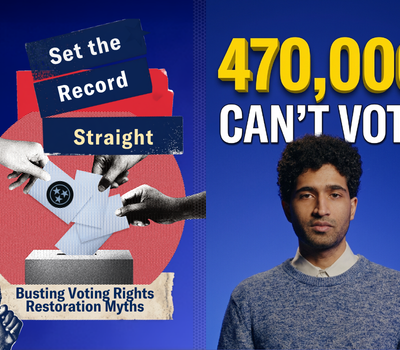
Thumbnail for the Set the Record Straight Series. Cover Reads: 470,000 Can't Vote

More from the Press


Placeholder image

Stay informed on civil rights issues. Discover our latest actions and updates in the Press Release section.

New Law Requires Federal Agents to Identify Themselves to Protesters

When people took to the streets this year to protest racial injustice and police brutality against Black people, they faced a repressive, violent response from local police and federal agents. Some of these agents arrived with militarized uniforms, riot gear, and weapons, but, notably, no visible name labels, badges, or even insignia marking their government agency. Congress just put a stop to this corrosive and undemocratic secrecy, requiring federal agents to identify themselves. Tucked inside the National Defense Authorization Act (H.R. 6395), which just became law, is a new requirement for federal military and civilian law enforcement personnel involved in the federal government’s response to a “civil disturbance” to wear visible identification of themselves and the name of the government entity employing them. That’s good news, because requiring such identification should be a no-brainer in a democracy. When government employees are interacting with members of the public and exercising government authority, such as the power to arrest people, the public should have the right to know who the employees are and which agency employs them. Furthermore, when government personnel engage in wrongdoing, such as attacking protesters, one of the first steps in holding them accountable is knowing who they are. It’s no surprise that rights-violating law enforcement would want to obscure their name plate and badge number before committing some unethical or even illegal act. Impeding transparency blocks oversight and accountability. What the nation witnessed in Washington, D.C. and Portland, Oregon underscores the vital need for the legislation. In Portland, incognito federal officers who refused to identify themselves snatched civilians off the street and whisked them away in unmarked vehicles. Only later did U.S. Customs and Border Protection and the U.S. Marshals Service reveal that they were involved. In our nation’s capital, the Trump administration swarmed the city with heavily-armed, unidentified officers with unclear governmental affiliations. When asked by journalists to give their names or specific governmental affiliation, these federal officers refused. The resulting images provoked outcries of our government resorting to the kinds of unaccountable “secret police” used by authoritarian regimes to silence dissidents and terrify ordinary citizens into submission. Protesters and security experts also flagged that the unidentified government forces’ appearances can be practically indistinguishable from the kinds of right-wing armed extremists that have, among other things, shot racial justice protesters on the streets of Kenosha, plotted to kidnap Michigan’s governor, and engaged in violent clashes around the country. This creates the risk that members of the public will treat law enforcement agents as illegitimate armed vigilantes, or defer to vigilantes who are posing as law enforcement.  In an important step forward for government transparency and accountability, lawmakers like Rep. Houlahan and Sens. Murphy and Schumer heeded the calls for reform and sought to ensure that a new identification requirement would be part of the final defense bill. Thankfully, they were successful. Even with this provision poised for enactment, additional reform is still urgently needed at all levels of government. For example, it is always better to have the officer’s name displayed rather than allowing a non-name identifier, such as a badge number, to be used as a substitute. Names are usually easier to remember than numbers or letters, thus making it easier for people to later identify and report officers. The nature of the existing exceptions should be narrowed, in addition to the total list of exceptions. Still, the message that Congress is sending to the executive branch and enshrining into statute is unmistakable: Secret police forces patrolling our neighborhoods in response to protests and other mass gatherings, in anonymity and shielded from accountability, are unacceptable. They do not belong in a democracy such as the United States.  When the next president takes office this month, his administration should affirm the principle as it implements the new law in the strongest possible manner — and keep its goal of a transparent and accountable government in mind as it works with Congress and civil society to respond to the inequities highlighted by the recent protests. 

By aclutn

Placeholder image

Incarcerated People Should Get Priority Access to the COVID-19 Vaccine. It’s the Smart and Human Thing to Do.

Governor Jared Polis of Colorado — otherwise a trailblazer when it comes to criminal legal reform — recently said, “There’s no way [the COVID-19 vaccine] is going to go to prisoners before it goes to the people who haven’t committed any crime.” Under fire from activists like us, he walked back that statement a few days later. But his initial instinct to throw incarcerated people under the bus is sadly typical, and we shouldn’t allow sentiments like that to poison the national discussion around vaccine access and distribution.   Following the U.S. Food and Drug Administration’s approval of a COVID-19 vaccine, the critical question for lawmakers — who should get the vaccine first — is still roiling. As with anything important, the devil is in the details. And in this instance, the details can determine life or death for thousands of incarcerated individuals.    Protecting them is a matter of science, law, and basic humanity.    Let’s start with science. Carceral settings have consistently been listed among the top coronavirus hotspots and the source of much suffering and death because they are too crowded and unhygienic to allow for social distancing. The death rate in prisons has been three times that of the general population. The infection rate of COVID-19 among those in immigration detention between May and August was 13 times higher than that of the general the rate of the U.S. population.   Individuals living in carceral settings also have higher rates of disability and chronic health issues that heighten their risk of severe illness or death from COVID-19. As just one illustration, public health experts note that incarcerated people should be treated as though they are 10 to 15 years older than their biological age. These vulnerabilities are due in part to the physical stress and strain imposed by their imprisonment. Prior to COVID-19, these facilities already denied detainees access to adequate nutrition, health care, hygienic supplies, and fresh air — a situation worsened by a woefully harmful and inadequate response to the pandemic.     Prison, jail, and detention administrators have consistently failed to take the necessary steps to prevent outbreaks that endanger both the people inside and outside their facilities, as the virus does not stop at the prison walls. Staff and contractors churn in and out constantly, allowing the virus to spread both within the facility and in the broader community. As a result, dozens of public health experts have supported lawsuits and advocacy by the ACLU and other organizations to increase protective measures and significantly reduce incarcerated populations. Just last week we won an order to cut the Orange County jail population in half, because social distancing was impossible without it. The science-driven arguments apply equally to vaccine distribution: The faster we get vaccines into detention settings, the faster we can protect everyone, both inside and out.        The law also supports the science. The Constitution protects individuals who are incarcerated and therefore unable to protect themselves. To that end, government officials must take reasonable efforts to protect those in their custody from becoming infected with COVID-19. Nothing is more reasonable than vaccinating the most vulnerable populations first, wherever they live. The fact that incarcerated people may be fighting for asylum, or have been convicted or accused of a crime, is irrelevantto the analysis here, and it should be.Now more than ever, federal and state officials must honor their oaths to these constitutional principles. Lives are at stake.   Finally, this is about basic humanity. COVID-19 has disproportionately decimated the poor, the medically vulnerable, people with disabilities, and Black and Brown communities, including immigrants. Many people fall into several of these categories at once, and far too many find themselves incarcerated — often because of this country’s legacy of systemic racism. Already at increased risk of infection, many are also at the mercy of their government to protect them. And, so far, governments have largely failed.     But because of ACLU litigation and advocacy, criminal defendants now have the right to remain silent and the right to a court-appointed attorney. We fought the racist war on drugs in the 1980s and have never stopped. We are ending the caging of migrant children nationwide. Our work since March protecting the nation’s most vulnerable from COVID-19 is a continuation of this legacy. Today, we are proud to say that people in prisons, jails, and immigration detention — along with people with disabilities and seniors in congregate settings, communities of color, and other vulnerable groups who have been most impacted by the pandemic — should be a first-tier priority for the COVID-19 vaccine. And if officials fail to prioritize incarcerated individuals for the vaccine, we will do what we do best: We will take those officials to court. 

By aclutn

Placeholder image

The Songs That Helped ACLU Staffers Survive 2020

How to sum up 2020: Stressful? Uncertain? Hard? If you’re like some ACLU staffers, one note of help came quite literally from listening to music. For a special year-end holiday episode, we asked a few staffers to tell us which song provided the service of escape or inspiration or just comfort.  It’s been a really long year, so we hope you enjoy this momentary departure from our usual talk of the latest civil rights and civil liberties battles in service of the songs that got us through this year. Here are a few of the songs that made us dance, jump, or simply keep going.

By aclutn

Placeholder image

Arkansas Politicians’ Relentless Push to End Abortion Access, and Humiliate and Shame Abortion Patients

This week, the ACLU is back in court working to protect the constitutional right to abortion in Arkansas. In 2017, the state legislature passed four anti-abortion laws to severely restrict access to abortion. If allowed to take effect, these laws would ban the only method of abortion provided in Arkansas after approximately 14 weeks in pregnancy; require that patients’ partners or others be notified of their abortion; force the health care center to report teenage patients’ abortion to local police where there is no reason to suspect a crime; and force physicians to request a vast number of medical records for each patient with no medical justification, violating physician-patient confidentiality and delaying — or outright blocking — access to abortion care. While the ACLU has successfully blocked these laws since their passage, we are still fighting in court to keep them blocked. The stakes of this fight could not be higher. In the few hours this week the laws were in effect, patients’ appointments were cancelled, and the consequences would be devastating if these laws are upheld. Five patients provided testimony in our lawsuit, sharing their stories of what access to abortion in Arkansas has meant for their lives. For Joan Doe, the partner notification requirement would have been untenable. “My boyfriend was abusive and controlling. If the clinic had had to notify him about the procedure, he would have used that information to exert even further control over me. He would not have wanted me to get an abortion, and would have attempted to prevent me from having one. [If this requirement was in effect at the time of my abortion], I would have had to try to travel out of state to avoid the clinic hav[ing] to notify him, even though I do not know how I would have been able to afford to do that. I barely had enough money to afford the procedure at the time, and the cost of traveling out of state would have been prohibitively expensive.” Mary Doe explained the burden these laws place on minors. “At 16 years old, I had an abortion at Little Rock Family Planning. At that time, I lived in my rural hometown of about 600 people with my mother and step-father …We lived in a secluded area, and we didn’t have enough money for many expenses. When I got pregnant, I knew I needed to have an abortion … my parents provided parental consent … But we could not tell [my boyfriend’s] parents … we were terrified what would happen if they found out. [We] were really scared that his parents would beat him up or kick him out of the house if they knew. “If the clinic were required to tell the local police about my abortion … This is especially concerning for me because I have family members on the local police force. I fear that they would disown me if they knew about my abortion. Even if it were meant to be kept confidential, it is a small community and the fact that I had an abortion would get around … I probably would not have gotten an abortion in Arkansas if notification to my boyfriend’s parents or the local police were required. I likely would have tried to travel out of state to get the abortion. I couldn’t afford this, so I would have to go without eating much for a week or two to be able to save up to travel.” Kate Doe suffered life-threatening complications during a prior pregnancy, and spoke about the impact that delaying care to collect a wide array of medical records would have. “I would have been frightened and intimidated if I could not have had an abortion unless the clinic first requested medical records from my prior doctors. That would be a huge invasion of my privacy. Seeking an abortion is a private decision, and I do not think it is necessary or appropriate to inform all of my previous doctors of my decision … I am concerned that if I had to contact my prior physician, information [about] my abortion would leak into my community. “Obtaining all prior medical records would also take additional time, and I am worried about the emotional and physical toll that delaying an abortion could place on women. Delaying the abortion could have put my body at risk for more complications, as with my last pregnancy. It would have been emotionally stressful as well, because it was important to me to terminate the pregnancy as soon as possible after I made up my mind that an abortion was the right thing for me and my family.” May Doe came to the decision that she needed an abortion when she received news of a life-threatening fetal diagnosis in the second trimester later in her pregnancy. After being denied care in her home state, she traveled to Arkansas: “If I hadn’t been able to get the abortion because of the new laws, it would have been torture. I had already waited nearly six weeks since receiving the diagnosis, and any further delay would push me beyond the gestational age limit to have an abortion in Arkansas. I am not sure what I would have done, or if there is another place I could go to get an abortion. I may have had to remain pregnant, and give birth to a baby that would shortly die. This would have been horrible for both my mental and physical health. “I feel fortunate that the Arkansas laws did not yet go into effect, and I was finally able to get the abortion I needed. I feel a lot of relief now that this ordeal is over. But if these laws go into effect, I know there are others like me who would not be able to access the care they need.” The ACLU will never stop fighting for the many people who, like these patients, need access to abortion care in Arkansas. Abortion is a right, and access to it should never depend on where you live. We’ll continue to remind Arkansas politicians of that for as long as it takes.

By aclutn

Placeholder image

A Tale of Two Body Camera Videos

Over the past month, two high-profile incidents reaffirmed why police body cameras cannot serve as a police transparency and accountability tool as long as state law empowers the police to determine what footage the public gets to see. As we have said time and time again, when the police are given the discretion to publicly release favorable body camera footage but withhold negative footage, police body cameras become nothing more than a police propaganda tool. The first such incident occurred on Nov. 19 in Omaha, Nebraska, where Kenneth Jones, a 35-year-old Black man, was pulled from the back seat of a car and killed by white police officers during a traffic stop. Despite having body camera footage of the incident, and immediate calls for transparency, the Omaha Police Department has refused to release the footage despite Nebraska’s strong tradition of open government. This decision, quite understandably, incensed the public. Omaha Deputy City Attorney Bernard in den Bosch, while acknowledging that “in the State of Nebraska, body cam videos are probably public records” nevertheless stated that “we have exercised our right to use the exception in the public records act to withhold them from public dissemination.”  Omaha Police Chief Todd Schmaderer took a different approach, saying that “I want to release the video” but then claiming he could not because “the video is the most inflammatory piece” of evidence, and that “arguably, if you are going to taint the jury pool, it would be with that piece of evidence.” The Omaha Police Department even went a step further, suggesting that Nebraska state law prohibits them from releasing the footage until the conclusion of any grand jury work related to the recorded incident. The chief’s claims are odd and suspicious for three reasons. First, when privately recorded videos of police conduct have been publicly released, they have had shockingly little impact on jury pools. Just ask the families of Eric Garner in Staten Island, New York or Daniel Shaver in Mesa, Arizona, where despite the release of graphic videos of their family members’ murders, the offending officers avoided any criminal liability. Second, the chief’s claim that state law prohibits him from releasing the footage is without merit. Even the local county prosecutor’s office told News Channel Nebraska that “nothing in the [state] grand jury law prohibits any police video from being released now.” Third, despite the chief’s claim that he was legally prohibited from releasing the body camera footage, he and his own police department went ahead and released several still images from the video — undermining all his previous claims.   All in all, the tangled web of strained and dubious claims by the Omaha Police Department are strongly indicative of someone trying to hide the truth; in this case, an unfavorable truth contained on body camera footage. But because Nebraska state law does not create an affirmative obligation to release police use-of-force body camera videos within a short time after an incident, the public has not seen the footage to date. Contrast that with the second incident, which occurred just over two weeks later, on Dec. 7, in Tallahassee, Florida. In that case, the Florida State Police raided the home of former Florida Department of Health data scientist Rebekah Jones, who has alleged she was fired from her job for refusing to manipulate COVID data. Following the raid, Jones tweeted that the state police “pointed a gun in my face. They pointed guns at my kids.” The tweet, which included a privately recorded video of the police entering Jones’ home, was picked up by the local press. In that case, like the case in Omaha, the police were wearing body cameras. Similarly as well, Florida’s body camera law, like that in Nebraska, does not require the immediate release of body camera videos that contain police uses of force, like entering a person’s home with guns drawn. However, in the Florida case, police body camera footage appears to show the state police acting in a more restrained manner than Jones was alleging. As a result, in what CNN properly noted to be a “rare move”, the state police released the body camera footage publicly, and they did it quickly. Transparency prevailed, but only because it favored the police. This double standard plays out in states like Nebraska, Florida, and many others where laws allow the police to be the sole or initial arbiter of what body camera footage the public gets to see. When body camera footage is negative, the police use bogus arguments to either withhold it or to justify selectively releasing portions of the footage to foster the story they are trying to tell. However, when body camera footage is favorable, the police tend to release the video with lightning speed. That is how a propaganda tool operates. If police body cameras are ever to become a real tool for promoting police transparency and accountability, release of footage that captures uses of force or alleged police misconduct should be quick and automatic. Further, as the ACLU’s model state body camera legislation states, “where a subject of the video footage is recorded being killed, shot by a firearm, or grievously injured, [release of the footage] shall be prioritized and the requested video footage shall be provided as expeditiously as possible, but in no circumstances later than five (5) days following receipt of the request.” States that do otherwise, either by leaving the release of critical footage to law enforcement discretion or by erecting laborious and costly legal hurdles to accessing important footage, should drop the ruse that they care about police transparency or the safety of their Black and Brown constituents who are so frequently the targets of police misconduct.

By aclutn

Placeholder image

The FBI is Secretly Breaking Into Encrypted Devices. We’re Suing.

The FBI is secretly breaking the encryption that secures our cell phones and laptops from identity thieves, hackers, and abusive governments, and it refuses to even acknowledge that it has information about these efforts — even though some details have been filed publicly in federal court. We’re suing to get some answers.   Between our emails, text messages, location information, social media activity, and more, our cell phones hold almost our entire lives. In recent years, governments have stepped up efforts to gain access to the information on our cell phones and personal computers. The federal government has been pressuring companies to build encryption backdoors that would severely undermine our digital privacy and security, and both federal and state governments have regularly paid third-party vendors to break into people’s encrypted devices.   Now, it appears the FBI has built an in-house capability to break into these devices. Publicly available information indicates that the Electronic Device Analysis Unit (EDAU), a team within the FBI, has acquired or is in the process of acquiring software that allows the government to unlock and decrypt information that is otherwise securely stored on cell phones. Public court records also describe instances where the EDAU appeared capable of accessing encrypted information off of a locked iPhone. And beyond that, the EDAU even sought to hire an electronics engineer whose major responsibilities would include “perform[ing] forensic extractions and advanced data recovery on locked and damaged devices.”   To learn more about the EDAU and its capabilities, we filed a request under the Freedom of Information Act asking that the Department of Justice and the FBI disclose records relating to the EDAU and its technological capabilities for retrieving information from locked electronic devices. The FBI responded in part by issuing what’s known as “Glomar” responses to two of our requests — which means that the agency refuses to even confirm or deny the existence of any records pertaining to the EDAU.   A valid Glomar response is rare, as there are only extremely limited instances where its invocation is appropriate — that is, only where the existence or nonexistence of records is itself exempt under FOIA. The problem with the FBI’s Glomar response is that, as detailed above, we already know records pertaining to the EDAU exist because information about the unit is already public. The fact that all of this information is already publicly known deeply undercuts the FBI’s Glomar theory. The FBI itself has made clear that it is attempting to access and decrypt personal electronic devices, so the claim that it can’t even acknowledge whether these records exist is implausible.   Seeking some much-needed transparency, today we asked a federal court to intervene and order the DOJ and the FBI to turn over all responsive documents pertaining to the EDAU. We’re demanding the government release records concerning any policies applicable to the EDAU, its technological capabilities to unlock or access electronic devices, and its requests for, purchases of, or uses of software that could enable it to bypass encryption.   By invoking the Glomar response, the federal government is sending a clear message: It aims to keep the American public in the dark about its ability to gain access to information stored on our personal mobile devices. But it’s not that the FBI has just shut the door on this information — they’ve shut the door, closed the windows, drawn the shades, and refused to acknowledge whether the house that we’re looking at even exists. It’s imperative that the public gets meaningful access to these records regarding the federal government’s capabilities to access our phones and computers. Our privacy and security are at stake.

By aclutn

Placeholder image

A Deportation Moratorium, What Comes Next for Biden?

This blog is the eighth in a series outlining a reimagined, just, and humane immigration system for the United States.  The past four years proved that the Biden-Harris administration must be bold and focused on overhauling the immigration system. The Trump administration has touted the “breathtaking” changes it has made to our immigration system. The changes are indeed breathtaking — in their dishonesty, abject cruelty, and white supremacist roots. The Trump administration has been single-mindedly obsessed with destroying our immigration and refugee system, using a global pandemic to upend it. On his way out, Trump is also shoving through “last-ditch efforts” at further harming immigrants. Our border militarization and immigration enforcement machinery is overfunded, unaccountable, and increasingly lawless. It is this vast, “formidable machinery” that Trump has stretched to its limits, but the issue predates Trump. The last four years under Trump have highlighted how cruel and unjust our immigration system can be — but also demonstrated the significant discretion the executive branch can exercise.  The Biden-Harris administration committed to an immediate moratorium on deportations. Hitting pause on banishing people from the United States acknowledges that our immigration system is deeply flawed — even more so after four years of Trump — but also provides the space to begin laying the groundwork for an audacious and inclusive vision for immigrants’ rights.   During a moratorium, the executive branch must immediately halt immigration enforcement and deportations while it works to undo policies like the evisceration of asylum. We know that just reversing course will be a massive task, but it is also not enough.  A moratorium also provides an opportunity for the Biden-Harris administration to reject our existing immigration system’s reliance on the punitive, enforcement-based approach driven by mass detention and mass deportation. This system costs taxpayers tens of billions of dollars a year. The executive branch should instead invest in a humane and effective system focused on helping people navigate a byzantine immigration system and on a pathway to citizenship. In this reimagined immigration system, ICE and CBP racial profiling rather than engage in and encourage it. Immigrants would not be caged while going through the immigration system, but instead be with family and a support system as they pursue relief under the supervision of a judge. And the government would provide lawyers for people who are too poor to afford one because that is what fairness and justice demand.  There is a real opportunity and political will to reimagine our country’s approach to immigration: shifting from a detention and deportation-obsessed approach to one that is rooted in fundamental due process and human rights.  Take, for example, expedited removal, created by Congress in 1996 as part of a

By aclutn

Placeholder image

CBP’s Plan to Expand Face Surveillance at Airports is a Civil Liberties Disaster in the Making

Over the last couple years, it’s become increasingly clear that facial recognition technology doesn’t work well, and would be a civil liberties and privacy nightmare even if it did. But that’s not stopping the Trump administration from moving forward with its dangerous plans to expand the technology’s use at U.S. airports and other ports of entry. U.S. Customs and Border Protection (CBP) has proposed a new rule that would massively expand the use of face surveillance at the border, further entrenching a dystopian surveillance infrastructure that threatens our rights to privacy and anonymity, and disproportionately harms people of color and immigrants. Today, we and a diverse group of rights organizations are calling on the government to withdraw its plans.       According to a notice published in November, CBP plans to collect the faceprint of virtually every non-U.S. citizen who enters or exits the U.S., including children. The faceprints will then be stored in a government database for up to 75 years, where they may be used not only by the Department of Homeland Security, but by foreign governments and federal, state, and local law enforcement to identify individuals for a variety of purposes. CBP says it will apply a face-matching algorithm to travelers, comparing their faceprints to a gallery of other images in the government’s possession.   This plan is unjustified, unnecessary, and dangerous. Unlike fingerprints and many other biometrics, faceprints can be collected covertly, at a distance, and without our consent. Once a government acquires a person’s faceprint, it creates a risk of a unique and unprecedented form of persistent surveillance, one that allows the government to identify and track people without their knowledge. Congress has not authorized the government to take such an extraordinary and unprecedented step, and the government already collects fingerprints from non-U.S. citizens entering the United States, undercutting its claims about the unique value of facial recognition for identity verification.   Face surveillance gives governments, companies, and individuals the power to spy on us wherever we go, and we are already seeing its harmful consequences. In China, the telecommunications firm Huawei was reportedly testing a facial recognition algorithm that could send automated alerts to police when it identifies a member of the Uighur community, an oppressed Muslim minority group that has been subjected to unconscionable human rights violations in China. And here in the United States, the government has already used this technology to spy on protesters.   CBP’s proposed expansion of the technology will disproportionately harm immigrants and communities of color. Several recent studies, including government studies, have shown that the technology is wrongful arrests for crimes they did not commit.   Faulty facial recognition technology could provide a pretext for subjecting people of color and religious minority groups to additional screening and harassment. And regardless of the accuracy of CBP’s face-matching technology, DHS’ retention and sharing of travelers’ faceprints for up to 75 years will facilitate unjustified law enforcement scrutiny of immigrant and other communities for decades.   Granting CBP the extraordinary and unprecedented power to conduct persistent, secret surveillance of public movements with a faulty technology is cause for significant alarm. CBP played a leading role in carrying out family separations under President Trump’s cruel policy. The agency has a must put the brakes on this country’s slide into an anti-immigrant dystopia.

By aclutn

Placeholder image

President-Elect Biden’s Voting Rights To-Do List

President Trump has assailed the right to vote during his entire time in the Oval Office. Trump’s term was bookended with baseless claims of voter fraud, an unoriginal yet effective trope that has been used throughout our country’s history to erect barriers to discriminate against Black, Hispanic, and Native American voters. Trump’s goal is obvious: to intentionally weaken public trust in our elections and embolden voter suppression efforts. Manufactured claims of fraud to explain away Trump’s loss of the popular vote in the 2016 election led to the creation of a sham commission that eventually disbanded after failing to provide any factual evidence to support Trump’s preposterous statements that millions of people had voted illegally. And following his loss of the 2020 presidential election, Trump has led a rabid assault on American democracy, which has eroded the public’s faith in the outcome of the election and catapulted efforts to subvert the will of voters by overturning the results of the election. Undeniably, there are problems with our democracy that must be fixed. But these issues do not arise from purported voter fraud. Rather, they are the legacy problems of our republic: systematic efforts by politicians to erect voting barriers and to discriminate against voters of color to tip the balance of power. These problems are enduring, persistent, and verifiable.  In Georgia and Arizona, the 2020 presidential election demonstrated the power of voters of color to disrupt entrenched political power structures, a development that has unnerved politicians who rely on low voter turnout to maintain the status quo. Next year will also mark the first national redistricting cycle since the Supreme Court gutted Section 5 of the Voting Rights Act, which required state and local governments with the worst records of voting discrimination to preclear voting changes with the Justice Department to ensure the changes did not racially discriminate. For the first time since 1965, congressional, state, and local government legislative districts will be drawn without the protections of Section 5 to prevent state and local officials from diluting the rising political power of minority voters.   It is imperative that President-elect Biden’s administration take ambitious action to protect the right to vote and improve the future of American elections under our existing federal voting laws and to champion new federal protections for voting rights. Here are the ACLU’s key recommendations:

By aclutn

Placeholder image