A smiling woman in an ACLU baseball cap and sunglasses sits at the top of a yellow and blue inflatable slide, holding up an “I ❤ Democracy” ACLU bumper sticker.

When Will Tennessee Certify the 2026 Midterm Election Results?

After High Turnout, ACLU-TN Thanks Tennessee Voters, Poll Workers, and Partners, Looks Ahead to an Orderly Certification

By Cathryn Stout, PhD.

Latest Publication


Citizenship Rights Restoration in Tennessee

Restoring your voting rights in Tennessee got easier in 2026. State Sen. Raumesh Akbari and State Rep. Karen Camper led the charge in the legislature to remove some of the biggest barriers standing between formerly incarcerated Tennesseans and the ballot box.

The Campaign Legal Center and Free Hearts, a Tennessee nonprofit led by formerly incarcerated women, have been on the ground helping people navigate this process and pushing for a fairer system. For eligibility requirements and step-by-step petition instructions, read the guide from Free Hearts and the Campaign Legal Center.

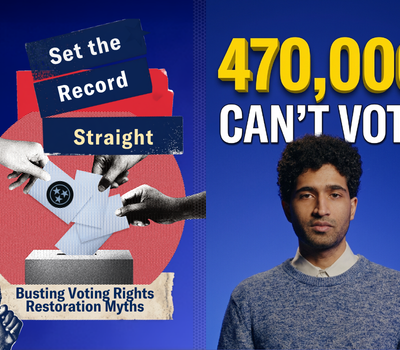
Thumbnail for the Set the Record Straight Series. Cover Reads: 470,000 Can't Vote

More from the Press


Placeholder image

Stay informed on civil rights issues. Discover our latest actions and updates in the Press Release section.

The Winner of the 2020 Election: Drug Legalization

The 2020 election was notable for many reasons, but one winner really stood out: drug legalization. Five states legalized either medicinal or adult use of marijuana. Oregon and went even further, becoming the first state to decriminalize the personal use and possession of small amounts of illegal drugs, including cocaine, heroin, and methamphetamine. The momentum garnered from these cross-country wins helped push the MORE Act through the House in recent weeks. If passed and enacted, this legislation would end the federal prohibition of marijuana. This week on At Liberty, Cynthia Roseberry, deputy director of our National Political Advocacy Department, joined us to discuss what this election means for the future of the drug war, and the long work of advocates to bring it to an end. “What we’re seeing now is finally the voice of the people being heard by policymakers,” said Roseberry. “It is a tipping point. It is a beginning, let me say that,” she added. “But it is a crucial point as we approach the 50 year anniversary of the war on drugs.”

By aclutn

Placeholder image

They The People: The Biden Administration Must go Beyond Repealing Trump’s Attacks on Trans Rights

The federal government has not been kind to transgender people over the last four years. Trans students were put at risk when the Department of Education withdrew critical guidance explaining how schools must protect transgender students. Trans people facing housing instability were left in the cold when the Department of Housing and Urban Development rolled back rules protecting trans and gender non-conforming people from discrimination at homeless shelters and other housing services receiving federal funds. Trans military members were devastated by a single tweet from the president that put their careers and livelihoods at stake. And the list of attacks goes on. The government is supposed to support and serve all of us, but trans folks have been intentionally and cruelly cut out these last four years, along with so many other communities. Of course, we are still here, and will continue to take care of each other no matter who is in the White House. We’ve heard Biden and Harris pledge to repeal the trans military ban and pass the Equality Act, and assure us that their administration will work to undo the harms of the last four years. Now we must must hold this administration accountable and ensure that they make a meaningful difference in the day-to-day lives of trans and non-binary people around the country. There’s one important action this administration can take right away to show transgender people that they respect and support us: give us identification that reflects who we are. That’s why one of the ACLU’s top priorities for the Biden-Harris administration is an executive order updating the process by which federal agencies change gender markers on IDs.  s order will ensure that all transgender people have access to an accurate ID. Currently,  to update a gender marker in the social security system, on a passport, on immigration documents, or on any other federal ID or record, an applicant must submit a letter from a medical doctor attesting to appropriate clinical treatment for gender transition. This executive order would remove those burdensome medical documentation requirements so that everyone has access to the appropriate gender marker, and add an “X” option so that non-binary, intersex, and other folks have an accurate designation. Access to accurate IDs is personally meaningful for trans folks but also practical, ensuring we can travel, apply for jobs, and enter public establishments with less risk of harassment or harm. But this update is not just about us, it’s a sensible solution for the federal government. IDs are intended to identify people, and are useless when they don’t match the applicant. Requiring trans folks to jump through hoops with doctor’s visits and medical letters to obtain updated IDs is costly, complicated, an invasion of privacy, and entirely unnecessary — and prevents many people from getting an updated ID to move through the world. Accurate IDs are not possible without appropriate options for non-binary folks, intersex people, and anyone else for whom an “M” or “F” is not suitable. An “X” designation is used throughout the world to indicate a sex or gender other than male or female, and must be available on our federal documents. Nearly 20 states already have self-attestation and an “X” designation on driver’s licenses and state IDs, so this update is also important to ensure that people can have consistent state and federal documents. The ACLU is excited to encourage this important step forward. In 2021, we’ll be sharing stories from trans and non-binary folks about the importance of accurate IDs, meeting with White House officials, and pushing the administration to follow through on their promises to the trans community. With one stroke of the pen, President-elect Biden can issue this order to not only provide a common-sense solution to access accurate IDs, but send a critical message to transgender people across the country: Our government sees you as exactly who you say you are, and we want you to be supported and included in this country. Building trust between the government and trans communities is a long and hard process, but it starts with recognition. 

By aclutn

Placeholder image

Biden Can End the Mass Detention of Immigrants

This piece was originally published in Washington Post The administration of President-elect Joe Biden must do more than reverse the cruel immigration policies of the Trump administration. While the Trump administration’s policies have been particularly egregious, they are just the latest manifestation of a system that is fundamentally flawed. It is not enough to just turn back the clock on the past four years.   It is time to put an end to the Immigration and Customs Enforcement detention machine.   Over the past several decades, immigration detention — in essence, incarcerating those awaiting a determination of their immigration status or potential deportation — has become our nation’s newest system of mass incarceration for Black and Brown people. Rather than perpetuating this costly and cruel system, the Biden administration can immediately take action to curtail it — without any new laws from Congress, with the goal of phasing out mass detention.   Specifically, the new administration should immediately close all family detention centers. It should terminate existing contracts with private prisons and local and state jails by the end of the year, beginning with those that have an egregious history of abuse. It should also refrain from entering into new ones.   During the first 100 days, the new administration’s budget proposal can signal changed priorities, including an immediate reduction of at least 75 percent in the detention budget of ICE.   The Biden administration should eliminate bond for those otherwise eligible for release, and operate under a presumption of liberty, not detention. Under current law, ICE could immediately release tens of thousands of people from custody, but it routinely ignores its own internal standards to deny liberty to immigrants. The administration should simultaneously work with Congress to eliminate any circumstances in which detention is mandatory.   Incarceration of immigrants used to be the exception, not the rule. Under the law, we aren’t supposed to incarcerate people to punish them for lacking immigration status — that is a civil matter — or to deter others from coming to the United States. But that’s precisely what we now do, and on a massive scale. Decades of racist “tough on crime” policies, new detention policies seeking to punish and discourage people from coming to the United States, and the expansion of the detention infrastructure in the aftermath of 9/11 have pushed us in this unwise, expensive and inhumane direction.   The numbers are staggering. In just over six decades, the United States has completely upended its 1954 goal of ending the use of detention in “all but a few cases.” The detention of immigrants on any given day has gone from just under 6,800 in 1994, to nearly 34,000 in 2013, to an all-time high of more than 52,000 in 2019. In short, in just 25 years, the average daily population of immigrant detainees has increased more than sevenfold. We have all but normalized a system that abuses and traumatizes immigrants as a matter of practice.   Although other agencies detain immigrants, ICE is responsible for the vast majority of detentions and holds people the longest — for months or even years. The cruelty of its vast network — more than 200 sites nationwide — is by design: Detain people in the middle of nowhere, without lawyers and with no support network nearby. Pressure the people who are still fighting their cases into giving up their legal claims. Deport people covertly, and repeat.   ICE detention is a critical piece of our country’s mass deportation conveyor belt, propping up a system that tolerates racist practices, harms families and children, and denies basic due process and human rights to hundreds of thousands of people each year — costing taxpayers more than $3 billion this past fiscal year alone. Detained individuals have suffered severe pain and medical neglect culminating in sometimes months-long hunger strikes, deaths, amputations and suicides. Recently, numerous women bravely came forward to report invasive and unnecessary surgeries, including covid-19 has laid bare the ultimate costs of immigration detention. ICE has refused to provide even basics like masks or soap, denied testing to keep infection numbers artificially low, recklessly transferred people between facilities with coronavirus outbreaks, and failed to provide urgent medical care. ICE’s neglect during a pandemic is killing people and spreading the virus.   In part because of litigation and advocacy, ICE detention levels declined significantly this year, demonstrating that people are needlessly detained. These lower levels of detention, coupled with a presumption of release, enable a new administration to make urgently needed changes.   These recommendations are the minimum of what the Biden administration must do. But implementing them would move us toward a reimagined system — without the systemic trauma and cruelty stemming from immigrant detention — that embodies our nation’s values of fairness, justice and human rights.

By aclutn

Placeholder image

A Middle Finger Cost Me My Livelihood as a Woman Athlete

It took a split second for my whole world to come crashing down.  My teammates on the University of Connecticut’s women’s soccer team were jumping and screaming and hugging each other. We had just won a championship game. It was one of the happiest moments of my life — my first championship win at the collegiate level. Without thinking, I flashed a middle finger in celebration as I embraced teammates on camera. I couldn’t have known that split-second, mindless gesture of celebration would cause UConn to suspend me from the NCAA tournament, revoke my scholarship, and completely upend my life as I knew it. All for a stupid mistake. Right away, UConn issued a press release calling the middle finger “unsportsmanlike” behavior. I cried the whole way home through the airport, and apologized to my team. Luckily, my teammates were so supportive. But UConn was not finished punishing me.  At that point, I knew I was suspended, but I didn’t really grasp what that meant until I tried to join my teammates in watching the NCAA selection show, which is always a big deal every year. I was essentially barred from seeing my team on campus. I wasn’t allowed to go to any team functions or even enter the locker room. I wasn’t allowed to wear any gear or to identify myself as a UConn athlete, either. And then over winter break, I learned that I had lost my full-ride scholarship. Without it, I could no longer afford to attend UConn. I had to transfer to another school with a partial athletic scholarship mid-year. That’s when I decided to take legal action against UConn. This was about more than a tournament, and even more than a lost scholarship. This was about discrimination on the basis of sex. UConn’s harsh punishment left me feeling ostracized. They attacked my whole identity as a career athlete. And I don’t think the same thing would have happened if I were a male athlete. 

By aclutn

Placeholder image

What 100 Years of History Tells Us About Racism in Policing

In the middle of the 2020 pandemic, America was shaken by the murders of George Floyd and Breonna Taylor, and the protests that erupted in the aftermath. But the disturbing trends we see today in police violence are the same patterns we’ve seen over the last 100 years. Again and again, commissions convened to examine why police brutality sparks unrest have come to the same conclusion: We must address the poverty and systemic racism that go hand in hand with policing communities of color.   This week, we launched a series of four short films taking a critical look at what we’ve learned from the last 100 years of racism in policing. The solution to healing this long-standing problem is clear: It’s time to divest from the police and reinvest in communities of color.

By aclutn

Placeholder image

Glennon Doyle on Telling Loved Ones Hard Truths

On our podcast, At Liberty, we learn a lot about history, civil rights and civil liberties issues, and how we can use legal advocacy to move the needle. This week, we spent time talking about how we can best share that knowledge with others, especially the people in our lives who may not be as tuned into these conversations.  Bestselling author Glennon Doyle, who knows a thing or two about difficult truth-telling, joined us to break down how those of us who are invested in civil rights work can better draw the people closest to us into our fights for justice and equality. Doyle is also the founder and president of Together Rising, a nonprofit organization that fundraises for women, families, and children in crisis. “My job as a white woman right now is to quietly understand and listen to what Black activists and strategists and organizers have been doing for so long, and then just show it to my people,” Doyle tells At Liberty. “My job is to be so grateful for any time that I’m invited into the meetings and minds of these women who have been on the ground for so long, and just a little bit at a time to [put their work] in front of my communities and say: ‘Join this. Humbly and quietly, join this.’” 

By aclutn

Placeholder image

Biden Must Restore Citizenship for Black and Brown People

President Trump’s relentless destruction of our immigration system is well documented. However, the myriad ways in which he attacked and targeted Black and Brown people seeking immigration benefits or citizenship, and even U.S. citizens is less discussed.    There have been three substantial attacks on citizenship for Black and Brown immigrants:

By aclutn

Placeholder image

The Biden Administration’s Disability Rights To-Do List

People with disabilities face enormous barriers in the United States today — from a pandemic that is killing disabled people, especially those in institutions, at staggering rates; to schools that too often fail, traumatize, and criminalize students with disabilities; to a criminal legal system that unnecessarily targets, incarcerates, and kills Black and Brown people with mental disabilities. The administration must make disability rights a priority from day one, with a commitment to addressing head-on these harms and the intersection of discrimination and marginalization around disability, race, and poverty. Here are just a few of the many items that should top the Biden-Harris administration’s to-do list: Ensure that people with disabilities can live in their communities, not in institutions, and support the direct care workforce:

By aclutn

Placeholder image

Biden Must Remove Border Patrol from Border Communities to Restore Civil Rights and Liberties

The approximately 15 million residents of the Southwest border region live under a massive  federal police presence and extensive surveillance: the ever-present hum of Customs and Border Protection (CBP) helicopters overhead; residents’ information collected by CBP surveillance cameras, drones, license plate readers, and blimps; and Border Patrol vehicles roaming their neighborhoods and questioning them at interior checkpoints. It’s all at enormous U.S. taxpayer expense, and it does not make us safer.  A meaningful shift in border policy to restore the civil rights and liberties of border communities means an end to walls, wasteful militarization, intrusive surveillance technology, and the removal of Border Patrol, CBP’s law enforcement arm, from policing U.S. communities.   Border Patrol not only executed the Trump administration’s cruelest border policies, from detention system, the agency also further expanded its over-policing and militarization of U.S. communities. Reversing Trump’s abuses is not enough. The next administration must reign in this rogue agency.    CBP’s violent tactics cause pervasive racial profiling, injuries, and deaths. Border Patrol vehicle chases increased under the Trump administration, injuring at least 250 people, a 42 percent increase, and killing 22 people. Despite clear legal boundaries, Border Patrol commonly flouts constitutional protections against racial profiling, often providing flimsy, pretextual reasons to stop or search Black and Brown community members. Border Patrol’s training materials even claim that a car riding too low or too high, or when someone makes too much or not enough eye contact, can justify a stop. CBP operates over 40 permanent interior checkpoints, which block border communities from essential services — including medical care during a pandemic — and limit free movement.    Consequently, U.S. citizens, legal permanent residents, tourists, and others are frequently pulled over or questioned by Border Patrol for no reason, near and far from the border — such as when a Border Patrol agent interrogated two U.S. citizens for speaking Spanish at a Montana convenience store. We sued and, in the course of litigation, CBP agents admitted to profiling “Mexicans.”    The Trump administration also flooded the border region with Border Patrol agents and, in unprecedented fashion, deployed CBP personnel and surveillance assets to monitor Black Lives Matter protests in cities nationwide. Immigration personnel’s over-policing and militarization of border and interior communities is rooted in our nation’s history of over-policing Black people and must end.   President-elect Biden stated that, “the border between Mexico and the U.S. shouldn’t be treated like a war zone.” To solidify that pledge, the Biden administration should issue an executive order directing CBP to comply with Fourth Amendment standards against unreasonable search and seizure throughout the U.S., including in any border zone, and direct the Attorney General to conduct all necessary investigations to assess steps to bring CBP policy and practice into compliance with those standards. Permanent interior checkpoints should be eliminated, and the number of Border Patrol agents should immediately be reduced by 50 percent.    Biden must also tackle the destructive border infrastructure that has further militarized the region, wasted tax dollars, and violated the law. Through unlawful money grabs, the Trump administration funded construction of over 300 miles of unauthorized border wall, devastating sensitive ecosystems, damaging communities, and funneling migrants into more deadly regions. Not only should all wall construction immediately cease, the Biden administration should assess how to dismantle existing walls and barriers through consultation with environmental experts and border and tribal communities, and rapidly remove unlawfully constructed border wall.    The Trump administration also deployed, through multiple operations, over 16,000 Defense Department personnel to the border. His administration issued various memos and directives expanding permissible use of force guidelines for military personnel at the border, including permitting the use of deadly force in certain circumstances. Retired military generals called these deployments “dangerous” and “wasteful,” and Border Patrol’s own union called them a “colossal waste of time.” Troops should be withdrawn from the border and not deployed again, and this region must not be subject to forever expanding surveillance.   Surveillance technology, justified as a means of border security, frequently spreads across border communities, degrading privacy rights of all residents. A recent study found 230 instances of local law enforcement using advanced technologies in border communities. CBP also operates an air force of drones, planes, and helicopters equivalent to Brazil’s entire combat air force, yet drones are responsible for only 0.5 percent of border apprehensions. The drones are more often loaned to other law enforcement agencies, including during recent protests over the killing of George Floyd. CBP must abandon its use of drones.   The Trump administration has begun to deploy hundreds of mobile surveillance towers, to be installed across the border over the next five years, adding to the dragnet of existing cameras across the region. This is despite CBP spending $1 billion on its last failed attempt to create a “virtual border fence.” These efforts don’t come with any of the necessary privacy protections, nor does peppering sensitive lands with mobile surveillance towers respect the environment or border communities. Invasive surveillance technologies are not a viable alternative to physical border barriers absent strict privacy protections. Other mass surveillance devices — like tethered blimps and surveillance towers — must never be used to surveil border communities or other interior areas of the U.S. President-elect Biden pledged to “ensure our values are squarely at the center of our immigration and enforcement policies.” A smart border policy that both restores the civil rights and liberties of border communities and upholds our values requires an end to walls, wasteful militarization, intrusive surveillance technology, and the removal of Border Patrol from policing U.S. communities. 

By aclutn

Placeholder image