A smiling woman in an ACLU baseball cap and sunglasses sits at the top of a yellow and blue inflatable slide, holding up an “I ❤ Democracy” ACLU bumper sticker.

When Will Tennessee Certify the 2026 Midterm Election Results?

After High Turnout, ACLU-TN Thanks Tennessee Voters, Poll Workers, and Partners, Looks Ahead to an Orderly Certification

By Cathryn Stout, PhD.

Latest Publication


Citizenship Rights Restoration in Tennessee

Restoring your voting rights in Tennessee got easier in 2026. State Sen. Raumesh Akbari and State Rep. Karen Camper led the charge in the legislature to remove some of the biggest barriers standing between formerly incarcerated Tennesseans and the ballot box.

The Campaign Legal Center and Free Hearts, a Tennessee nonprofit led by formerly incarcerated women, have been on the ground helping people navigate this process and pushing for a fairer system. For eligibility requirements and step-by-step petition instructions, read the guide from Free Hearts and the Campaign Legal Center.

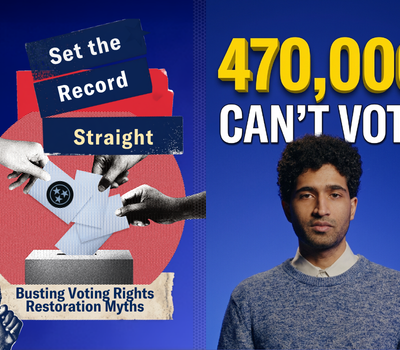
Thumbnail for the Set the Record Straight Series. Cover Reads: 470,000 Can't Vote

More from the Press


Placeholder image

Stay informed on civil rights issues. Discover our latest actions and updates in the Press Release section.

The Biden Administration’s Religious Freedom To-Do List: Recommitting to Religious Liberty for All.

Over the last four years, the Trump administration has embraced a distorted view of religious freedom that is rooted in bigotry against minority faiths and atheists and promotes an official preference for Christianity. They’ve targeted Muslims for no reason other than rank prejudice and favored certain types of Christians in law and policy, with no regard for the harms those actions have inflicted on everyone else. President-elect Biden and his administration must make restoring religious liberty for all and protecting the separation of church and state among their top priorities.   Here are just a few of the many actions that should be at the top of the Biden administration’s religious-freedom to-do list: Rescind the Muslim ban and affirm that Muslims are a valued part of America’s pluralistic religious tapestry Within days of taking office, President Trump signed an executive order banning foreign nationals from seven predominantly Muslim countries from visiting the United States and prohibiting refugees from entering the country. The order followed through on Trump’s bigoted promise as a candidate to enact “a total and complete shutdown of Muslims entering the United States.” Although the ban’s terms and criteria shifted slightly over time as the administration tried to defend it in court, the Supreme Court upheld the ban and that shameful policy remains in place today. President-elect Biden must fulfill his campaign promise to rescind the Muslim ban. He must also a license to discriminate, no matter the harm to others. In October 2017, the Department of Justice issued religious-liberty guidance for all executive agencies, declaring that federal law “might require an exemption or accommodation for religious organizations from antidiscrimination law … even where Congress has not expressly exempted religious organizations.” In fact, the ultimate federal law — the U.S. Constitution — has long been understood and interpreted to prohibit religious exemptions that impose harm on others, in part because these exemptions violate the separation of church and state by elevating some faith beliefs over the rights of others. But that hasn’t derailed the Trump administration’s effort to gut health care protections by enacting rules that allow any health care worker to refuse care to patients based on the worker’s personal religious or moral objections, or permit any employers to deny their employees contraception coverage. Nor has it stopped the administration from giving special privileges to certain religious groups by, for example, proposing or implementing rules that allow federal contractors with the Department of Labor to discriminate against LGBTQ employees and others, or that make it easier for federally funded social services providers to turn away religious minorities and LGBTQ people, all based on the contractors’ and providers’ religious beliefs. The Trump administration has even gone so far as to argue in the Supreme Court that religious groups contracting with the government to provide foster care services for children should be able to discriminate against prospective LGBTQ foster parents—potentially opening the door to all manner of discrimination by those performing core government services with taxpayer dollars. And it has argued that the First Amendment protects the ability of businesses to turn away same-sex couples based on the business owners’ religious beliefs. In other words, the Trump administration has advocated for a far-reaching constitutional right to discriminate. The Biden administration must take every action necessary to reverse these positions, which misinterpret religious liberty to enable discrimination and undermine our basic rights to be treated equally. It must immediately rescind the DOJ’s 2017 religious freedom guidance and withdraw all proposed and non-final regulations permitting discrimination based on religious beliefs against LGBTQ people and people seeking reproductive care. Recommit to the separation of religion and government President Trump and his administration have demonstrated a sweeping, dangerous contempt for the separation of church and state. The right to believe what we want and to exercise our faith, so long as we’re not harming others, is unquestionably a fundamental component of religious freedom. But the First Amendment also guarantees, through the Establishment Clause, an equally vital aspect of religious liberty: the right to be free from governmental imposition and promotion of religion. Our government represents us all and should remain neutral on matters of faith. Instead, President Trump continually singled out and discriminated against Muslims and privileged Christian beliefs over the rights of others. He encouraged public schools to teach biblical doctrine. His Secretary of State, Mike Pompeo, used government resources to deliver a sermon, called “How to be a Christian Leader,” to a religious organization. And Attorney General William Barr has repeatedly

By aclutn

Placeholder image

The Biden Administration Must Prioritize Reversing Trump’s Damage to Racial Justice Policy

In the last four years, the Trump administration has aggressively dismantled federal protections that ensure equal treatment against racial discrimination, amplified racist rhetoric, and explicitly targeted communities of color with harmful executive actions. The Biden-Harris administration must both reinstate federal rules that protect against racial discrimination, and take meanginful steps to further advance racial justice in the U.S. Here are just a few of the many items that should top the Biden Administration’s to-do list:  Support H.R. 40 The Biden-Harris administration must support H.R. 40, a bill that would set up a long overdue commission to examine the institution of slavery, its legacy, and make recommendations for reparations to Congress.  During slavery, Black people were forced to labor for the enrichment of America. After slavery, the emancipated suffered violent repression and exploitation under Jim Crow laws and Black codes in the South and de facto segregation across the nation. Since then, the vile policies of enslavement, codified in American culture and the Constitution, shifted to take on new forms of injustice and drivers of oppression that are still woven across our institutions today — from education and healthcare to our criminal legal system. The U.S. government has continued to perpetuate and often profit from racially-exclusionary policies and practices that  disadvantage Black people in all aspects of society. This is evident in modern day voter suppression, policies that deny Black people fair housing opportunities, redlining practices that perpetuate segregation, legislation such as the Homestead Act, which actively denied economic justice opportunities to Black people, and mass incarceration.  H.R. 40 is a critical first step toward addressing the fundamental injustice, cruelty, brutality, and inhumanity of the institution of slavery in the United States and its legacy. Reparations for slavery are necessary if we are to advance racial justice in this country.  The Biden administration must support H.R. 40. End attacks on racial and gender equity trainings The Biden-Harris administration must rescind President Trump’s

By aclutn

Placeholder image

The First Amendment Fight Against the WeChat Ban

Imagine waking up one day, unlocking your phone, and realizing that you could no longer send or receive messages through your favorite app. Or make or receive calls. Or scroll through your social media feed. Imagine that all of these functions were rolled into one essential app that you and your friends, family, and co-workers depended on, and that the U.S. government had decided to ban it. That’s exactly what the Trump administration is attempting to do with WeChat, a communications app that millions of people in the United States depend on to connect with friends, family, and business contacts across the world.    On Friday, we and the ACLU of Northern California asked the Ninth Circuit Court of Appeals to block the Trump administration’s autocratic effort to ban WeChat. Our friend-of-the-court brief, filed in support of a group of WeChat users who have challenged the ban, explains why the administration’s actions violate the First Amendment. The First Amendment protects our freedom of speech. It applies here because WeChat users depend on the app for a wide variety of speech and expression. Nineteen million Americans, primarily Chinese Americans, rely on WeChat daily to call and message with friends, family, and colleagues. The app is no ordinary communications tool: It’s also a platform for social media, news, money transfers, and e-commerce. It hosts an enormous community — more than one billion users worldwide — that simply can’t be replicated. For many of WeChat’s users, the app is their primary or only source of communication with friends and family in China, where the government blocks popular messaging platforms like Facebook, WhatsApp, and Instagram. In August 2020, the Trump administration issued an executive order declaring WeChat a threat to national security. As we

By aclutn

Placeholder image

Bold and Visionary: A Criminal Justice To-Do List for the New Administration

Millions of people took to the streets this year demanding racial justice and an end to racism in policing and the criminal legal system more broadly. On Election Day, voters provided their own stamp of approval by passing ballot measures in red and blue states alike to reform drug policy and other laws that have led to our mass incarceration crisis. Prosecutors and sheriffs committed to tackling mass incarceration won elections from Florida and Michigan to Texas and California. In fact, it is fair to say that a future Biden-Harris administration has a mandate to fight against mass incarceration. An Associated Press poll from June found that 94 percent of Americans believe that the criminal justice system needs to change — including a large majority of Republicans — and 69 percent of Americans support major changes or a complete overhaul of the system.   President-elect Biden and Vice President-elect Harris have already indicated that they will make racial justice a priority in their administration, including by reforming the criminal legal system. This is welcomed. The ACLU believes that now is the moment for bold action to tackle this crisis. The U.S. leads the world in incarceration and in police violence. Now is the time for visionary steps to end mass incarceration.  Here is our top to-do list for the first 100 days: End the War on Drugs A Biden-Harris administration should issue an executive order declaring an end to the war on drugs, directing federal prosecutors to no longer pursue drug cases, commuting the sentences of people serving time for drug-related cases, and pardoning people with past criminal convictions for drug-related offenses. Moreover, the administration should support reform bills like the MORE Act, which would remove marijuana from the list of scheduled substances, expunge many past convictions and arrests, and support racial justice efforts. Grant Mass Clemency   The Executive has complete authority to grant clemency or demand the initiation of a mass clemency process, either of which President-elect Joe Biden could do in his first 100 days in office. Doing so would show he is serious about ending this country’s mass incarceration crisis and addressing the harms caused — disproportionately against Black and Brown people — by the 1994 crime bill and other failed “tough on crime” policies. There are tens of thousands of people who could be released within the first 100 days, by granting categorical clemency to the following groups:  1. People who would serve a lesser sentence than they are currently serving if convicted under current laws; 2. People convicted of drug offenses; 3. People incarcerated for technical probation or parole violations; and 4. Older incarcerated people. And for everyone who is granted clemency, it is incumbent on leaders across the federal government and in local communities to thoughtfully and holistically support people leaving prison.  Embrace Use of Force Standard An important first step in reining in police use of force is to set clear national standards, requiring all police departments to adhere to common-sense limitations and best practices based on principles of necessity, proportionality, and de-escalation. Notably, research has found that when police departments adopt such policies, they not only kill fewer people, but also suffer fewer officer deaths in the line of duty. President-elect Biden has already identified the creation of a national, model use-of-force standard as one of his racial equity priorities. It’s important that this use-of-force standard truly conforms to the best practices in the field by embracing the principles set forth in the PEACE Act, which permit officers to use force only when necessary, proportional, and less extreme alternatives are exhausted. Dramatically Reduce Pretrial Detention The federal system, which rarely uses cash bail, should be a model for states and localities. But the federal pretrial detention rate is an appalling 75 percent. The Biden-Harris DOJ must seek detention for only the most extreme cases and aim for a pretrial detention rate no higher than 5 percent, instruct prosecutors to make charging decisions that avoid presumptions of detention, and invest in supportive services — such as transportation and child care assistance to make it easier for people to attend their court dates — instead of bias-enforcing risk assessment tools that do not address the underlying problems. The administration should also support legislation to eliminate presumptions of detention, which violate the basic tenant that people are innocent until proven guilty. In encouraging local reform, the administration should align with these same principles and focus on funding evidence-based support rather than discriminatory algorithms or onerous conditions. End Private Prisons   Criminal justice policy should be driven by public safety needs, not by the greed of private corporations. But more than 100,000 people in the United States are incarcerated in private prisons, where profit-seeking takes priority over safety, security, and rehabilitation. In 2016, the Obama administration announced that it would end the use of private prisons by the federal Bureau of Prisons, but that order was reversed in the early days of the Trump administration.  The Biden administration should end the use of private prisons by the Bureau of Prisons, the U.S. Marshals Service, and all other federal agencies.    End the Federal Death Penalty The federal death penalty is plagued by racial bias, geographic arbitrariness, and unfairness — just like the death penalty in the states. The Biden-Harris administration must honor its pledge to work toward federal legislation to end the federal death penalty. The Trump administration recklessly carried out an unprecedented number of federal executions, all during the pandemic, leading to spikes in COVID-19 cases and subjecting staff, witnesses, loved ones of the victims, and people incarcerated in federal prisons alike to escalated risk of the disease. The Biden-Harris administration should immediately suspend all federal executions while it works to end the federal death penalty once and for all.   End Solitary Confinement   The United States is the world’s leader in solitary confinement, with tens of thousands of men, women, and children locked in isolation on any given day. Although international human rights standards require that solitary confinement be used only as a last resort and for no more than 15 days, it’s common for people in U.S. prisons to be isolated for months, years, and even decades. The Obama administration enacted limited reforms at the federal level, but much more needs to be done. The Biden administration should ban solitary confinement lasting longer than 15 days for people in federal custody, and create incentives for states and localities to do the same.  

By aclutn

Placeholder image

We’ve Had Enough Death in 2020. Why Add More?

I was in the middle of reciting Ya Seen, the 36th chapter of the Quran, when the executioner signaled to me that was enough. It was time to kill Orlando Hall. Across a strip of tape dividing us, Orlando received a shot of lethal injection before I could finish the verse’s final, essential line. “So glory be to Him in whose hand is the dominion of everything, and to Him you will be returned.” Orlando lost consciousness while reciting the Shahada, as I, his spiritual advisor, had instructed him. The execution of Orlando Hall on Nov. 19 was the first I had ever witnessed. As a business professor at Indiana University, I never thought I’d ever be in that position, nor did I expect to become a spiritual advisor to a man on death row. What struck me in the execution chamber was how surreal it felt. It almost looked like a hospital. Orlando lay on the gurney as if awaiting surgery, with tubes attached to his arm like an IV. A blanket lay over him, concealing the straps that held him down. The facade seemed deliberate. But unlike doctors in an operating room, the executioners — standing just four feet away from me — wore no masks. The Bureau of Prisons had posted signs throughout the facility advising COVID-19 safety measures such as wearing masks, washing hands, and keeping six feet apart. They had also suspended visitation since March in an effort to curb the spread of the virus. But executions, despite being potential super-spreader events, continue.

By aclutn

Placeholder image

The Biden Administration’s Women’s Rights To-Do List

Over the past four years, the Trump administration has gone out of its way to launch attacks on women — including in housing, the workplace, and schools. When President-elect Biden and Vice President-elect Harris take office, their administration and Congress must make it a top priority to not just undo the damage, but to push forward an agenda that will ensure everyone has the freedom to live, work, learn, and serve free from discrimination based on sex. Here are just a few of the many items that should top the Biden administration’s to-do list:  Assure safe and stable housing for women and families. The COVID-19 pandemic has put as many as 40 million people in this country at risk of eviction. This is both a racial justice and gender justice issue: Black women face eviction at

By aclutn

Placeholder image

The Trump Administration Thinks COVID-19 Is No Longer a Risk to Abortion Patients

The Trump administration’s quest to force abortion patients to needlessly risk COVID-19 exposure as a condition of obtaining care has entered its sixth month, and is as violently out of touch with reality as ever.   Following an October order from the Supreme Court, the U.S. District Court for the District of Maryland is considering new evidence in our lawsuit challenging a Food and Drug Administration (FDA) policy requiring patients who need a medication used for early abortion care to travel in person to a clinical setting for the sole purpose of picking up a pill and signing a form. That policy has been blocked under a court order we won in July — but Trump’s Department of Health and Human Services (HHS) has continued to fight us every step of the way.   Their latest argument: COVID-19 is no longer a serious risk, so the federal government should be free to force us to risk exposure as a condition of obtaining essential reproductive health care.   This could not be farther from the truth. On Oct. 30, the day the Trump administration filed their latest brief in the district court, nearly 100,000 people in the United States were diagnosed with COVID-19 — then a new global record — and nearly 1,000 people died from it. The United States broke its own record days later, and then again and again; yesterday, a staggering 196,000 new cases and 2,760 new deaths were reported in a single day. The nation’s top infectious disease experts warn that the country “could not possibly be positioned more poorly” for this winter and that we are entering the “most concerning and most deadly phase of this pandemic.”   Despite the Trump administration’s own experts at the CDC acknowledging that being Black or Hispanic is associated with dramatically higher risks of hospitalization and death from COVID-19, Trump’s lawyers argue that it is no big deal to force medication abortion patients — a President-elect Joe Biden takes office in January, he should not only direct the FDA to agree not to enforce the in-person requirement during the public health emergency (precluding the need for further litigation), but also instruct the FDA to undertake a comprehensive review of the full set of restrictions on mifepristone. This will ensure that beyond the pandemic, patients’ access to this safe, effective medication is based on the latest science and medical evidence. Medication abortion — like all abortion services — is essential health care, and we hope to never again see FDA restrictions weaponized for a political, anti-abortion agenda.

By aclutn

Placeholder image

Separated Families, Death, and Despair — All at the Hands of CBP. We Need Action, Now.

Customs and Border Protection (CBP) is at the heart of some of the greatest moral horrors of the last four years, personified in stories that we cannot forget: the children breathlessly crying for their parents after being separated at the border; the children sleeping in the dirt in open air cages and people trapped in cells so overcrowded that they pressed their palms against the windows in a desperate plea for help; and the little girl with her arm around her father’s neck, desperately holding on as they both drowned while attempting to cross the Rio Grande river. As President-elect Biden enters office, he faces a stark imperative: These abuses must never happen again. It will take bold action in a climate where border fear-mongering has too often excused cruelty and met abuse with impunity.  As President-elect Biden contemplates how to resource the Department of Homeland Security’s handling of the pandemic, it should focus on significantly cutting the budget of CBP. It is the largest federal law enforcement agency in the country and the largest law enforcement air force in the world, with a budget of more than $17.1 billion for both the Border Patrol and operations at ports of entry.Despite its already enormous size, in 2019 DHS claimed that 40 percent of CBP’s resources were being absorbed by an “unprecedented surge” in the number of families fleeing Central American countries, leaving the agency “[unable] to manage its other border security missions.” Simultaneously, it was illegally siphoning funds from other parts of the government to build Trump’s border wall. As the Trump administration’s fiscal ineptitude and cruelty has demonstrated, funding is not the issue when it comes to CBP. CBP simply must not have responsibilities that it’s proven incapable of handling.  CBP should have no role in detaining people beyond a brief period for processing — including asylum seeking parents and kids. In the past two years, at least seven children died in CBP custody or shortly after being released, many after receiving delayed medical care or being denied care altogether. At Border Patrol stations, kids have gone “days, sometimes weeks, in facilities without enough food or toothbrushes.” In Texas, Border Patrol agents reportedly “took away the children’s blankets and mats,” forcing them to sleep on the cement floor as “punishment.”  It’s not exclusively kids. Border Patrol stations don’t have bedding, showers, or staff trained to interact with or assist traumatized people. The ACLU and its partners have documented freezing temperatures and filthy cells where people are held virtually incommunicado for days. Border Patrol agents subject pregnant people to physical mistreatment, verbal abuse, and severe delays in medical care (if it is provided at all). In February 2020, a woman in Border Patrol custody was forced to give birth to her baby while standing up, holding on to the side of a trash can in a Border Patrol station near San Diego. Yet in 2019, CBP unlawfully spent emergency funds Congress allocated for the care of adults and children on dirt bikes and dog food — instead of medical care, food, and sanitary conditions. As the Biden transition team contemplates a new model for receiving asylum seekers, it should develop alternatives to detaining them. The incoming administration cannot forget what this recent history shows: CBP simply cannot be trusted with detention.    CBP should also be removed from the asylum process, where life or death is often at stake. CBP personnel confiscate crucial (often irreplaceable) personal documents from people seeking asylum and have lied on government forms. Implementing the Trump administration’s disastrous forced Return to Mexico policy, Border Patrol agents sent asylum seekers back to Mexico with fake future court dates, even writing “Facebook” in place of peoples’ actual addresses. The Trump administration replaced trained asylum officers with CBP agents to conduct credible fear interviews — a crucial step in the asylum process. That’s akin to having an arresting police officer also sit as the judge.   CBP should also never make decisions about how and when to separate families arriving at our border. Families belong together, and that presumption should never be challenged by a law enforcement agency that is notorious for human rights abuses.   We also need reforms that address CBP’s culture of impunity for abuse — including the death of people at the hands of CBP. Since January 2010, at least 117 people — including some U.S. citizens — have died following encounters with CBP. On May 23, 2018, 20-year-old Claudia Patricia Gómez González was shot in the head by a Border Patrol agent shortly after she crossed into the United States. CBP only admitted the facts of this killing after the release of a bystander video. Agents almost never face consequences for their actions and some deaths go unreported altogether. We need stronger standards to limit CBP’s use of deadly force. CBP officers should be required to keep their badges visible at all times and wear body cameras (with appropriate privacy protections in place). We need a complaint mechanism that’s accessible online, and a uniform process for review and investigation of abuses.  President-elect Biden has pledged to ensure that CBP personnel are held accountable for inhumane treatment. Accountability will require more than the appointment of new leadership. It will require a reckoning with and recalculation of CBP’s role. 

By aclutn

Placeholder image

The U.S. Government Is Secretly Using Cell Phone Location Data to Track Us. We’re Suing.

The federal government is secretly purchasing and using our cell phone location information to locate and track people in the United States, including for immigration enforcement. We’re suing to bring some much-needed transparency to these disturbing practices.   The GPS chips in modern smartphones provide us with many conveniences, allowing apps on our phones to quickly map our location, provide weather updates, and more. But many of those apps don’t keep our location information to themselves. Without users realizing it, apps regularly sell users’ location information to other companies who use it for marketing and other purposes.   In February, The Wall Street Journal reported that this sensitive location data isn’t just for sale to commercial entities, but is also being purchased by U.S. government agencies, including by U.S. Immigrations and Customs Enforcement to locate and arrest immigrants. The Journal identified one company, Venntel, that was selling access to a massive database to the U.S. Department of Homeland Security, U.S. Customs and Border Protection, and ICE. Subsequent reporting has identified other companies selling access to similar databases to DHS and other agencies, including the U.S. military.   These practices raise serious concerns that federal immigration authorities are evading Fourth Amendment protections for cell phone location information by paying for access instead of obtaining a warrant. There’s even more reason for alarm when those agencies evade requests for information — including from U.S. senators — about such practices. That’s why today we asked a federal court to intervene and order DHS, CBP, and ICE to release information about their purchase and use of precise cell phone location information. Transparency is the first step to accountability. We’re asking the agencies to turn over all records related to their purchase and use of cell phone location data, including contracts, policies and procedures for use, communications with companies, legal analyses, and more.   Among the questions we seek answers to is how the government can justify obtaining sensitive cell phone location data without getting a search warrant. In Carpenter v. United States, a case argued by the ACLU, the Supreme Court ruled that law enforcement agencies cannot request personal location information from a cellphone company without first obtaining a search warrant from a judge. As Chief Justice Roberts wrote, these records deserve protection because mapping a cellphone’s location “provides an intimate window into a person’s life, revealing not only his particular movements, but through them his ‘familial, political, professional, religious, and sexual associations.’”   If law enforcement agencies can buy their way around the Fourth Amendment’s warrant requirement, the landmark protection announced by the Supreme Court in Carpenter will be in peril. Despite federal agencies spending hundreds of thousands of dollars on access to cell phone location databases, those agencies have not publicly explained their legal justifications or internal limitations on access to this invasive information. More than nine months after we submitted a request for information under the Freedom of Information Act, DHS, CBP, and ICE have yet to provide us with a single responsive record. DHS has even refused to provide its legal memorandum about these practices to U.S. senators who have requested it.   The public deserves to know how the agencies are accessing bulk databases of Americans’ location data and why. Today’s lawsuit aims to find out.

By aclutn

Placeholder image