A smiling woman in an ACLU baseball cap and sunglasses sits at the top of a yellow and blue inflatable slide, holding up an “I ❤ Democracy” ACLU bumper sticker.

When Will Tennessee Certify the 2026 Midterm Election Results?

After High Turnout, ACLU-TN Thanks Tennessee Voters, Poll Workers, and Partners, Looks Ahead to an Orderly Certification

By Cathryn Stout, PhD.

Latest Publication


Citizenship Rights Restoration in Tennessee

Restoring your voting rights in Tennessee got easier in 2026. State Sen. Raumesh Akbari and State Rep. Karen Camper led the charge in the legislature to remove some of the biggest barriers standing between formerly incarcerated Tennesseans and the ballot box.

The Campaign Legal Center and Free Hearts, a Tennessee nonprofit led by formerly incarcerated women, have been on the ground helping people navigate this process and pushing for a fairer system. For eligibility requirements and step-by-step petition instructions, read the guide from Free Hearts and the Campaign Legal Center.

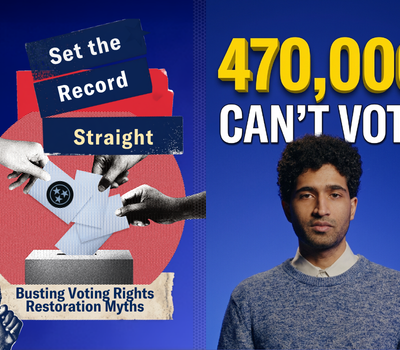
Thumbnail for the Set the Record Straight Series. Cover Reads: 470,000 Can't Vote

More from the Press


Placeholder image

Stay informed on civil rights issues. Discover our latest actions and updates in the Press Release section.

Race-Conscious Policies—Including Affirmative Action—Are Necessary For Addressing Racial Inequity

Affirmative action recently survived yet another legal attack: Last month, the First Circuit Court of Appeals ruled in Harvard’s favor in a long-running case challenging affirmative action. The court rightly upheld a lower court finding that Harvard’s use of race as a factor in its admissions process is constitutional. The decision is a welcome affirmation that using race-conscious decision-making is both lawful and necessary in higher education. Consideration of all aspects of a student’s background for admission—including race—is not only constitutional; it’s critical to becoming a more equitable society. That’s why the ACLU filed a friend of the court brief (also known as an amicus brief) supporting Harvard’s ability to consider race when deciding which of its 35,000 applicants will fill the 1,600 seats in its incoming class each year. But the fight for affirmative action and other race-conscious policies—policies that explicitly address systemic racial barriers—is not over. The Harvard affirmative action case is the latest legal challenge engineered by conservative legal strategist Edward Blum, who has been suing to bring an end to race-conscious policies, including affirmative action, for more than 25 years. Opponents of race-conscious decision-making, like Blum, misleadingly characterize such policies as discriminatory simply because they acknowledge the reality of race. But in fact, race-conscious policies aim to address racial discrimination by recognizing and responding to the structural barriers that have long denied full social, political and economic participation to people of color in the U.S. Blum opposes race-conscious policies in part because he believes that these barriers no longer exist. “In 1964 and 1965,” Blum has stated, “America was held hostage by the legacies of slavery and the chokehold of Jim Crow. Fast forward to [today] … the chokehold has gone away.” This view is misguided at best. Affirmative action opponents often favor so-called race-neutral admissions policies, which do not explicitly consider race. But in the face of persistent structural inequality, such policies are anything but “neutral.” Research shows that schools that rely on race-neutral policies are less diverse and less accessible to historically underrepresented students of color. Campuses that have implemented race-neutral admissions policies in recent years have seen dramatic declines in enrollment numbers among underrepresented groups. For example, in the first year UC Berkeley eliminated race as a factor in its admissions, the admissions rate for Black students dropped from 50 percent to 20 percent and from 45 percent to 21 percent for Latinx students. For its part, although the Supreme Court has consistently ruled it is legal to use race as a factor in a holistic application process, it has long viewed race-conscious policies with suspicion. Since its 1978 decision in Regents of the University of California v. Bakke, the court has failed to meaningfully distinguish race-based policies, which seek to dismantle racial hierarchy, from those that aim to perpetuate it. While the court continues to permit affirmative action policies in higher education, it has done so with increasing hesitance and an ever-growing preference for race-neutral alternatives. And importantly, the court is not the only place where skepticism of race-conscious policies exists: Voters in California recently rejected a ballot measure that would have restored the state’s affirmative action policy, suggesting broad public unease with race-conscious decision-making. But the view of race consciousness as racial discrimination is deeply flawed. As the late Justice John Paul Stevens once asserted: “There is no moral or constitutional equivalence between a policy that is designed to perpetuate a caste system and one that seeks to eradicate racial subordination.” This latest case against Harvard demonstrates that color-blindness cannot uproot this country’s legacy of racism. We must face race head-on to meaningfully address the racial inequality that persists in our society. Note: This story originally appeared on MsMagazine.com.

By aclutn

Placeholder image

The Biden Administration Can Make Us All Safer: End ICE Collaboration Programs

Last year I met with a woman while she was jailed in an immigration detention site near Miami, Florida. She told me about her 5-month-old baby, whom she hadn’t seen in three months. She said that her husband, a U.S. citizen, had been driving her to Walmart when local police questioned them during a random traffic stop. She was not accused of a crime, and she was in the process of petitioning for residency based on her marriage to a citizen. Despite this, police took her to a local jail and detained her for Immigration and Customs Enforcement (ICE) — even though it was unlawful to do so.  When local police act as ICE’s force multipliers, an ordinary police encounter like the one above can ruin a person’s life and tear a family apart. That is why millions of people across the country live in fear of encountering police or other law enforcement as they go about their daily lives. Immigrants, their family members, and their friends are all less likely to come forward as witnesses, provide crime tips, or seek police protection for fear of immigration enforcement. That means everyone is less safe. The Biden administration must dismantle the federal programs that are to blame. By doing so, the Biden administration will signal to cities and counties across the country that they are right to redirect local resources to pressing needs — like the pandemic — and away from local police taking on federal immigrant enforcement.  One such federal program utilizes 287(g) agreements, which delegate federal immigration enforcement authority to state and local police. Being in the routine business of immigration enforcement incentivizes local police to make pretextual arrests — with the actual goal of identifying immigrants to detain for ICE. It emboldens racist and xenophobic law enforcement officers across the country to use immigration enforcement as a means of threatening and harassing people in immigrant communities. These abuses are one reason why communities — including in Georgia and South Carolina — have elected sheriffs who pledged to end their localities’ 287(g) agreements. The Trump administration drastically increased the number of

By aclutn

Placeholder image

The Questions You Probably THINK You Know the Answer to — But Likely Don’t — About ICE Detention

Immigrations and Customs Enforcement (ICE — pronounced “ice,” like a cube) detention is civil detention. It is not intended to be punishment for a criminal conviction, though conditions are often as bad or worse than those you’d find in prison. It may be shocking to learn that the U.S. government detains tens of thousands of people each day in immigrant detention.   ICE detention exists to ensure people who are currently going through immigration proceedings in the U.S. attend their court dates. An immigration judge can also determine a person’s release presents a “danger to the community” (a subjective determination that isn’t necessarily accurate or fair). ICE detention also serves to effectuate deportation orders for people who are out of legal options to stay in this country. Generally, people in ICE detention are in limbo, waiting to learn whether they can legally remain in the country, or whether they will be deported. Why should we be concerned about immigration det

By aclutn

Placeholder image

Can Liberals Win in a Conservative Court?

This piece originally ran in The New York Review of Books. President Trump is on his way out the door, even if he goes kicking and screaming. The Biden-Harris administration will have its hands full picking up the pieces. Trump has left the federal government a kind of environmental disaster area, desperately in need of a massive cleanup. No president in US history has done more to degrade the presidency, constitutional norms, or American politics. The good news is that Trump did most of his damage unilaterally, through executive action, and therefore Biden can unilaterally reverse those actions.  On one matter, however, changing course will be far more challenging. With the support of Senate Majority Leader Mitch McConnell and the Federalist Society, Trump has appointed more than three hundred new federal judges. He has named fully 30 percent of federal court of appeals judges, and three Supreme Court justices: Neil Gorsuch, Brett Kavanaugh, and Amy Coney Barrett. They all serve for life. And unless Democrats win both runoff Senate races in Georgia, Biden will require the assent of a Republican-controlled Senate to appoint any new judges or justices. What does this landscape mean for the future of the federal courts, and the Supreme Court in particular?  To find a Supreme Court as conservative as today’s, you have to go back to the Progressive Era and the early days of the New Deal, when practically the only constitutional rights the Supreme Court recognized were the rights of big business owners to be free of regulation designed to protect consumers and workers. Today’s court has six Republican appointees and only three Democratic ones, and the Republican appointees all came with burnished conservative credentials. Trump’s last-minute appointment of Justice Barrett saw a civil rights hero, Ruth Bader Ginsburg, replaced by a deeply Catholic abortion opponent and acolyte of the late Justice Antonin Scalia. Justice Kavanaugh has thus far shown himself to be more conservative than Anthony Kennedy, whose seat he has assumed. And Justice Gorsuch, while less predictable, has many very conservative views, including a fundamental distrust of the administrative state.  So, what is a civil libertarian to do? When preelection opinion polls appeared to promise that Democrats could win not only the presidency but also the Senate, some talked of “court reform.” The reformers argued that the Republicans had effectively “packed” the Supreme Court through a series of technically legal but unprecedented maneuvers, from the refusal to give Merrick Garland a hearing almost a year out from one general election to the ramming through of Justice Barrett’s confirmation just days before another. But absent Democratic control of the Senate, court reform is illusory. And even if reform had been possible, it risks further politicizing the court, and that, in turn, would carry its own substantial costs. Constitutional rights and civil liberties, by definition, protect those who cannot protect themselves through the political process: members of minority groups, dissidents, the vulnerable and powerless. Their protection requires an institution that does not answer directly to the democratic polity. Indeed, that’s the best argument for life tenure, as a guarantee of independence. If the court becomes just another political arena, constitutional rights will cease to function as a check on majority power.  We are stuck, therefore, with the hand that has been dealt us. What then? When one considers how many important cases have been decided in the last couple decades by 5–4 votes, with Justice Ginsburg in the majority, it is easy to despair. The right to marriage equality, and recent decisions upholding the right to abortion, were decided by a single vote. Privacy rights to cell phone location data, Guantánamo detainees’ access to court, and juveniles’ right not to be executed similarly were all decided by a single vote. So, too, was the court’s recent protection of Deferred Action for Childhood Arrivals (DACA) recipients, and its invalidation of Trump’s attempt to skew the 2020 census by asking about citizenship. The Affordable Care Act survived its first and most significant challenge by a single vote as well. (As ACLU National Legal Director, I was counsel in the census and cellphone privacy cases, and filed an amicus brief in the DACA case.) If the liberal side in these cases had had to attract not just one conservative vote, but two, we might have lost them all. But there is reason not to give up hope. A conservative-dominated Supreme Court is actually nothing new. The bench has been comprised of a majority of conservative and Republican appointees ever since 1971. Yet, in that time span, the court has ruled that discrimination on the basis of sex violates equal protection, recognized the right to abortion, and rebuffed a concerted effort by the Reagan administration to overturn that right. It invalidated laws making same-sex sexual relations a crime and recognized marriage equality. It expanded the jury trial rights of criminal defendants and the First Amendment rights of anonymous pamphleteers, flag-burners, proponents of unpopular and even hateful views, and Internet users. It limited the application of the death penalty, upheld affirmative action, and ruled that ostensibly neutral housing practices that have a disparate effect on racial minorities violate federal law. And most recently, the court ruled that laws that prohibit discrimination “because of sex” also prohibit discrimination on the basis of transgender status or sexual orientation (I was counsel in this last case as well).  Last term alone, the court reached “liberal” results in virtually all of its most controversial cases — including abortion, LGBT rights, DACA, and Trump’s claim that he could not be required to turn over private financial records to a grand jury or congressional committees. Whatever else one might say, the court has not been the unremittingly conservative body that some predicted and many feared.    Why would a conservative court have reached all of these liberal decisions? One reason is that constitutional cases are decided by the application of precedent, so justices are not free to vote their party line, as are members of Congress. The law is not, of course, divorced from politics, but it is different from politics in this sense. Precedents do not dictate results, but they provide more direction and constraint than cynics are generally inclined to acknowledge. One reason the conservative court has reached liberal results is because that was actually the best reading of the law. Second, the court’s legitimacy rests on its remaining open to argument. If the court decided every controversial issue on partisan ideological lines, it would lose its ability to resolve disputes in a way that people by and large accept. Consider, for example, Trump’s current attack on the results of the presidential election. The federal courts are hearing — and rejecting — those claims, and are virtually certain to reject Trump’s effort to reverse the election’s outcome. Once that happens, at least some people will be more likely to accept the results of the election than if we did not have an institution removed from politics to decide the dispute. But the courts’ ability to play that part requires that they are perceived as open to both sides, and guided by law, not pure politics.  Third, the court’s standing with the public also depends on its not diverging too far from where the country is on matters of constitutional principle. Political scientists who have studied the court over time have found that, while it may not literally “follow the election returns,” its decisions generally reflect contemporary public values. A conservative-majority court reached all the liberal outcomes listed above in part because public opinion, over time, increasingly recognized the equality claims of women and LGBT persons, questioned the death penalty, supported affirmative action, and the like.   A caveat is important here. The forces outlined above tend to operate in those cases in which the court knows that it is being watched. But every year, the Supreme Court decides many significant cases that draw relatively little attention — and in those cases, the conservative justices tend to vote much more consistently along conservative lines. Thus, in important cases pitting employees’ or consumers’ rights against businesses, the court has rarely ruled against business. Because the results in these cases are often below the radar, the conservatives may feel less incentive to restrain their ideological biases. Republicans have long lamented the tendency of their appointees to move to the center once appointed to the court. This was arguably true of Justices Harry Blackmun, David Souter, John Paul Stevens, Sandra Day O’Connor, Anthony Kennedy, and appears to be true of John Roberts. But if I am right that the court’s reputation turns on its being perceived as fair — as deciding cases based on principle rather than political ideology, as open to argument, and as in tune with the nation’s evolving fundamental values — there will be incentives on any conservative-majority court for one or more justices on the right side of the court to move left, at least in some significant cases. On a liberal-majority court, by the same token, the incentive would be for one or more of the liberals to move right. (Because the Supreme Court has so rarely been dominated by liberals, we don’t have as much evidence for that transformation, but there are certainly examples of Democratic appointees who voted more conservatively than expected once appointed, including Felix Frankfurter and Byron White.) All of this suggests that it is too early for civil libertarians to give up on the Supreme Court. But it also underscores that the battle for civil liberties must be waged not only, or even mostly, before the court. The Supreme Court did not deliver us equal protection for women or marriage equality. The feminist and LGBT movements did that, through painstaking political and legal work in a variety of forums, including corporate boardrooms, university faculties, city councils, state courts and legislatures, governors’ and mayors’ offices, dinner-table conversations, Congress, and the executive branch. The court then recognized the advances that had been won outside its four walls.  There are some areas of legal dispute in which one simply has no choice but to sue in federal court, so one cannot give up on the judiciary even when it is dominated by conservatives. When a red state passes a law banning abortion, the very politics that made the state law possible are likely to infect the state’s courts — in particular, as most state court judges have to run for election. When the Department of Homeland Security targets immigrants for enforcement actions that deny due process, the only recourse is federal, and neither the president nor Congress have shown much sympathy for immigrants. Criminal defendants often lose through every phase of the state criminal process, only to prevail when, after completing the state appeals process, they are allowed to seek relief from a federal court through a claim of habeas corpus. One of the surest ways for a state judge to lose his seat is to vindicate a criminal defendant’s constitutional rights; federal courts, with their judges’ life tenure, have proved more receptive.  So the work of civil libertarians will continue apace, inside and outside the federal courts. We may increasingly turn to more sympathetic forums to make initial inroads, as advocates for marriage equality so effectively did. But in the end, if the country supports civil liberties and civil rights, the Supreme Court is unlikely to get in the way. This means all of us can and must do our part to defend liberty. As one of the United States’ greatest judges, Learned Hand, said:

By aclutn

Placeholder image

Bloody Masks and Fevers on Shift: Immigrant Workers Face Abuse in Nebraska Meatpacking Plant

Last spring, as people across the globe raced to shut themselves indoors and shelter away from the threat of COVID-19, meatpacking workers in America suddenly found themselves exposed, vulnerable, and directly at the front line of the disease’s spread. By early April, the coronavirus was tearing through plants in states like Iowa, South Dakota, Texas, and Nebraska, infecting tens of thousands of mostly immigrant workers who’d been drawn to remote towns and cities by the meatpacking industry and its jobs.   Nervous health officials urged some hotspot plants to temporarily shut down, warning that crowded and enclosed processing rooms were vectors for the disease and were facilitating its spread into nearby communities. Recognizing the threat that the outbreaks posed to their operations – and their bottom line – some producers began implementing rudimentary protections for their workers including paid sick leave, on-site testing, and increased spacing on production lines.   Others, however, did little to protect workers, even after the scale of the danger they faced was obvious and undeniable. Noah’s Ark Processors, a plant operating in Hastings, Nebraska, is a glaring example of the dangerous and abusive treatment that meatpacking workers have faced during the COVID-19 pandemic. This week the ACLU filed suit against Noah’s Ark, alleging that the company pressures workers to remain on shift even when they become symptomatic, isn’t replacing blood-stained masks during their long shifts, has done nothing to facilitate social distancing inside the plant, and is failing to provide onsite testing to identify emerging infection clusters.   “Noah’s Ark has refused to implement even the most basic protections against a coronavirus surge in the plant,” said Spencer Amdur, an attorney at the ACLU. “At this point in the pandemic, there is no excuse for failing to do even the bare minimum to protect workers and the surrounding community.”  Alma was one of the workers on the production line at Noah’s Ark and is a plaintiff in the ACLU’s lawsuit. After emigrating from Cuba in 2012, she was hired to work in the plant a few years ago. It was a tough job. Her hands and wrists often ached from grueling hours spent on the “kill floor” – an enclosed room where cow carcasses are butchered and prepared for cold storage – but it paid decently. She and her husband Antonio, also a Noah’s Ark employee, were raising four children, and the family needed the money. (Note: the ACLU is using pseudonyms for them due to their fear of retaliation by management.)   Like many meatpacking plants, the majority of the plant’s workforce were immigrants, and Isabel says that even before COVID-19 emerged she and Antonio were unsettled by the way management treated them. But things took a sharp turn for the worse when the pandemic began.   “People were scared, but [management] made it seem like it wasn’t a big deal,” she said. “The first thing they said was that nobody could miss work. They would say that [COVID-19] was just nonsense. Even when things got more serious, they didn’t care.”   Then, in late April, workers at the plant began to fall ill.

By aclutn

Placeholder image

New Court, New President: What’s Next for Civil Rights and Civil Liberties

As of now, we know the status of two of the three branches of the federal government. We have President-elect Joe Biden in the executive, and an even more conservative majority in the Supreme Court with the appointment of Justice Amy Coney Barrett. The future of Congress is still unknown as we await the results of two runoffs in Georgia that could hand control of the Senate to either party.  Even before the results of those Senate races are in, we know that the fate of civil rights and civil liberties hangs in the balance. Civil rights protections previously defended by a narrow majority in the Supreme Court could be in jeopardy. At the same time, the Biden administration will have the opportunity to roll back Trump-era assaults like the Muslim ban; it might also get a chance at its own appointments.  On At Liberty this week, we’re joined by our National Legal Director David Cole, who helps us to understand and forecast the impact of a Biden presidency and the most conservative Supreme Court in more than half a century.

By aclutn

Placeholder image

To Protect Black Trans Lives, Decriminalize Sex Work

Like pretty much everything in 2020, Trans Day of Remembrance is going to be different this year. It’s going virtual. But one thing that hasn’t changed is that transgender people are still being murdered for being who we are. The list of names keeps growing. This year is the deadliest ever, and it isn’t even over yet.  Thirty-four trans people have been killed since January. The real number is probably even higher. Trans people are often misgendered by law enforcement or don’t report attacks, so we don’t even know about most of the violence that happens to our sisters. Most of the deaths this year were of Black trans women. Many were sex workers. I am not surprised. As a trans woman of color and a former sex worker myself, I know what it’s like to be targeted for who you are, and to not have anyone to call for help because your job is illegal.

By aclutn

Placeholder image

Trump’s Last-Ditch Census Move Could Shape the Electoral Map for the Next Decade

Trump’s days as president are coming to an end, but his efforts to weaponize the census continue — and could impact our democracy for the next decade. We’re going to the Supreme Court on Nov. 30 to make sure that doesn’t happen.  If the census fight feels like a case of déjà vu, there’s a good reason. We already took the Trump administration to court to block its attempt to add a citizenship question to the 2020 census. The Supreme Court agreed with us and ruled that the citizenship question was illegal. Because of that victory, the census proceeded this year as it has for the last 70 years, free of the discriminatory citizenship question.  Still, the fight continues. In spite of squarely losing on the citizenship question, the Trump administration tried again in July to weaponize the census. This time, it issued a memo directing the secretary of commerce to exclude undocumented immigrants from the count that determines how many congressional seats each state gets. This would be an unconstitutional and radical break with the 230-year history of the census, and could reshape the Electoral College map for years to come.

By aclutn

Placeholder image

Remembrance, Resilience, and Response: Addressing An Epidemic of Violence Against Trans and Non-Binary People

Each year on Nov. 20, Trans Day of Remembrance (TDOR) gives us an opportunity to remember and honor the trans and non-binary people who have been killed at the hands of transphobic and transmisogynistic violence. In 2020, over 350 trans and non-binary people have been killed around the world, the large marjority of whom were trans women and trans feminine people. Within the United States, there have been at least 28 documented cases of trans and non-binary people who have been murdered this year, with Transrespect Versus Transphobia Worldwide (TvT) reporting that almost 80 percent were people of color. While TDOR largely focuses on those we have lost to murder, it is also important to recognize trans and non-binary people who have died because of medical neglect, lack of access to shelter, suicide, and other preventable causes. This increasing and alarming rate of death has been labeled a pandemic, and continues to impact trans and non-binary communities, especially Black trans and non-binary communities, in every corner of the United States.  In addition to high murder rates, trans and non-binary people also face widespread physical and sexual violence, especially from law enforcement. There is a long history of trans and non-binary people being targeted by the police and the criminal legal system as a whole. As maya finoh, a Black non-binary abolitionist and cultural worker, reminds us, “The [U.S. criminal legal system] was absolutely designed to warehouse us, to surveil us, to police us…specifically [those of] us who are Black…immigrants…queer, trans, et cetera.” Research conducted by the NYC Anti-Violence Project concluded that trans and non-binary people are seven times more likely to experience physical police violence as compared to cisgender people. Black trans and non-binary people continue to experience the highest rates of police brutality and incarceration in the LGBTQ community, and are even criminalized for defending themselves against anti-Black, transphobic, and transmisogynyistic attacks. 

By aclutn

Placeholder image