A smiling woman in an ACLU baseball cap and sunglasses sits at the top of a yellow and blue inflatable slide, holding up an “I ❤ Democracy” ACLU bumper sticker.

When Will Tennessee Certify the 2026 Midterm Election Results?

After High Turnout, ACLU-TN Thanks Tennessee Voters, Poll Workers, and Partners, Looks Ahead to an Orderly Certification

By Cathryn Stout, PhD.

Latest Publication


Citizenship Rights Restoration in Tennessee

Restoring your voting rights in Tennessee got easier in 2026. State Sen. Raumesh Akbari and State Rep. Karen Camper led the charge in the legislature to remove some of the biggest barriers standing between formerly incarcerated Tennesseans and the ballot box.

The Campaign Legal Center and Free Hearts, a Tennessee nonprofit led by formerly incarcerated women, have been on the ground helping people navigate this process and pushing for a fairer system. For eligibility requirements and step-by-step petition instructions, read the guide from Free Hearts and the Campaign Legal Center.

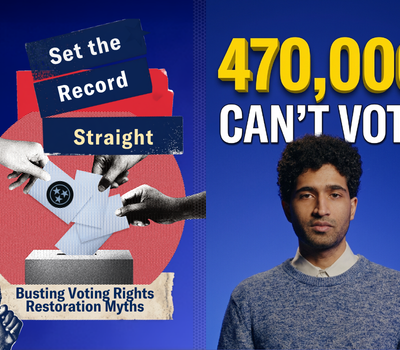
Thumbnail for the Set the Record Straight Series. Cover Reads: 470,000 Can't Vote

More from the Press


Placeholder image

Stay informed on civil rights issues. Discover our latest actions and updates in the Press Release section.

How COVID-19 is Setting Working Women Back

In early October, the United States Labor Department reported that women were leaving the workforce at four times the rate of men. A few months earlier, a report from McKinsey Global revealed that while women made up 43 percent of the workforce, they had borne 56 percent of COVID-related job losses. This data — and much more — led one news source to call this moment “America’s First Female Recession.” This week, Colleen Ammerman joined At Liberty to discuss why this is happening, and what we can do about it. Ammerman is the director of Harvard Business School’s Gender Initiative. She is also the co-author of an upcoming book Glass Half Broken: Shattering the Barriers That Still Hold Women Back at Work. While disparities in pay and access to power in the workplace are not new, Ammerman says the divides are now starker than ever because of COVID-19: “What we’re seeing the pandemic do is really just both reveal and entrench some of these inequalities, both along racial and gender lines.”

By aclutn

Placeholder image

President-Elect Biden’s Reproductive Freedom To-Do List

After four years of attacks on our reproductive rights and health by the Trump administration and the anti-abortion legislators it has emboldened around the country, there is much to repair. When President-elect Biden and Vice President-elect Harris take office, their administration must make it a top priority to not just undo the damage, but to take bold, visionary steps to make reproductive health care — including abortion — accessible to all, regardless of their income or ZIP code. Congress, too, has a key role to play in ensuring that everyone is afforded the dignity to make our own decisions about our lives. Here are just a few of the many items that should top our elected officials’ to-do list: Reverse dangerous Trump administration regulations targeting reproductive health care, including:

By aclutn

Placeholder image

Men Are Being Fired for Being Caregivers. Here’s Why that Hurts Women Too.

One of the simplest joys of expecting a baby is sharing the news with other people. That wasn’t the case for Steven van Soeren, a product designer for Disney’s streaming service, when his wife became pregnant. “You shouldn’t have a kid,” one Disney coworker told him, according to allegations in his complaint. “I don’t know why he decided to have a kid,” said another within earshot of van Soeren. Objections to van Soeren becoming a father weren’t limited to cruel remarks. Shortly after van Soeren returned from two weeks of paternity leave, he was fired. Van Soeren thought that was wrong — and illegal. He sued his former employer, but a federal court dismissed van Soeren’s case last month, reasoning that his firing wasn’t unlawful discrimination because van Soeren himself had not been pregnant. The late Supreme Court Justice Ruth Bader Ginsburg would have disagreed. She was well known for her legal strategy arguing cases on behalf of men to demonstrate how sex discrimination harms us all. Ginsburg wanted everyone to have equal opportunity to work and participate in family life according to their own needs and wants, regardless of their gender. She also knew that in order for women to enjoy full equity outside the home, society would have to empower men to share the responsibilities within it. That meant breaking free from traditional gender roles and discriminatory laws that dictated that caregiving was a woman’s job — and never a man’s. Ginsburg’s view of the law prevailed, in 1975 and beyond. In a 2003 decision authored by then-Chief Justice William Rehnquist (and joined by Ginsburg, by that point a member of the court herself), the Supreme Court noted that by denying men paternity leave or discouraging them from taking it, employers “created a self-fulfilling cycle of discrimination that forced women to continue to assume the role of primary family caregiver.” Congress, it held, was rightly empowered to address sex discrimination of this kind. Yet the van Soeren decision demonstrates that existing federal law is insufficient. Local laws have filled the gap — New York City, for example, added express protections against discrimination for caregivers, regardless of gender or one’s ability to become pregnant, in 2016. In June, Sen. Cory Booker introduced legislation that would protect all mothers, fathers, and other family caregivers from employment discrimination. That’s important because caregiving isn’t just about parenting. The New York City Commission on Human Rights, which enforces local laws against caregiving discrimination, regularly receives complaints from New Yorkers who say they’ve been penalized for caring for their spouses, parents, and other loved ones. One man reported losing his job after telling his supervisor that he needed to take a week off to care for his wife after an illness. He says his supervisor laughed at him for doing “the woman’s job” and then replaced him while he was out caring for his wife. Another New Yorker said she asked to work remotely from her mother’s home in another state while her mother went through cancer treatment. She was surprised when the request was denied; she worked for an international company, where teams were spread across multiple offices and collaborate remotely, and other employees had been allowed to work remotely for personal travel or a spouse’s sabbatical. And though she wasn’t able to care for her mother, she was punished simply for making the request, coming under increased scrutiny and, ultimately, laid off while others without caregiving responsibilities were allowed to keep their jobs. Fortunately, both workers were protected by New York City’s law. But without nationwide express protections from caregiver discrimination in all its forms, the van Soeren decision sends a terrible message — and one that could not land at a worse time. Women are at the center of the most unequal recession in modern American history. The back-to-school season — without physical school reopenings in many parts of the country — has worsened the situation: Of 1.1 million workers who dropped out of the workforce in September, 80 percent were women. This shouldn’t be surprising. Parents, overwhelmingly mothers, have had no alternative but to drop out of the labor market to manage their children’s education. This decision is likely the result of women’s entrenched income inequality, leading many different-sex couples to try to preserve the earning potential of the partner who makes more. In most cases, that’s the man. Other mothers have had the choice made for them, either because they work in jobs that can’t be done from home or because their employers penalized them for having children at home while they worked. Coupled with the already disproportionately high rates of unemployment for women since the start of the pandemic, it may take decades for women to recover. And these disparities are far worse for women working in low-wage positions, Black women, and other women of color. All of this explains why Ginsburg might well have decided to take on a case like van Soeren’s. As Ginsburg famously said, “Women will only have true equality when men share with them the responsibility of bringing up the next generation.” Now more than ever, lawmakers across the country must work to make Ginsburg’s vision a reality by ensuring caregiving discrimination protections for all — regardless of gender.

By aclutn

Placeholder image

A Change in Administration Is Just A Starting Point For LGBTQ Justice

This piece was originally published on Advocate.com.

By aclutn

Placeholder image

Securing Tenants’ Right to Counsel is Critical to Fighting Mass Evictions

On election night, voters in Boulder, Colorado delivered a critical win in the fight for housing justice. By a margin of 59-41 percent, voters passed No Eviction Without Representation (NEWR) — a critical measure that will ensure all Boulder tenants who are facing the terrifying, complex process that is an eviction proceeding will be provided with free legal representation. NEWR also establishes a rental assistance fund and an education process that will notify Boulder renters of their housing rights. Protections like those afforded by NEWR are always important, but they are particularly crucial in the midst of a devastating global pandemic. The economic consequences of the pandemic have cost millions of people across the country their jobs and the ability to pay the rent — leaving millions of renters with the added threat of eviction and losing their homes. The odds are stacked heavily against tenants who are taken to  eviction court. Less than 2 percent of renters in Boulder who are summoned to court are able to find or afford legal representation. This is not surprising considering many are facing eviction because of unforeseen circumstances or financial stress that prevents them from being able to afford their rent. Meanwhile, the vast majority of landlords are armed with legal representation and the protection of professional organizations that lobby on their behalf. Many renters don’t even get to the courthouse because of the severe financial burdens they already bear. With the passage of NEWR, Boulder becomes the seventh city in the country with a right to counsel program. Other cities that have adopted right to counsel measures in eviction proceedings — including New York City and San Francisco — have seen reductions in evictions. In securing a universal right to counsel in eviction proceedings, NEWR will ensure that renters have the tools and knowledge they need to safeguard their housing rights and help balance power between landlords and tenants. Where does the fight for housing justice in the form of right to counsel head now? On Tuesday, the Baltimore City Council will hold a hearing on a right to counsel bill. Passage of this legislation is critically important. Baltimore currently has one of the highest eviction rates in the United States. Approximately 70,000 eviction orders are issued in Baltimore every year, resulting in thousands of evictions. Unsurprisingly, 96 percent of landlords are represented by a lawyer in eviction cases in the city while the same is true for just 1 percent of renters. A recent report found that a right to counsel program like NEWR in Baltimore could cut evictions by 92 percent. Furthermore, the report estimates that every dollar Baltimore spends on providing free legal representation in eviction cases would result in more than $3 in savings on social safety net resources. Ending mass evictions is a key racial and gender justice priority. Due to decades of inequalities in our housing system, communities of color and low-income women feel the impacts of eviction the most — Black women in particular. The numbers say it all:

By aclutn

Placeholder image

The Affordable Care Act — and With It, Our Civil Rights — Are Under Attack

Ask a dozen civil rights lawyers to name the great civil rights laws of the last 100 years, and you’ll get a dozen answers. Some might name the Civil Rights Act of 1964, the landmark law which ended segregation in public places and barred discrimination on the basis of race, sex, color, religion, or national origin at work and in other public places. Others might point to the Fair Housing Act, which took aim at dismantling entrenched residential segregation and fighting housing discrimination. Still others might highlight the Americans with Disabilities Act, which paved the way for a more accessible world. What few people might include in the list, but should, is the Affordable Care Act of 2010, the law that made health insurance — and with it, health care itself — accessible to millions for the first time. It earns its place as a great civil rights law for several reasons: It bars certain forms of discrimination; it begins to address effects of longstanding discrimination; and by providing coverage for the health care all people need, it enables the freedoms other civil rights laws aim to protect. Simply put, it is not possible to fully participate in the economic, social, and civic life of our nation without stable health coverage.  But the Affordable Care Act is now imperiled. This week, the Supreme Court will hear arguments in California v. Texas — a case that puts this critical law in jeopardy of being struck down in its entirety. While most legal scholars think such a ruling unlikely, any decision striking the law would have devastating ramifications for the civil liberties advancements that the ACA has provided. And it would have particularly cruel and deadly consequences in the midst of a pandemic and recession. Dismantling the ACA now would exacerbate the longstanding, systemic disparities in access to health care, economic opportunities, and other resources faced by Black, Latinx, and disabled people in this country — disparities that are now approaching epic proportions in light of the pandemic.    The Affordable Care Act made huge advancements for many groups of people to whom stable health insurance and health care were often denied, whether because of express discrimination or the effects of discrimination.   Women: The ACA bars sex discrimination, full stop. This means, for example, that at long last insurers may no longer charge women higher rates. The ACA as implemented covers care long excluded from insurance coverage that was seen as exclusively women’s care: mammograms, screenings for cervical cancer, contraception coverage and counseling, lactation support, and prenatal care. These forms of discrimination had material consequences. Before passage of the Affordable Care Act, women were estimated to spend 68 percent more than men in out of pocket health care costs. The ACA takes aim at discrimination that perpetuates gender inequity, including the discrimination in health care that perpetuates gender disparities in wealth. LGBTQ people: The ACA’s bar on sex discrimination also means that LGBTQ people can’t be subject to discrimination in federally funded institutions, public health care programs, or by insurance companies. The ACA eliminates barriers that many LGBTQ people previously faced in receiving health care — a crucial step toward ensuring health care is accessible to all — regardless of gender identity or sexual orientation.   People of color: The ACA makes important strides to address racial injustice in health care as well. It bars discrimination based on preexisting conditions, a provision critical to ensuring that those who are sick — and thus most in need of health insurance — aren’t effectively barred from accessing it. While this provision is important to people of all races, it is also an essential part of beginning to redress the health disparities that reflect the legacy of race discrimination in the country. This is evident in  the higher rates of hypertension among Black people, for example, and the disproportionate rates of COVID-19 infections and deaths among Black and Latinx communities.  The data is striking: Because of the ACA, between 2013 and 2017, the coverage gap between Black and white Americans declined from 11 to 5.3 percentage points. Similarly, during the same period, the coverage gap between Hispanics and non-Hispanic whites dropped from 25.4 to 16.6 percentage points. Additionally, the ACA expanded Medicaid for people whose income is below 138 percent of the federal poverty level. In short, the ACA has helped make important strides in reducing racial, ethnic and economic disparities in in access to health care and coverage.  People with disabilities: The ACA has been a life saver for people with disabilities. It protects against coverage limitations based on preexisting conditions or lifetime limits, and guarantees coverage of services for mental illnesses and developmental disabilities. It provides access to long-term, home-based health care, which can mean the difference between institutionalization and independence for people with disabilities. And it expressly precludes discrimination in access to health care based on disability. People experiencing poverty: The ACA also expanded Medicaid for people up to 138 percent of the federal poverty level — although not every state availed itself of the option, despite its literal life-giving opportunities. Prior to the ACA’s passage, Medicaid eligibility for parents was limited to those with very low incomes (often below 50 percent of the poverty level), and adults without dependent children were ineligible under federal rules, regardless of their income level, according to a report from the Kaiser Family Foundation. The ACA is part of the path to equity — remedying systems of oppression and discrimination — that runs to the core of living or dying, particularly during the time of COVID-19. As we said in our 2012 brief, the ACA “advances the twin goals of liberty and equal protection.” The ACA is worth fighting for. Our civil liberties and civil rights are worth fighting for.

By aclutn

Placeholder image

Putting Rap Lyrics on Trial is a Violation of Free Speech

If song lyrics could be used as evidence in criminal trials, many of the most famous artists in history would be in serious trouble. Bob Marley sings “I Shot the Sheriff.” The Talking Heads’ biggest hit is “Psycho Killer.” The opening lines to Queen’s “Bohemian Rhapsody” are “Mama, just killed a man.” Fortunately for these artists, artistic expression is protected as free speech under the First Amendment.  However, some art forms are seen differently by many courts. Rap music, in trial after trial, has been treated as inherently incriminating. In Tennessee, an aspiring Knoxville rapper, Christopher Bassett, was convicted of the 2015 murder of Zaevion Dobson. At trial, the state showed the jury a rap video featuring Bassett as evidence against him, despite the fact that the videos were recorded months before the murder and make no mention of the victim. Prosecutors argued that Bassett’s sometimes violent and graphic imagery was a confession in song.  “Double O,” the song they claim indicated the defendant’s gang affiliation and appetite for violent retribution, includes lyrics like: “We all gon’ blow / Till we all ten toes / To the sky.” To understand lyrics like these, they must be put in context. Bassett’s music is “drill rap,” a genre characterized by themes of gun violence, maintenance of neighborhood boundaries, and the tragedy of lives lost or taken. Nobody familiar with drill rap would raise an eyebrow at Bassett’s lyrics — they reflect the genre and its frequent use of the trope of a protagonist engaged in criminal activity. The actions described in the lyrics may sound violent, but the lyrics themselves are protected by the First Amendment.  The Supreme Court has ruled that it is unconstitutional to use protected speech as evidence when that speech is irrelevant to the case. This precedent was established in the 2013 case Dawson v. Delaware, in which the state tried to introduce the defendant’s Aryan Brotherhood tattoo as evidence in a murder trial. But because both the defendant and the victim were white, the tattoo — artistic expression protected by the First Amendment — was irrelevant. Dawson set a heightened evidentiary standard when it comes to art forms and other protected speech, whether a tattoo or a song. “Double O” does not meet this standard. The state claims that Bassett’s lyrics prove gang affiliation, and they proposed a theory that the murder was gang-related. But it was never proven that either the victim or Bassett were actually in gangs. This accusation hasn’t been proven, and nor is it relevant. And Bassett was not charged with any gang-related offenses. The music video was entirely irrelevant to any issue before the court. Rap is not the only genre of music with lyrics about crimes. Country music in particular frequently features lyrics glorifying criminal behavior. We see it in Nashville “outlaw” musicians like Johnny Cash, who sang he “shot a man in Reno just to watch him die.” We see it in Appalachian “murder ballads,” like Dolly Parton’s “Banks of the Ohio,” which is about a jilted lover stabbing a victim in the heart. But country lyrics are understood to be fiction, not criminal evidence. In almost every case that used music lyrics as evidence, the defendant has been Black or Latinx. Bias against rap is merely thinly-veiled bias against Black and Latinx people.  Tennessee’s use of “Double O” lyrics as evidence at trial is not only an illegal violation of constitutional free speech and free association rights, but would discourage artistic expression in the future. This is why we filed an amicus brief last week in Bassett’s appeal, challenging the admission of the rap video as evidence and asserting his right to free speech. If this precedent is allowed to stand, no one who has ever spit a rhyme is safe.

By aclutn

Placeholder image

Democracy Persists

Today we turn a page from one of the darkest moments in civil liberties and civil rights. Over the last four years, we weathered an all-out attack on immigrants; withstood racist dog whistles as loud as bull-horns; and witnessed presidential back-slapping of white supremacists. For his anti-civil rights and civil liberties agenda, Donald Trump was democratically and ceremoniously removed from the Oval Office by his employer: the American people.  Our nation’s electoral systems have withstood record turnout, an avalanche of mail-in ballots in a pandemic, and the attacks of a president who would rather tear down democratic norms and institutions than admit he is a loser in a national election. It may have been slow — at times excruciating — but our democracy worked as it should have: Every vote will be counted. And the people will choose their leader — rather than leaders choosing the voters. Throughout our history as a nation, some presidents have tested this country’s dedication to democratic values more than others. Against Trump’s administration, we’ve filed over 400 legal actions and brought thousands of people to airports, courthouses, and mass mobilizations. Together, we won victories to stop LGBTQ employment discrimination, protected and expanded voting rights, blocked state-level abortion bans, and battled Trump’s Muslim ban in court three times. With his policies and rhetoric, this president tried to make us a nation of us versus them. He pitted citizens against immigrants. He encouraged white supremacists while Black people are being murdered by police. And he waged war against our free press. Yet in spite of that, our staff and supporters poured their hearts and souls into fighting to ensure that the promise of America withstands Trump’s assaults on our values — as we have repeatedly done throughout our history.  After 100 years, we know that the ACLU will fight to advance freedoms where we can and defend them where we must regardless of whomever resides in the White House. As we did with President Trump, we are determined to hold President-elect Biden and Vice President-elect Harris accountable to the promise of our Constitution. And thanks to our supporters and members, we now have the strongest ACLU our nation has ever known.  And while Trump’s relentless attacks on our civil liberties will soon be over, there is work to do to create a more perfect union. And we at ACLU are here to do it. Right now, we are looking for the families of 545 children who were separated at the border. We are representing LGBTQ rights and defending the census at the Supreme Court. There are more battles just around the corner to preserve the rights many have fought and won.  We will forge a pathway to citizenship for the 11 million undocumented and stateless people living in the United States — without caveats or compromise.  We will join the chorus calling for this nation’s long overdue racial reckoning.  “We the people” won’t rest until we live in an America where equality and justice are a lived reality for all of us. Now is not the moment to sit back. We are still fighting and we are more resolute than ever to ensure that in our United States of America, the Constitution’s promise to “we the people” means all of us. We will continue that fight, no matter who occupies the White House, and we will prevail.

By aclutn

Placeholder image

Criminal Justice Reform Takes Another Big, Messy Step Forward in 2020 Elections

Criminal justice reform was a key issue in Tuesday night’s elections, from the presidential race all the way down to municipal ballot initiatives.   One exciting indication of just how far the movement to end mass incarceration has come? On Election Day it used to be possible to round up all reform-related electoral results in a few bullet points, but this week, there were so many criminal justice victories that it is impossible to summarize them all in a few paragraphs.   Below are some of the highlights we were tracked most closely on election night. These results show a vibrant movement growing in strength and pushing into unchartered and difficult territory.

By aclutn

Placeholder image