A smiling woman in an ACLU baseball cap and sunglasses sits at the top of a yellow and blue inflatable slide, holding up an “I ❤ Democracy” ACLU bumper sticker.

When Will Tennessee Certify the 2026 Midterm Election Results?

After High Turnout, ACLU-TN Thanks Tennessee Voters, Poll Workers, and Partners, Looks Ahead to an Orderly Certification

By Cathryn Stout, PhD.

Latest Publication


Citizenship Rights Restoration in Tennessee

Restoring your voting rights in Tennessee got easier in 2026. State Sen. Raumesh Akbari and State Rep. Karen Camper led the charge in the legislature to remove some of the biggest barriers standing between formerly incarcerated Tennesseans and the ballot box.

The Campaign Legal Center and Free Hearts, a Tennessee nonprofit led by formerly incarcerated women, have been on the ground helping people navigate this process and pushing for a fairer system. For eligibility requirements and step-by-step petition instructions, read the guide from Free Hearts and the Campaign Legal Center.

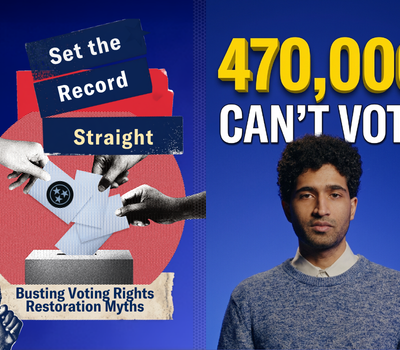
Thumbnail for the Set the Record Straight Series. Cover Reads: 470,000 Can't Vote

More from the Press


Placeholder image

Stay informed on civil rights issues. Discover our latest actions and updates in the Press Release section.

At the Polls, Episode 8: Know Your Rights on Election Day

It’s time for the main event: Election Day. Are you ready to vote?  Election Day is finally here, and we at the ACLU are here to ensure you Know Your Rights when you head to the polls. Listen to this week’s episode of At the Polls to get the rundown to make sure you’re ready to cast your ballot.

By aclutn

Placeholder image

What State Question 805 Has Already Won

Oklahoma is a study in the contradictions of criminal justice reform. While the state is the world’s leading incarcerator, it is also a criminal justice reform success story. That paradox is mirrored in State Question 805 — on the ballot this November — which is both a modest criminal sentencing reform, and is precipitating transformative political and cultural change in Oklahoma’s reform movement.   Four years ago, as the state’s incarceration crisis reached new peaks, voters passed a ballot initiative that shortened prison sentences for property and drug-related crimes. Since that time, Oklahoma has seen prison populations decline by about 20 percent while crime has also steadily decreased by about 5.5 percent.   In response, a small but politically powerful group of prosecutors and other tough-on-crime truthers have aggressively tried to roll back reforms year-after-year, grinding the legislative progress to a crawl. The near stalemate has left thousands of people languishing in Oklahoma’s prisons with decades-long prison sentences — including world-leading rates of women who are incarcerated — while costing the state half a billion dollars on prisons every year.   Against this backdrop, conservative and progressive supporters formed a new coalition, even larger and more diverse than the coalition formed in 2016, to put State Question 805 on the ballot this November. That initiative is a limited roll-back of a form of extreme incarceration called “enhanced” sentencing, which would save the state about $200 million and shorten sentences for nonviolent crimes.   Enhanced sentencing is tough-on-crime snake oil sold alongside the mandatory minimums and three strikes laws that proliferated in the 1990s. These policies were pushed on states through political fear mongering with no underlying evidence they would improve safety.   When an enhanced sentence is triggered by a single previous conviction, decades or even life in prison is automatically stacked on top of already-long maximum prison sentences. This practice” resulted in severely punitive, dehumanizing, and outrageously expensive sentences for minor things like selling small amounts of marijuana or stealing a pair of hedge clippers. Fast forward to the present, and many other states have since repealed or rolled back these policies, recognizing them as wasteful failures.   Narrowing the practice of enhanced sentencing to only violent crimes — the goal of State Question 805 — may seem like a no-brainer. But the fight over 805 has been fierce. Opponents are engaged in ugly, fear-mongering messaging that would make even the architect of the Willie Horton ad blush. Some domestic violence survivors and advocates, failed by the criminal justice system for decades and offered little but incarceration in response, have expressed concern about ending enhanced sentencing for a few crimes related to domestic violence. (The most serious crimes related to domestic violence are unaffected by the initiative.)   As Election Day draws near, an unprecedented conversation is unfolding in Oklahoma. It’s a deeper dialogue about criminal justice that has never occurred in the state before. It is happening directly with Oklahoma voters at Rotary Clubs, editorial boards, sorority events, campaign rallies, and in TV debates.   By the end of this pandemic-inflected campaign, Yes on 805 campaign staff and volunteers will have had nearly two million conversations with voters over the phone and by text. This includes hundreds of thousands of conversations with voters who were initially skeptical about 805 — sometimes deeply so — and we have changed their perspectives and their vote.   We are going farther than conversations about criminal justice reform that just skim the surface. We are talking about why decades-long sentences are ineffective and unjust, even for more complex cases.   For weeks, we have been having conversations with voters every day about why and how we can still hold people accountable without sending them to prison for decades. We’ve pointed voters to the growing number of Oklahoma police chiefs, prosecutors, and judges who have pulled back the veil on the not-so-well-kept secret that extremely long prison sentences do not improve safety.   We’ve talked to voters about the power of redemption and second chances for people who are incarcerated and their loved ones, who are disproportionately from Oklahoma’s Black communities. We’ve told voters about the domestic violence survivors that support the ballot initiative and who know that we cannot incarcerate our way out of domestic violence.   Of course, we don’t convince everyone we speak with to vote yes. The plain truth is that the fearful, scary, and outright dishonest messages from those defending the status quo are powerful. But every conversation is another chance to expand thinking and change culture and we are doing it, inch-by-inch. That is a shift that will last well beyond Election Day, win or lose.   If Oklahoma is ever going to permanently shed the title of world’s leading incarcerator, it will have to go beyond minimal, less controversial reforms and permanently close the book on tough-on-crime dogma. State Question 805 has already achieved success by opening up an entirely new chapter in Oklahoma’s long journey toward ending mass incarceration.    

By aclutn

Placeholder image

The Dangers of Expanding what can be Patented in the Age of COVID-19

As the COVID-19 crisis takes its devastating toll, the need for scientific collaboration is self-evident. After the first outbreaks, scientists in China sequenced the viral genome and released that data, permitting laboratories globally to develop their own tests to diagnose patients for COVID.  Yet, members of Congress, led by Sen. Thom Tillis (R-N.C.), have pointed to the pandemic as a reason to radically change patent law. The changes would allow corporations to have exclusive rights over genes, connections between genomes and disease, and other products and laws of nature, inhibiting scientific innovation. Contrary to the arguments offered by Sen. Tillis and his allies in Congress, changing patent law to permit exclusivity on natural phenomena would give companies the ability to charge excessive fees for genetic testing to detect increased risk for diseases such as breast cancer, drive up patient costs for coronavirus testing, and inhibit scientific progress. That is why the American Civil Liberties Union and the ACLU of North Carolina have launched a campaign to educate people about the dangers these changes to Section 101 of the Patent Act pose, and to ask Sen. Tillis to abandon these efforts. The current ongoing public health crisis is an excellent example of what’s at risk if these patent law changes move forward. Today, scientists around the world are contributing information about the thousands of new strains of coronavirus they have sequenced, data that is vital to understanding the virus and developing testing and treatments. While there have certainly been serious problems with sufficient access to tests in the United States, the issue is not that laboratories lack patent protection to develop them. Dozens of laboratories have created and are offering diagnostic tests. Imagine an alternate scenario: The first laboratory to sequence the COVID-19 genome immediately files for patent protection on the genome and its connection to disease, threatens other labs that want to test for the virus with patent infringement suits, and seeks to monopolize testing. Other labs follow their example, and soon different strains of the novel coronavirus are subject to competing patent claims, impeding the ability of the scientific and medical communities to freely investigate the virus and its evolution. This scenario is not fantastical. The U.S. Patent & Trademark Office adopted a policy in 2001 authorizing patents on genes once they were “isolated” or removed from their natural environment. Patents covering many thousands of genes and their connections to health conditions were issued, and patent holders exercised their rights to stop others from sequencing those genes, even when the other laboratories were using different, more comprehensive, or less costly methods.  The ACLU represented 20 leading medical professional associations, geneticists, breast and ovarian cancer patients, and women’s health advocacy groups to challenge the Patent Office’s policy. In 2013, we won a unanimous ruling from the U.S. Supreme Court, which drew on over 150 years of precedent prohibiting patents on laws of nature, products of nature, and abstract ideas. By invalidating patents on two genes connected to hereditary risk for breast, ovarian, and other cancers, the court broke the monopoly controlled by the patentholder on all testing that could be conducted in the United States.      Outraged by the Supreme Court’s decisions in our case and two others, the patent bar unleashed a major lobbying campaign to overturn them. Their efforts gained steam during the summer of 2019, when a group of senators and representatives, led by Sen. Thom Tillis as the chair of the Senate Judiciary Subcommittee on Intellectual Property, jointly issued a draft bill that would explicitly retract all of the Supreme Court case law barring patents on laws of nature, products of nature, and abstract ideas. Over 160 medical, scientific, patient advocacy and civil rights organizations as well as over 80 biomedical scientists led by Drs. Harold Varmus and David Baltimore opposed the proposal. We highlighted that allowing patents on natural materials, natural processes, and ideas could “hamstring basic science and slow discovery, thereby compromising the nation’s ability to enhance the quality of health care and foster economic progress.”    Shockingly, patent proponents are seizing on the COVID-19 crisis to renew their calls to expand what is eligible to be patented. They assert that companies were slow to develop diagnostic tests for the novel coronavirus because they lacked certainty that they could obtain patents. They are, in effect, asking for the ability to charge monopoly prices for testing of a new disease that is causing a global public health crisis. And they are pushing for permanent changes to patent law that will undermine medical practice and scientific research well after this crisis ends. Since the outbreak, the ACLU has emphasized the need to respect the expertise of public health officials and scientists while preserving our civil rights and civil liberties. Our advice for Congress and patent policymakers is no different when it comes to patents. Many in the medical and scientific communities already have recognized how over-reaching patents would only hinder progress, calling for open science partnerships or adoption of the “Open COVID Pledge” – which commits to making intellectual property available for use in ending the pandemic and minimizing the impact of the disease, free of charge. As the COVID-19 crisis makes clear, we all have a stake in how far patents reach. Patents dictate who has access to scientific breakthroughs, when, and at what cost. Granting exclusive rights over what belongs to the public impedes, rather than fosters, innovation and discovery. There will be many different ways we must mobilize to address the pandemic. Drastically expanding what can be patented should not be one of them.

By aclutn

Placeholder image

Moving Forward: Muslims Belong Here

Four years ago, an election altered the reality of Muslims in America and all over the globe. As president, Donald Trump made real his promise to ban Muslims by abusing his authority under the Immigration and Nationality Act (INA). Once that ban was legitimized by the Supreme Court, he used the same authority to issue ban after ban, discriminating against Black and Brown people in furtherance of his white supremacist agenda.   As we round the corner on this presidential term, it is critical that these discriminatory bans and all the related policies, including social media vetting, are rescinded and a more stringent standard is put in place to protect against these abuses of authority by future presidents. Every executive order and proclamation using authority INA 212(f) must be rescinded immediately and the original National Origin-Based Antidiscrimination for Nonimmigrants Act (NO BAN Act) must be signed into law to protect the American people from such discrimination and abuse moving forward.   Throughout his campaign, Trump promised to ban Muslims from the United States with naked vitriol that disregarded the Constitution and the American ideal of equality. In the days and weeks that followed, people from all walks of life preemptively promised to register with Muslims if Trump created a registry, and safety pins became a symbol to express silent solidarity for all who might be attacked. In an attempt to prevent harm to Muslims in its final days, the Obama administration dismantled the framework for the original post-9/11 registration program, National Security Entry-Exit Registration System (NSEERS). Few realized the forthcoming reality, and instead many hoped that Trump’s campaign was an attempt to garner the votes with his base and would not manifest in discriminatory policies.   That hope was short-lived. Just one week into his presidency, Trump issued his Muslim ban, sending his own administration into disarray and our country into chaos. But this time it was different. Instead of the public silence that followed NSEERS, as people were disappeared from our country, many were outraged and ready to act. In hours, airports nationwide were flooded with protesters demanding that Muslims be let into the country. Members of Congress, including Rep. John Lewis, showed up and waited for every person at the airport to be released.   It was a defining moment in American history: an uprising that made our collective resistance to oppression and discrimination clear.   However, the will of the people is not always immediately reflected in the outcomes of our government or our systems. Though numerous courts rejected Trump’s ban and cited its naked discrimination and animus, the administration repeatedly re-enacted it — and even claimed that the third version of the ban was the result of a secret process that was disconnected from the President’s promise to ban Muslims from the United States. Ultimately, the Supreme Court decided that claim gave it just enough cover to uphold the third Muslim ban, in a 5-4 ruling that is one of the court’s historic failures.   It was not the first time the Supreme Court failed, and it likely won’t be the last. One of the most infamous Supreme Court failures was allowing the incarceration of Japanese people in America through so-called internment camps. It was 40 years after Fred Korematsu refused to submit to Japanese incarceration camps that his conviction was finally overturned in federal court, though the Supreme Court decision still stood. A few years later, a bill was passed and signed into law providing redress and reparations for those who were incarcerated. A few months after that, Fred Korematsu was awarded a Medal of Freedom. Indeed, he spent his life fighting for these freedoms and recognition alongside numerous advocacy organizations and people all over the country. It’s no surprise that his daughter, Karen Korematsu, founded the Korematsu Institute and has played a critical role in defending the rights of Muslims.   Much like Japanese incarceration, the Trump administration used fear-mongering under the veil of “national security” to further its discriminatory agenda — this time by suspending visas under INA 212(f) to repeatedly ban Black and Brown people. It began with the Muslim and refugee bans, and once legitimized by the Supreme Court, it

By aclutn

Placeholder image

At the Polls, Episode 7: Why Do We Take Voting Rights Away in America?

Across the country, over 5 million people who are of voting age cannot vote because of felony disenfranchisement laws, including one in five Black Americans. These laws are a relic of the Jim Crow era, and were intentionally designed to suppress the vote — particularly the Black vote — by limiting the impact of the 13th, 14th, and 15th Amendments. This week, Demetrius Jifunza, Lewis Conway, and Jennifer Taylor join us on At the Polls to share how these laws have impacted them personally after incarceration, and how states are fighting back. Listen to the podcast to learn more.

By aclutn

Placeholder image

Racial Justice Demands That Every Vote Is Counted

This year, ensuring every mail-in ballot is counted is more important than ever. While the share of voters casting ballots by mail has grown steadily in recent years, the spread of the COVID-19 pandemic triggered a surge in mail-in voting during primaries that has continued in the lead-up to Election Day. Already, 90.7 million absentee ballots have been requested or sent to voters in 50 states and the District of Columbia. Critically, a growing number of people of color plan to vote by mail rather than in-person in this election.  Anticipating this unprecedented surge in absentee ballots, the ACLU Analytics team generated estimates of absentee voting volume by race and candidate support by vote method in every county in the battleground states of Michigan, Wisconsin, Pennsylvania, and Georgia. The team combined data gathered by a nationwide representative tracking survey conducted by YouGov with turnout modeling based on updated in-cycle ballot data to construct estimates through statistical modeling. Our findings identify which counties potentially face the largest racial representation gap — that is, if the absentee ballot count is not completed, they will cause the biggest disenfranchisement of voters of color. What happens in these counties may well change the course and outcome of the election. Across all four states, we found that the key geographies to watch will be the greater metro areas with large populations of people of color, such as Detroit, Milwaukee, Madison, Philadelphia, Pittsburgh, and Atlanta. Failing to fully count the absentee votes in the counties that are home to these metro areas would mean disregarding between 32.9 percent (in Gwinnett County, Georgia) and 61.4 percent (in Washtenaw County, Michigan) of the votes of people of color.  While any call about the outcome of the election before many ballots are counted is improper,  the fact that Michigan, Wisconsin, and Pennsylvania don’t begin processing ballots until Election Day or the day before increases the odds of confusing, unfounded, and premature victory calls before all ballots have been counted. Further, Georgia has the largest gap in vote-by-mail usage by race. While ballot processing can happen earlier, a time crunch and election staff shortages mean a quick count is not assured.  Attempts to suppress the by-mail vote and the voices of voters of color — whether through delays, ballot rejections, or outright interference with the full count — can absolutely change the outcomes of the election this year. We must keep an eagle eye on the counties identified in our report and make sure the mail-in vote is counted completely and accurately. Mishandling or miscounting ballots in these counties could perpetuate the historical disenfranchisement of voters of color with which we are all too familiar.  In spite of past elections that may have primed voters to expect a winner to be declared the night of the election, it’s vital for us all to remember that the official winner is never truly known on election night. In every election, the results called on election night are based on projections of unofficial tallies. Sufficient results to even make those projections may take days if not weeks, and for the sake of accuracy, that’s a good thing. This year, discounting the mail-in vote would disenfranchise voters of color and distort the election outcome. Ensuring that every vote — whether cast by mail, early, or in-person on Election Day — is counted must be the responsibility and priority of election officials everywhere. Pundits and politicians don’t decide the outcome of the election — voters do. 

By aclutn

Placeholder image

We’re Ready for the Election

With less than a week to go, the only thing we can be sure of is that this Election Day will most likely look, feel, and be different than previous years. We are, after all, living through a pandemic, economic crisis, fight for racial justice, and an election season.  If you haven’t planned how you are going to cast your vote or already voted this election, there’s still time. You can find more information here about how to make your voting plan, and learn about the specific guidelines in your state. If you plan to vote by mail, consider dropping off your ballot in-person at a drop box or election office. If you plan to vote in-person, make sure to check the location of your polling place or early vote center. You can also learn about your rights at the polls here.  And just as we’ve been asking our supporters to make a plan to vote, we at the ACLU have been preparing for months and years for this Election Day: activating volunteers, motivating voters, and fighting for our rights across the country in courts, legislatures, and in the streets.  The ACLU national office and our state affiliates and chapters have been working around the clock to protect and expand your access to the ballot this election season. Through litigation and advocacy, we’ve fought and scored

By aclutn

Placeholder image

Dear Congress: Platform Accountability Should Not Threaten Online Expression

Tomorrow, the Senate Commerce Committee is holding a hearing entitled “Does Section 230 Enable Big Tech Bad Behavior?” This is just the latest attempt by Congress and the Trump administration to amend, reinterpret, or eliminate Section 230, a key provision of federal law that generally ensures online platforms, including social media, can’t be held liable for the speech and content their users post on these platforms. This law means Yelp can’t be held legally responsible every time one of its users posts a false negative review. The Bed Bug Registry doesn’t have to visit every hotel with a magnifying glass to confirm reports from the public. And Facebook can offer a forum for billions of users to share their thoughts, pictures, memes, and videos freely without having to approve every post before they go up.  Over the summer, Donald Trump issued numerous legislative executive order. The desire on the part of policy makers to do more to create platform accountability is understandable. The ACLU shares that goal, and has long advocated for strong consumer privacy protections at the federal and state level for that very reason. We have also pressed the platforms to provide transparency and meaningful review processes for their content moderation practices. However, we should be wary of proposals that risk harming online expression and be skeptical of focusing on Section 230 as a method of requiring platform accountability.  Section 230 protects people’s ability to create, communicate, and build community online. The ACLU will remain vigilant in ensuring that the internet continues to be a place for self-expression and creation for all. We urge members of Congress to do the same, particularly as they examine proposals to amend Section 230. 

By aclutn

Placeholder image

Don’t Let the Supreme Court Open the Door to More Discrimination Against LGBTQ People

The Supreme Court will soon hear oral arguments in Fulton v. City of Philadelphia, a case about whether governments can be forced to give taxpayer funding to faith-based organizations that provide government services in ways that discriminate against LGBTQ people. If that sentence took you a minute to unravel, and then you couldn’t quite believe you read it right — well, you’re not alone. But unfortunately, it’s true. The Fulton case, which will be heard on Nov. 4, involves the foster care system. Catholic Social Services had a contract from Philadelphia to provide services to foster youth, including screening foster parents. When the city learned CSS insisted on following its own religious screening criteria — which rejected same-sex couples as foster parents — the city didn’t renew its contract. CSS then sued the city. In a similar case, a Protestant organization contracted to provide these services declined to place foster youth with foster parents who were not Protestants, and specifically discriminated against Jewish and Catholic families. Child welfare experts agree that these types of policies lead to more foster youth spending more time in group homes, because the agencies are turning away eligible foster parents. But the implications of the case go far beyond the foster care system. Local, state, and federal governments often give taxpayer dollars to private agencies to provide government services. Many of these private agencies are faith-based. For example, the U.S. State Department contracts with nine organizations to provide resettlement services to refugees, including housing. Six of the nine are faith-based, and five of those six are Christian. Faith-based organizations have government contracts to provide everything from public assistance to substance use treatment, from childcare to shelters. Many of these faith-based organizations do not discriminate and follow best practices in their field to put the needs of those receiving their services first. And that’s how it should be. In the past, the Supreme Court has said that governments can’t deny an organization funding just because the organization is religious. But our opponents in Fulton want something much more than the ability to compete for government funding on equal footing with secular organizations. They want a right for religious organizations to receive government funding to provide government services, even if they selectively refuse to provide those services and discriminate in violation of contract terms and the law. This isn’t religious liberty. It’s government-funded discrimination against the most vulnerable in our society, excused because some want to impose their religious beliefs on others. If the Supreme Court agrees with Catholic Social Services, it is the people who are most marginalized who will suffer. Middle class and wealthy people for the most part get to choose whether and how to engage with faith-based organizations. Working class and poor people do not. The possibilities for harm are sweeping, and there would be no clear stopping point. If you stop by your local church on your way home from work to apply for food stamps, they might stop processing your application as soon as they learn you are pregnant and unmarried. If you are a transgender woman with no housing and no place to stay, you could be turned away from a federally-funded homeless shelter run by a faith-based organization. You could end up sleeping on the street in the freezing cold because of who you are. If you were told you had to complete a drug treatment program funded by the state government to avoid jail time, that program could insist that you embrace Christianity to complete it. You might not be allowed to bring your kids to a taxpayer-funded daycare center because you have a partner who is the same sex as you or a different religion than you. If you are a high school student interested in an after-school program paid for by your local government, you could be rejected because you are Mormon or bisexual. These same communities are under attack in many other ways. For example, the Trump administration recently proposed a regulation designed to allow federally-funded homeless shelters to turn people away because they are transgender, or because they don’t match sex stereotypes. If this proposal were to become law, it would embolden life-threatening discrimination against some of the most vulnerable people in the nation, and lead to more early deaths of trans people. The wrong decision in Fulton could do the same. And because a ruling in Fulton would be based on the constitution, Congress would not be able to fix it. But that’s not a reason to give up — it’s a reason to fight harder for our communities in every way we can, both before the court’s decision and after. We must insist that the court not bend the constitution to force the government to withhold services from some of the most vulnerable in our communities. We must fight for the economic security of LGBTQ people, whether that is through passing the Equality Act, decriminalizing sex work, or providing emergency COVID-19 rent relief. And we must fight for genuine religious liberty for all.

By aclutn

Placeholder image