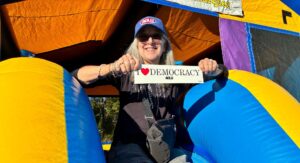
A smiling woman in an ACLU baseball cap and sunglasses sits at the top of a yellow and blue inflatable slide, holding up an “I ❤ Democracy” ACLU bumper sticker.

When Will Tennessee Certify the 2026 Midterm Election Results?

After High Turnout, ACLU-TN Thanks Tennessee Voters, Poll Workers, and Partners, Looks Ahead to an Orderly Certification

By Cathryn Stout, PhD.

Latest Publication


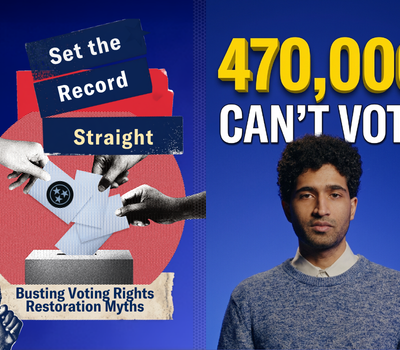
Citizenship Rights Restoration in Tennessee

Restoring your voting rights in Tennessee got easier in 2026. State Sen. Raumesh Akbari and State Rep. Karen Camper led the charge in the legislature to remove some of the biggest barriers standing between formerly incarcerated Tennesseans and the ballot box.

The Campaign Legal Center and Free Hearts, a Tennessee nonprofit led by formerly incarcerated women, have been on the ground helping people navigate this process and pushing for a fairer system. For eligibility requirements and step-by-step petition instructions, read the guide from Free Hearts and the Campaign Legal Center.

Thumbnail for the Set the Record Straight Series. Cover Reads: 470,000 Can't Vote

More from the Press


Placeholder image

Stay informed on civil rights issues. Discover our latest actions and updates in the Press Release section.

Attacks on Trans Athletes are Also an Attack on Intersex People

Intersex people make up as much as 1.7 percent of the population and are born with bodies that differ from what others might think of as “typically” male or female. Although being intersex isn’t that rare, this population is widely misunderstood and underrepresented, much like the trans community. Racist colonial erasure, late-stage capitalism, and the medical industrial complex have combined to create implicit assumptions (and often explicit recommendations) with which trans and intersex groups are all-too familiar. We are told, usually by cis and non-intersex people, there’s only one right way to have a body — and that that body should be as normatively close to binary and cis as possible. At interACT: Advocates for Intersex Youth, we are working hard with our partners at Patterson Belknap LLP to prepare our friend-of-the-court brief to the Ninth Circuit Court of Appeals. This follows the district court blocking an Idaho law that targeted trans student athletes and sought to exclude trans and intersex women and girls from school sports. We’re hopeful the judges of the Ninth Circuit recognize why it is so important to stop this law from going into effect. As we prepare our brief, we also approach Intersex Awareness Day on October 26. It is particularly important on this day to recognize why intersex people continue to show up in support of the trans community and in opposition to the unrelenting efforts to deny trans people their rights. Intersex groups and the advocates who work on their behalf joined the effort to oppose HB 500 — Idaho’s law attacking transgender student athletes — not only because many intersex people are also trans (and vice versa), and not only becase the proposed approach to sex testing in sports violates the rights of the intersex community as well.

By aclutn

Placeholder image

The Supreme Court Case That Could Jeopardize LGBTQ Rights

In March 2018, the city of Philadelphia learned that two of the agencies it contracted with to provide foster care services would not, based on religious objection, accept same-sex couples as foster parents. The city told the agencies their contracts with the city were in jeopardy unless they complied with basic nondiscrimination requirements. While one of the agencies agreed to comply, the other — Catholic Social Services (CSS) — refused. Instead, CSS sued the city, claiming the Constitution gives it the right to opt out of the nondiscrimination requirement. After a lower court and a federal circuit court ruled in the city’s favor, CSS appealed to the Supreme Court. The case, Fulton v City of Philadelphia, has implications not only for the future of foster care, but for the protection of all people from discrimination in the alleged name of religion. Arguments are set for November 4th.  Louise Melling, Deputy Legal Director of the ACLU, joined the podcast this week to discuss what’s at stake in Fulton. “The ACLU has no question about the right of people and organizations to have their beliefs and to practice their beliefs, but it’s to practice your beliefs as long as they don’t hurt others,” said Melling. “And in this context, if Catholic Social Services can practice its beliefs in terms of turning away families because they’re same-sex, it is hurting others.”

By aclutn

Placeholder image

At the Polls, Episode 6: Your Voting Questions, Answered

When we launched the podcast miniseries, At the Polls, we asked listeners to send us their questions about voting this year. While over 44 million people have already cast their ballots, some questions remain about our rights and options as voters. Listen to the full podcast for your most frequent voter questions, answered.  

By aclutn

Placeholder image

When Black Mourners are Threatened with Official Violence

In early June, as people around the globe joined in massive protests against the police brutality and racism that killed him, George Floyd was laid to rest at the same Pearland, Texas cemetery where his mother is buried. Led by a horse-drawn carriage containing his body, George Floyd’s grieving family and hundreds of supporters walked slowly from the church to the burial ceremony.    What they did not know is that on the rooftops above them, six teams of snipers were positioned to fire on the crowd of mourners. Manned surveillance aircraft and drones circled in the sky above. And hundreds of local and state police, federal agents including Border Patrol, and National Guard personnel were prepared to descend upon the mourners with extreme violence at even the slightest provocation.     All of this was revealed in police records that the ACLU of Texas obtained earlier this month. The records also show the federal tactical teams were authorized to get “geared up” and “ready to deploy” in view of the crowd in response to as little as “verbal aggressive language” against police officers or throwing empty water bottles. And their instructions permitted rapid escalation, including the use of gas munitions and even “use of deadly force anytime under Ch. 9 Texas Penal Code” against the mourners if the federal agents, police officers, or soldiers believed it necessary.     A Powerpoint briefing deck created in preparation for these deployments describes the “mission” of this multi-agency force as “provid[ing] security for Pearland Police Department, Dawson High School, and the surrounding area with officers stationed for a quick response to rioting and looting.” The only apparent factual basis for these fears were social media posts and messages that a handful of Pearland residents shared with the police department, in many cases expressing their fears that the burial would lead to looting and other property damage.     There is a peculiar kind of racist imagination at play in these messages and the broader discourse on “looting”: the notion that rather than paying their respects to the dead and watching in anguish as George Floyd is lowered into the ground, Black mourners will use the funeral and burial as a reason to fan out across a small Texas town and steal goods from its stores. In this warped framework, any gathering of Black people expressing sadness or anger is a threat to be surveilled, and something that must be neutralized if its participants show the smallest sign of organized resistance. This results in heavily armed police and federal agents being given full permission to wield violence, including deadly violence, against Black people even in times of grief. In this framework, no corner of Black life is free from the threat of police violence — including mourning the people whose lives were taken by that same violence.     This same racist, harmful role for policing — planning violence against Black people in order to deter real or imagined threats to white property ownership — dates back to slavery. Such white fears were common during slavery, because systems of white supremacy require force to maintain themselves. Indeed, the first municipally-funded police department in America was the Charleston City Watch and Guard, a specialized form of slave patrol that monitored Black social gatherings, shut down underground meetings, and sought to block enslaved Black people from organizing resistance to or escape from bondage.    After the end of the Civil War, slavery ended but the mission of police departments and local sheriffs did not change much. Across the former Confederacy, these agencies enforced the Black Codes: an arbitrary set of restrictions that made it hard for newly-freed Black people to organize politically or move to new places in search of better opportunities. Texas was no exception; the Texas Rangers in particular were widely known in the nineteenth century for extrajudicial killings of Mexican Americans and bounty hunting of Black people who escaped from slavery. Meanwhile, their investigation of a 1919 race riot focused less on the Ku Klux Klan than on civil rights groups that they blamed for inciting the riot (at the height of this riot, a mob of nearly 1,000 white people burned down multiple Black-owned houses and killed Black people without law enforcement intervening). It was more than a century after the end of the Civil War, in 1988, that a Black person was first appointed to join the Texas Rangers. And this was not confined to the South: Police in northern cities adopted similar racist practices as more Black people arrived as part of the Great Migration.    Targeting George Floyd’s burial march with snipers and aerial surveillance fits all too comfortably into this history. Not only are the white fears the same, but the weapons and agencies being used to placate those fears and maintain white supremacy are the same. Now, they’re just upgraded with 21st century technology and assisted by Customs and Border Protection (CBP), which has grown to become the country’s largest federal law enforcement agency and claimed broad powers in communities across the nation.    As a result, George Floyd’s family and community cannot even mourn his death at the hands of police without being surveilled by aircraft and drones, under the watch of snipers, federal tactical teams, and National Guard members ready to unleash tear gas and bullets on them at a moment’s notice.     It would be both lazy and wrong to blame this on “bad apples.” Multiple officials at the local, state, and federal levels approved this militarized and potentially lethal response to George Floyd’s burial ceremony. This is about the rot at the core of American policing.    It is time for us to fundamentally rethink the role of policing in American society. While crime has been trending downward for decades and violent crime and property crime have fallen significantly since the early 1990s, over the past four decades, the cost of policing in the United States has almost tripled, resulting in further lethal violence and harm against Black communities. Until we address how white supremacy so easily uses policing as a weapon against Black communities, and until we concretely reduce the role, power, and responsibilities of the police in American life, Black mourners of the next victim of police violence will be forced to wonder whether a sniper on a nearby rooftop is awaiting orders to interrupt their mourning with yet more violence. 

By aclutn

Placeholder image

What 40 Years in Sex Work has Taught Me About Decriminalization

Content Warning: This piece contains graphic descriptions of violence, including sexual assault.The worst night of my life was the night that changed everything.   It was hot out.

By aclutn

Placeholder image

Eye on Civil Liberties: Where You Can Have an Impact in Elections Closer to Home

The intense focus on the presidential race can easily obscure policies that could have more of a direct impact on communities in both red and blue states but they are no less important. Many voters don’t engage with the electoral process because they don’t think their votes make a difference or count for much. Down-ballot races are where voters can make a real impact in shaping policies and spark a broader public debate.  The ACLU is nonpartisan, so our goal with down-ballot campaigns is to ensure that voters are educated about the potential consequences of an election, not to support specific candidates. We don’t tell voters who to vote for but provide them the tools to cast an informed vote by elevating the key issues at play in the race.  So what policies are at stake in this election? Here’s a quick snapshot of the types of civil liberties and civil rights issues that could be on your ballot.  Criminal Justice Reform This summer police accountability and other criminal justice reforms were thrust front and center. These are issues we’ve long worked on but now take on new importance and are reflected across the spectrum of races where we’re engaged.  Take the Maricopa County, Arizona attorney race. Elected prosecutors, district attorneys, or county attorneys have an enormous impact on the criminal legal system — they decide who to charge with crimes, whether to offer a second chance or send someone to prison, and when to hold police accountable. In Maricopa, we’re focusing on how candidates can hold police accountable when they kill someone and end prosecutions of low-level marijuana possession, charges that disproportionately impact people of color.  Conditions of confinement are also a key issue in the criminal justice space. Sheriffs are often the people directly in charge of local jails, meaning they’re responsible for conditions in these facilities and the people incarcerated there. In Cobb County, Georgia, Montana stands out as a state with strong protections for reproductive freedom, especially in its geographic region, but that’s mostly because of its governor, as well as some important state supreme court precedents. The state legislature continually passes abortion restrictions like targeted regulations of abortion providers (Proposition 115, that would ban abortion later in pregnancy. Prop. 115 would make it a crime for doctors to provide abortion care starting at 22 weeks in pregnancy, robbing pregnant people of the ability to make their own personal medical decisions, taking into consideration their own personal situations. Prop. 115 is a one-size-fits-all mandate that fails to acknowledge every pregnancy is unique — and shows no compassion for what families face in unimaginably complicated circumstances. And it takes away the ability of doctors to provide the best medical care for their patients. Immigrants’ Rights Typically, the federal government shapes our policies on immigration. But they frequently also try to involve local law enforcement in their efforts to find, detain, and deport immigrants, splitting families and communities. This is the case for local sheriffs who are often asked to house detained people, including immigrants, and have the power to enter into agreements with federal immigration enforcement to deputize local police as immigration agents.  In the run-up to November 3, we’re focused on three specific sheriff races that have the ability to transform the quality of life for immigrant families. In Charleston, South Carolina, Cobb and predatory payday loan interest rates, which average more than 400 percent. These payday loans, marketed as a short-term fix for those in financial stress, are actually designed to trap borrowers in a cycle of long-term debt. The consequences of payday lenders fall especially hard on communities of color, where payday lending stores are located in higher numbers than in other neighborhoods. It becomes incredibly hard for minority families to build wealth, save for the future, or have a safety net because dollars are systematically drained away. This ballot measure comes at a time when many Americans are devastated by the global health pandemic and the longstanding racial disparities it has exacerbated, leaving millions unable to meet their families’ basic needs. While many of these issues will take work to resolve, voting for this ballot measure will be a move in the right direction to help remedy economic and racial injustice.  In California, the most diverse state in the nation, voters can choose to support Proposition 16, which would bring affirmative action back to the state for the first time in decades. The current affirmative action ban means fewer and less profitable opportunities for women and communities of color. But this isn’t only about money and jobs — lives are at risk. Black, Latinx, and Native American people are dying disproportionately from COVID-19 because of the devastating consequences of decades of discrimination in education, housing, jobs, health care, and more. Affirmative action would help reduce and eliminate those harms by leveling the playing field, for instance, through expanding access to health care education to all communities. Research has shown that communities of color receive better health care from medical professionals of those communities. If passed, Proposition 16 will help bring equal opportunity to all Californians, increasing access to fair wages, good jobs, and quality schools for everyone. Make a Plan to Vote Of course, none of these policies will change if you don’t vote. So make a plan and recruit friends and family. For more on how to vote in your state, check out our Let People Vote tool. ——— Paid for by American Civil Liberties Union, Inc., Anthony Romero, Executive Director, 125 Broad Street, New York, New York 10004.  Not authorized by any candidate or candidate’s committee.   Paid for by the American Civil Liberties Union, Inc. on behalf of the Committee to Advance Constitutional Values.   Authorized and paid for by American Civil Liberties Union, Inc., 125 Broad Street, New York, NY 10004, 212-549-2500, on behalf of Yes on 805, Inc.   Paid for by American Civil Liberties Union, Inc.; Anthony Romero, Registered Agent.  Authorized by Abortion Access for All.   Paid for by American Civil Liberties Union, Inc., 125 Broad Street, New York, NY 10004, and authorized by Nebraskans for Responsible Lending.   Paid for by American Civil Liberties Union, Inc., ID #1259514, and authorized by Yes on 16, Opportunity for All Coalition, Sponsored by Civil Rights Organizations.

By aclutn

Placeholder image

Let Trans People Vote

Do you have a plan to cast your ballot on November 3rd or before during early voting? We’re all are asking this question, but for many transgender people it invokes an extra layer of questions and anxiety. Will I need to show ID? If so, can I get my name and gender marker changed on my ID in time?  Did I change my name on my voter registration? How should I dress? Will a poll worker embarrass me, out me, or challenge my identity? WIll I get harassed for being trans or some other reason? Transgender voters encounter a number of barriers that make exercising our right to vote complicated, intimidating and unnecessarily difficult. State ID laws have created a web of barriers for transgender residents to cast their ballot. There are around 378,450 voting-eligible transgender people across the country who do not have accurate IDs. And 81,000 transgender voters live in states with the strictest photo ID requirements.

By aclutn

Placeholder image

Photographer Josué Rivas on Indigenous Representation

This week and in recent years, a growing number of states and cities across the country celebrated Indigenous Peoples’ Day. It comes as an important corrective after decades of celebrating the “discovery” of the Americas by Christopher Columbus each year. We know, of course, that no such discovery happened — what did happen was colonization, and centuries of subjugation, murder, disenfranchisement, and displacement of Native Americans. As we reflect on our history and on the stories that have been too often excluded, we consider the importance of not just what stories get told, but of who gets to tell them.  This week on At Liberty, we are joined by Josué Rivas, who helped us think through these questions. Rivas is a visual storyteller, educator, creative director, and self-described “Indigenous futurist.” He descended from the Mexica Otomi peoples. He aims “to challenge the mainstream narrative about Indigenous peoples” and to “be a visual messenger for those in the shadows of our society.” 

By aclutn

Placeholder image

Make an Informed Decision: Where the Presidential Candidates Land

Everything we’ve fought for is at stake in this election. Our right to protest a broken system, our right to equal treatment at work, and even our right to vote. It’s up to us to decide what comes next. The ACLU does not endorse or oppose candidates, but we do want to give you the information you need to make informed decisions. It is crucial that you study where the candidates land on the issues. See below for the presidential candidates’ positions on key civil liberties issues.

By aclutn

Placeholder image