A smiling woman in an ACLU baseball cap and sunglasses sits at the top of a yellow and blue inflatable slide, holding up an “I ❤ Democracy” ACLU bumper sticker.

When Will Tennessee Certify the 2026 Midterm Election Results?

After High Turnout, ACLU-TN Thanks Tennessee Voters, Poll Workers, and Partners, Looks Ahead to an Orderly Certification

By Cathryn Stout, PhD.

Latest Publication


Citizenship Rights Restoration in Tennessee

Restoring your voting rights in Tennessee got easier in 2026. State Sen. Raumesh Akbari and State Rep. Karen Camper led the charge in the legislature to remove some of the biggest barriers standing between formerly incarcerated Tennesseans and the ballot box.

The Campaign Legal Center and Free Hearts, a Tennessee nonprofit led by formerly incarcerated women, have been on the ground helping people navigate this process and pushing for a fairer system. For eligibility requirements and step-by-step petition instructions, read the guide from Free Hearts and the Campaign Legal Center.

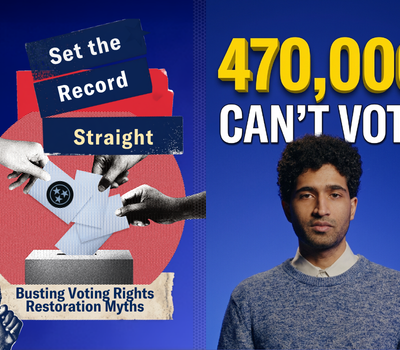
Thumbnail for the Set the Record Straight Series. Cover Reads: 470,000 Can't Vote

More from the Press


Placeholder image

Stay informed on civil rights issues. Discover our latest actions and updates in the Press Release section.

In Memory of Justice Ruth Bader Ginsburg (1933-2020)

Ruth Bader Ginsburg, the Supreme Court justice who first rose to national prominence as an ACLU lawyer fighting for equal rights for women, has died at 87 years old.   She began Harvard Law School as a young mother and one of only nine women in her class, and became the architect of a legal strategy to eradicate gender discrimination in the United States. She modeled her approach after that of Thurgood Marshall on race discrimination, planning for a series of cases at the Supreme Court, each precedent paving the way for the next that would further expand rights and protections. In 1993, she joined the court as an associate justice, and over the decades became a cultural icon beloved for her vision and passion in defending the rights of women.   Ginsburg was born in Brooklyn in 1933 to Jewish parents with roots in Eastern Europe. Her mother Celia, who died shortly before Ginsburg graduated from high school, instilled in her a sense of independence and a love of learning. She went on to Cornell University, where at 17, she met her future husband, Martin Ginsburg. They married after graduation, and soon had a daughter, Jane.   Ginsburg attended Harvard Law School, where women were barred from living in the dorms and from using certain campus facilities. When the dean hosted a dinner for the first-year women, Ginsburg recalled, “He asked each of us to stand up and tell him what we were doing taking a seat that could be occupied by a man.” Discrimination dogged her early career. After transferring to Columbia Law School, she graduated first in her class, but she had trouble getting a job. She later accepted a position teaching civil procedure at Rutgers Law School, where her employers informed her that she would be paid less than her male colleagues because she had a husband who earned a good income. She and other female professors filed a federal class-action discrimination case against the university, and won. For fear of demotion, she hid her pregnancy with her son, James, until after her contract renewal. Simply living her personal and professional life at a time of openly discriminatory policies for women had positioned her to fight. In the late 1960s, Ginsburg began volunteering for the ACLU, and soon wrote a brief in the case Reed v. Reed. Sally Reed had separated from her husband, and when their son died, both parents sought to be appointed the executor of his estate. Idaho law automatically appointed the father because he was a man. Ginsburg named as co-authors on the brief two women lawyers whose ideas had helped build her arguments: Dorothy Kenyon, an early advocate for women’s rights, and Pauli Murray, a brilliant African American activist who had pioneered the argument for applying the 14th Amendment to women’s rights. In 1971, the Supreme Court ruled for Sally Reed, the first time it would strike down a law for treating men and women differently. The court ruled that giving a mandatory preference to one sex is “the very kind of arbitrary legislative choice forbidden by the Equal Protection Clause of the Fourteenth Amendment.” In an ACLU memo, Ginsburg called the victory “a small, guarded step.” In 1972, Ginsburg joined the ACLU as the founding director of the new Women’s Rights Project. That same year, she also accepted a job as the first female tenured law professor at Columbia.     In the early ‘70s, gender discrimination affected most aspects of life. The Women’s Rights Project tallied hundreds of federal laws that discriminated on the basis of sex — in education, employment, reproductive rights mortgages, credit cards, loans, house rentals, prison, and the military. Most legal scholars believed the law should treat women differently, to protect them. For instance, some laws prevented female employees from lifting more than 15 pounds, or working at night. Some lawyers were beginning to take on cases of sex discrimination, often to help a specific woman, not necessarily with a view toward changing the law on gender equality. Ginsburg wanted to do just that. In 1973, Ginsburg took on another Supreme Court case. Sharron Frontiero was an Air Force officer whose husband, Joseph, had been denied the housing and medical benefits that female spouses of male Air Force officers received automatically. In writing both muscular and spare, Ginsburg expanded the scope of her brief to encompass the history of women’s subjugation, with references to Alexis de Tocqueville and Alfred Lord Tennyson, and pared down the language to a precise and devastating argument. “That’s when it dawned on me how brilliant she is,” said Brenda Feigen, then co-directing the Women’s Rights Project with Ginsburg. “She was at her most creative and profound,” she said. “She told the story of sex discrimination — how it had been and how it had to end.” It was in Frontiero that Ginsburg gave her first oral argument before the Supreme Court. “I knew that I was speaking to men who didn’t think there was any such thing as gender-based discrimination and my job was to tell them it really exists,” she has said. To make the point to the nine men who were sitting on the bench, she quoted the nineteenth-century women’s-rights advocate Sarah Grimkè: “I ask no favor for my sex. All I ask of our brethren is that they take their feet off our necks.” She apparently succeeded. Feigen, who was by Ginsburg’s side in the court, recalled, “There was not a single question from any of the justices. They must have been transfixed.”   Ginsburg’s team won the case. Yet they did not convince a majority of the justices that sex discrimination should be treated exactly like racial discrimination. “My expectation, to be candid, was that I would repeat that kind of argument, maybe half a dozen times. I didn’t expect it to happen in one fell swoop,” Ginsburg later said.   While at the ACLU, Ginsburg played a role in 34 Supreme Court cases, and won five of the six cases she argued before the court — Frontiero, Weinberger v. Wiesenfeld, Califano v. Goldfarb, Duren v. Missouri, and Edwards v. Healy. Many of her cases involved sex discrimination against men, which she felt might rouse more sympathy among the male justices, and show that discrimination hurts everyone. Ginsburg sometimes said that one of her favorite cases involved a man whose wife died in childbirth, leaving him alone to care for their newborn son. Stephen Wiesenfeld’s wife had been the primary breadwinner, and upon her death, he went to the local Social Security office to inquire about survivors’ benefits for a parent and learned that he didn’t qualify because he was a man. Ginsburg convinced the Supreme Court that the section of the Social Security Act that denied fathers benefits because of their sex was unconstitutional. She won a unanimous decision.   “Ruth was careful to build brick upon brick,” said Aryeh Neier, then executive director of the ACLU. “She wanted to create a stable structure. She wasn’t interested in reaching for the roof right away. In my tenure at the ACLU, this was the most clearly planned litigation strategy.”   Ginsburg’s legacy would be felt at the ACLU long after her departure in 1980 to become a judge on the U.S. Court of Appeals.   President Clinton nominated Ginsburg to the Supreme Court in 1993. She was introduced at her confirmation hearing by Eleanor Holmes Norton, Delegate to the U.S. House of Representatives from Washington D.C., who had served as the assistant legal director at the ACLU. “When Ruth Ginsburg founded the ACLU Women’s Rights Project, today’s axiom that the 14th Amendment applies to women was not axiomatic at all,” she said. “Judge Ginsburg has spent her life making things how they ought to be. Using her gifted mind, honed by indefatigably hard work, she has used the law, always carefully, always defensibly, for all of those left at the margins, for want of a lawyer or a judge with the brilliance and commitment to pull them mainstream. As a lawyer, she was an activist intellectual who brought grace to both roles.”   The last to testify at her confirmation hearing was Stephen Wiesenfeld, the widower for whom Ginsburg won Social Security benefits some 20 years earlier when she was at the ACLU. He described his experience of being a newly-widowed father struggling to raise his son without his wife’s Social Security benefits and how Ginsburg “saw immediately the gains, the consequences, and the long range effects and the logistics of revising this inequity in the Social Security system.”   Sen. Joe Biden, then the Chairman of the U.S Senate Committee on the Judiciary, thanked Wiesenfeld for his testimony and added, “I shared a similar fate that you did in 1972 and raised two children with a professional wife who had passed away, and it is amazing how much has changed.” Ginsburg was confirmed to the court in a vote of 96 to 3.   On the court, Ginsburg continued her efforts to push for full gender equality under the 14th Amendment. In 1996, she wrote the decision in United States v. Virginia, which struck down the male-only admission policy at the Virginia Military Institute and established a new standard of review for sex discrimination cases.   Over time, as the court became more conservative, Ginsburg also became more pointed in her dissents.   In 2006, the court ruled against Lilly Ledbetter, who had been paid less than male colleagues in comparable jobs at the Goodyear Tire & Rubber Company. In a rare move, Ginsburg, then the sole woman justice on the court, read her blistering dissent aloud from the bench. “The court does not comprehend…the insidious way that women can be victims to discrimination,” she accused. “The ball is in Congress’ court.” A few years later, President Obama signed the Lilly Ledbetter Fair Pay Act into law.   Then in 2013, the court gutted the Voting Rights Act of 1965. “Race-based voting discrimination still exists,” she rebuked her colleagues, again reading her dissent. Dismantling the act, she said later, was “like throwing away your umbrella in a rainstorm because you are not getting wet.”   In a country hungry for integrity and for leadership fighting the erosion of civil rights, a new generation of young women branded Ginsburg “The Notorious RBG” on social media, and showed their esteem for her in unexpected ways. Children dressed up as Ginsburg for Halloween, her face appeared on tattoos, pillows, and shower curtains, and her story was told in a documentary and a feature film, multiple biographies, and several children’s books.

By aclutn

Placeholder image

Why We Want to Vote By Mail

Voting by mail is the safest way to cast a ballot for many voters, whether they are immunocompromised, have a disability, or simply want to protect the health of their community. Six voters from across the country shared with us why they want to vote by mail, and why it should be an option for all voters. No excuses. 

By aclutn

Placeholder image

Federal Judges are Failing Incarcerated People During the Pandemic

I am tired of members of my profession dismissing my clients’ humanity. Sadly, it happens a lot: “Your clients are probably lying to you, which is unsurprising,” reads an email from a representative of the Texas State government. “People get better medical care in jail,” claim people who have never been incarcerated a day in their lives as reason to keep people locked up during this pandemic. “We can’t trust inmates to follow the law, so how could we trust them to quarantine from others if they were released?” asks a judge who swore an oath to protect the fundamental rights of these “inmates.” It should not be news to anyone that the scales of justice are tipped in favor of the powerful, but it’s never been starker to me than now. I’ve spent the last six months on the frontlines of the legal battle to protect incarcerated people from preventable illness and death as jails and prisons fumbled their response to the COVID-19 crisis. What I’ve seen is a chasm between the courage and humanity of my clients — people discarded in crowded facilities trying

By aclutn

Placeholder image

No More Forced Prayers in School

For years, the Smith County School System in Carthage, Tennessee, has violated the separation of church and state with impunity. But no more.   Yesterday evening, a federal district court issued a permanent injunction that requires the school district to stop an array of unconstitutional activities that have included, among other practices, imposing prayer on students, displaying religious symbols and messages throughout school facilities, and inviting the Gideons International, an evangelical Christian association, to distribute Bibles to fifth-graders during homeroom.   The court’s order comes in the form of a consent decree, meaning the school district — to its credit — recognized that these practices are legally indefensible and agreed to an injunction to resolve a lawsuit filed last year by the ACLU and ACLU of Tennessee on behalf of two families.   The families, including

By aclutn

Placeholder image

At the Polls, Episode 1: What to Expect on Election Day 2020

We usually know what to expect on any given presidential Election Day. After all, they happen every four years. But this is the first election in our lifetime to occur during a global pandemic, and there have already been significant changes to the electoral process as more voters plan to mail in their ballots than ever before. How will that change our quintessential American tradition of watching the results roll in on election night? 

By aclutn

Placeholder image

Election Season is Here. Are You Ready to Vote?

It’s after Labor Day, the weather is changing, leaves are turning, which all means — Election season is officially here. November 3 is now less than 50 days away, and we at the ACLU have been working for months nationwide to ensure voters safe and secure access to the ballot and to protect everyone’s rights while voting — and now that time is here. During the COVID-19 pandemic, it is essential that we not only protect our health but also our civil liberties — including our fundamental right to vote. It’s on all of us to make our plan to vote. Today is not too early to act. 

By aclutn

Placeholder image

The Myth of the “Bad” Immigrant

Immigrant communities are often asked to “get right with the law,” but is the law right in the first place? That’s what Alina Das asks in her new book, No Justice in the Shadows. She delves into her experience as the daughter of immigrants, an immigration attorney, and a clinical law professor to explore the intersection of immigration and the criminal justice system. Too often, she argues, our immigration system is used as a tool of discrimination and oppression, rather than as a tool of justice, and the consequences are dire. Our current immigration system is breaking up families, and forcing people to face persecution — even death — in their home countries, and it’s all based on a false premise of ensuring public safety and national security. Das joins At Liberty this week to discuss her book, and how we need to fundamentally reenvision the immigration agencies in our country, which she says are ultimately charged with enforcing laws rooted in white supremacy.

By aclutn

Placeholder image

Lower Courts Agree — It’s Time to End Qualified Immunity

Earlier this month, Mississippi federal court judge Carlton Reeves reluctantly held that a white police officer who detained, interrogated, and illegally searched Clarence Jamison, a Black man driving a Mercedes-Benz, for nearly two hours despite clearing multiple background checks, could not be held accountable for his actions. Why? Because his hands were tied by qualified immunity. Judge Reeves relates his frustration in his opinion:   “Judges have invented a legal doctrine to protect law enforcement officers from having to face any consequences for wrongdoing. The doctrine is called ‘qualified immunity.’ In real life it operates like absolute immunity.”   Qualified immunity is a legal defense that can shield police officers from liability for misconduct. Once an obscure legal doctrine, it has become a central focus of activists’ calls for police accountability following nationwide protests over police brutality. In fact, officer Derek Chauvin, the cop who killed George Floyd by kneeling on his neck for over eight minutes in a video seen around the world, might evade accountability in a civil suit through qualified immunity.   The Supreme Court created the first version of this defense more than 50 years ago as a limited amendment to the Civil Rights Act of 1871, also known as the “Ku Klux Act” because it was meant to protect the rights of freed slaves after the Civil War in the face of the Klan’s reign of terror. Under Section 1 of the act, now referred to as Section 1983, people were given the right to sue state government officials for violating their constitutional rights and hold them liable for damages.   Starting in 1967, though, the court amended the law — officers would be shielded from liability if they could show that they acted in “good faith” and had “probable cause” for their actions. Over time, the court has stretched the doctrine to where it is today: An officer who has violated the Constitution cannot be held liable for damages unless the violation was so “clearly established” in the law that any reasonable officer would have known that their actions were unlawful. This requirement is nowhere to be found in the Constitution or any federal statute. Nevertheless, the Supreme Court has developed an absurdly narrow definition of what counts as “clearly established” law.        To meet the “clearly established” standard, the burden is now on the victim to find a previous case with facts nearly identical to their own. This is the burden that fell on Alexander Baxter, whom the ACLU represented in a petition that the Supreme Court recently denied. Mr. Baxter, homeless at the time of his arrest, was chased by two Nashville police officers and a police dog into a basement following a report of a residential burglary in 2014. Once there, Mr. Baxter surrendered by sitting on the ground and raising his hands into the air. Still, the officers unleashed the dog, which bit Mr. Baxter’s armpit, sending him to the hospital for immediate medical attention.   Without formal legal assistance and with limited access to the prison’s law library, Mr. Baxter later filed a hand-written complaint from prison, but a federal appeals court granted qualified immunity to the officer. The reason for qualified immunity? Mr. Baxter surrendered by sitting on the ground with his hands up, whereas in the closest prior case, the court ruled in favor of a victim who surrendered by lying down.   Yep, that’s it. Because Mr. Baxter could not point to a previously decided case where the suspect had also surrendered by sitting down with his hands up, the officer was off the hook. According to the Sixth Circuit Court of Appeals, without a case with identical circumstances, there was no way for the officer to clearly know that what he did was wrong.   But it’s even more problematic than that. Because the Sixth Circuit did not reach the question of whether the conduct was, in fact, illegal, the law still doesn’t clearly establish that police may not order a canine attack on a suspect who surrenders by putting their hands up. This means another officer could claim immunity for the same behavior in the future. It’s a never-ending catch-22: A victim must cite exact legal precedent to win their case, but because judges dismiss so many cases over slight twists of facts without deciding whether the underlying government conduct is unconstitutional, it’s increasingly difficult to create any legal precedent.   As District Court Judge Reeves writes in his powerful opinion, “Let us not be fooled by legal jargon. Immunity is not exoneration. And the harm in this case to one man sheds light on the harm done to the nation by this manufactured doctrine.”   Qualified immunity is one reason why police are emboldened to use excessive force without fear of repercussions. They know the law protects them, even if they may be violating the Constitution — a fact driven home by Judge Reeves as he lists a handful of the Black people killed at the hands of police. Senseless shootings like Jacob Blake’s and Dijon Kizzee’s will continue occurring because police officers are essentially allowed to gun down Black people with impunity. This is the abhorrent cost our society pays for qualified immunity.   Still, there is hope. More lower courts and even Supreme Court justices themselves are starting to question the doctrine, as indicated by Justice Thomas’ dissent from the Court’s decision not to take up Mr. Baxter’s case. It is no longer blindly accepted that the need to shield police officers from financial burden is more important than the need to hold them accountable and protect the rule of law. In fact, officers are virtually never at risk of monetary liability and have contributed to payments in less than one-half of 1 percent of civil rights damages actions. Most costs are paid by municipalities, insurance companies, or unions.   The Supreme Court should abolish qualified immunity and return Section 1983 to its original meaning. At the very least, it needs to give guidance to lower courts to make clear that a case with identical facts is not necessary to hold officers liable for their conduct. While these reforms will never repair the harm done to many lives or heal the trauma Mr. Baxter experienced, they will deter future police unlawfulness and, when such abuse occurs, increase the chances that its victims are compensated for the harms suffered.   Communities must also demand that other actors — Congress, police chiefs, mayors, and prosecutors — abolish the doctrine and begin funneling resources away from law enforcement and into community services like housing, education, accessible health care, and violence prevention programs. If we truly want systemic changes to policing, these are the institutions that will help communities grow and thrive. 

By aclutn

Placeholder image

The Trump Administration’s Attack on Abortion Access Disproportionately Harms Communities of Color Already Devastated by COVID-19

Six months into the COVID-19 pandemic, it is devastatingly apparent that the United States’ longstanding racial inequalities have only been amplified during this crisis. Nowhere is that truer than in health care, including reproductive health care.   Even before the pandemic, people of color faced severe barriers to accessing essential reproductive health care as a result of interrelated factors such as structural racism, gendered oppression, and associated economic disparities. Abortion restrictions, such as bans on insurance coverage for abortion or laws mandating delays in abortion care and an extra unnecessary trip to the clinic, have a disproportionate impact on women of color. And Black women are still over three times more likely to die from pregnancy or childbirth than white women. These inequalities, sued over this very requirement on behalf of a coalition of medical experts and reproductive justice advocates, arguing that it is an unconstitutional restriction on abortion access and places people, particularly people of color, at serious risk during the pandemic by requiring medically unnecessary travel and in-person interactions that needlessly increase exposure risks.   In a tremendous victory for people who need abortion care, we won: A federal district court ruled that the FDA must suspend enforcement of this requirement for the duration of the public health emergency. But the Trump administration is not giving up the fight; undeterred by their failed attempts to defend this restriction in the lower courts, they have now taken the extraordinary step of asking the Supreme Court to step in.   There’s no question that the FDA’s policy — and the Trump administration’s insistence on reinstating it — is a direct attack on the health and safety of people of color. Sixty percent of people who receive abortion care are people of color, including 53 percent who identify as Black or Latinx. As has been well documented, people of color are suffering higher rates of severe illness and death from COVID-19 than white people, both because they experience higher rates of preexisting medical conditions that increase the severity of COVID-19, and because they are

By aclutn

Placeholder image