A smiling woman in an ACLU baseball cap and sunglasses sits at the top of a yellow and blue inflatable slide, holding up an “I ❤ Democracy” ACLU bumper sticker.

When Will Tennessee Certify the 2026 Midterm Election Results?

After High Turnout, ACLU-TN Thanks Tennessee Voters, Poll Workers, and Partners, Looks Ahead to an Orderly Certification

By Cathryn Stout, PhD.

Latest Publication


Citizenship Rights Restoration in Tennessee

Restoring your voting rights in Tennessee got easier in 2026. State Sen. Raumesh Akbari and State Rep. Karen Camper led the charge in the legislature to remove some of the biggest barriers standing between formerly incarcerated Tennesseans and the ballot box.

The Campaign Legal Center and Free Hearts, a Tennessee nonprofit led by formerly incarcerated women, have been on the ground helping people navigate this process and pushing for a fairer system. For eligibility requirements and step-by-step petition instructions, read the guide from Free Hearts and the Campaign Legal Center.

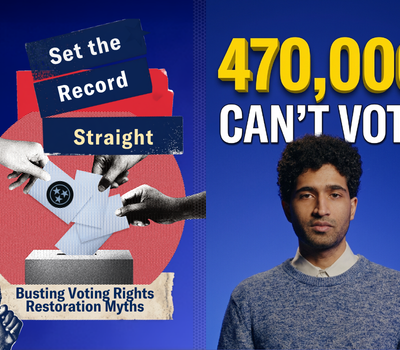
Thumbnail for the Set the Record Straight Series. Cover Reads: 470,000 Can't Vote

More from the Press


Placeholder image

Stay informed on civil rights issues. Discover our latest actions and updates in the Press Release section.

Reproductive Abuse is Rampant in the Immigration Detention System

Last week, a hideous allegation emerged in a complaint filed on behalf of immigrants detained at the privately operated Irwin County Detention Center (ICDC) in Georgia. In the complaint, nurse Dawn Wooten blew the whistle on “jarring medical neglect” she says she learned about while working at the facility, including an allegation that a government-contracted doctor repeatedly performed sterilizing procedures on women in Immigration and Customs Enforcement (ICE) custody without their knowledge or consent.   These allegations have an eerie familiarity: the U.S. has a long history of forcibly sterilizing Black, Brown, and Indigenous people. And the whistleblower complaint raises the concern that reproductive abuse is not just a part of our country’s past.   The issues are not limited to the allegations at the ICDC. The Trump administration’s hostility toward the reproductive freedom of immigrants in its custody has long been evident. In 2017, groups working with young immigrants discovered that the Office of Refugee Resettlement (ORR), which has custody over immigrants under age 18 who come to the country without parents, had instituted a policy of blocking pregnant young people from accessing abortion care and trying to coerce them to carry pregnancies to term against their will.   After learning of that anti-abortion policy, we sued on behalf of Jane Doe, a then 17-year-old Central American immigrant. Jane found out she was pregnant after being placed in a government-funded shelter, and immediately asked for an abortion. Federal officials responded by ordering the shelter to block her access to abortion care and forcing her to receive counseling at a religiously affiliated “crisis pregnancy center.”   Jane took the administration to court, fighting back to protect not only her own right to reproductive freedom, but the rights of a class of hundreds of other young immigrants like her who were also subject to the ORR’s anti-abortion policy. As a result of a protracted legal battle that went all the way up to the Supreme Court, Jane was able to receive the care she needed, and won a court order blocking ORR from obstructing all pregnant immigrant minors in its custody from making their own decisions about their bodies and their lives.   But the hostility against immigrants’ reproductive autonomy continued. In 2018, the Trump administration reversed an Obama-era policy that presumed pregnant people should not be detained. Now, ICE is making opaque, “case-by-case” decisions about whether a pregnant woman should be caged. In 2019, the ACLU of San Diego & Imperial Counties and ACLU of Texas Border Rights Center filed a series of administrative complaints to the Department of Homeland Security’s Office of Inspector General (OIG) based on interviews with more than 100 people soon after their release from Customs and Border Protection (CBP), including Border Patrol, custody. One pregnant woman said she was repeatedly slammed against a chain link fence by a Border Patrol agent. Another said she experienced a miscarriage while detained in a Border Patrol facility for 12 days, but did not receive any hygienic products or medical care.   Numerous pregnant women detained by Border Patrol recounted being told by officers to get abortions, all while being held in crowded, unsanitary facilities with little access to food or water. Medical attention for these women was often delayed or denied, all while they endured verbal abuse. This neglect and mistreatment has devastating results: During the first two years of the Trump administration, the number of undocumented women who miscarried while in government detention nearly doubled.   In February 2019, a 24-year-old Honduran woman went into premature labor and delivered a stillborn child four days after being detained by ICE. This spring, the ACLU of San Diego & Imperial Counties and Jewish Family Service of San Diego filed a complaint to the DHS OIG on behalf of a pregnant woman who was forced to deliver a child in a Border Patrol hielera while standing and still wearing pants, after Border Patrol agents repeatedly denied her requests for medical attention. And these cases only represent the experiences of immigrants in detention that have thus far come to light.   The evidence is clear: Immigrants are routinely abused, silenced, traumatized, and even killed by the U.S. immigration detention system, and it has to stop. Irwin Detention Center must be shut down. And to protect all immigrants and the reproductive freedom of those in detention, we must defund ICE and CBP, dismantle the cruel immigrant detention system, and ensure that everyone has the ability to make their own reproductive health care decisions.

By aclutn

Placeholder image

For Justice Ginsburg, Abortion Was About Equality

Justice Ginsburg is often quoted as having said, “Fight for the things that you care about, but do it in a way that will lead others to join you.” She did exactly that when it came to reproductive rights and abortion in particular. Justice Ginsburg fought, she cast decisive votes, and she led in a way to bring others along by speaking the truth about why abortion matters: Abortion rights are about equality, restrictions on abortion about the forever story to treat women as second-class citizens. Her mark is in the jurisprudence, it’s on our protest posters, and it’s in our hearts. Writing in dissent in Gonzales v. Carhart, a case in which the court upheld a federal restriction on abortion, Justice Ginsburg plainly stated: “[L]egal challenges to undue restrictions on abortion procedures do not seek to vindicate some generalized notion of privacy; rather, they center on a woman’s autonomy to determine her life’s course, and thus to enjoy equal citizenship stature.” It was a point she had been making since her 1993 Senate confirmation hearings. In that hearing, Justice Ginsburg emphasized: “The decision whether or not to bear a child is central to a woman’s life, to her well-being and dignity. … When government controls that decision for her, she is being treated as less than a fully adult human responsible for her own choices.” Justice Ginsburg wrote about women and women’s equality as she spoke about abortion. (At the time, there was not yet a broader awareness of the importance of abortion for transgender men and nonbinary people). She recognized that when legislatures spoke of banning or restricting abortion, women were their target. Restrictions on abortion were part of the forever effort and set of laws restricting women that Justice Ginsburg could not abide. She spoke most robustly in her dissent in Gonzales about the sexism that is foundational to abortion restrictions, and that infected the majority opinion. In that case, Justice Kennedy, writing for the court, upheld a federal law outlawing certain abortion procedures. In the decision, he infamously wrote, “While we find no reliable data to measure the phenomenon, it seems unexceptionable to conclude some women come to regret their choice to abort” and further opined that women’s regret could be greater upon learning about the procedure used for their abortion. The court’s solution: Ban the abortions to avert regret. Justice Ginsburg, in turn, is famous for her response. “This way of thinking reflects ancient notions about women’s place in the family and under the Constitution — ideas that have long since been discredited.” She pointed as illustration to Supreme Court cases from the late 19th and early 20th century upholding a state’s refusal to license a woman to practice law and upholding “protective” legislation that limited the number of hours a woman could work — provisions that had been justified by “our delicacy.” She pointed to passages in which the court justified limited working hours given our “physical structure” and the demands attendant to “a proper discharge of her maternal funct[ion].” She quoted the court in the lawyering case reasoning that the “natural and proper timidity and delicacy which belongs to the female sex evidently unfits it for many of the occupations of civil life. … The paramount destiny and mission of woman are to fulfil[l] the noble and benign offices of wife and mother.” Men, one of the cases pointed out, were, “or should be, woman’s protector and defender.” In other words, she called out the court — the five men who constituted the majority — for assuming the role of protector in 2007, for denying women the choice of how to proceed to protect us from regret. As she said, “The solution the court approves, then, is not to require doctors to inform women, accurately and adequately, of the different procedures and their attendant risks. … Instead, the court deprives women of the right to make an autonomous choice, even at the expense of their safety.”   Her implicit message was even more pointed. One of the decisions to which she pointed had language more explicit than that which she quoted:

By aclutn

Placeholder image

At the Polls, Episode 2: How might changes to the Postal Service impact the election?

Did you know the U.S. Postal Office existed before the Declaration of Independence? The USPS’ role in this country is so essential that it was written into the Constitution. This year, it’s preparing for an unprecedented task: delivering millions of mail-in ballots for Election Day.  In this week’s episode of At the Polls, we answer voters’ questions about absentee voting along with Joyce Harris, a veteran employee who has been with the USPS for more than 30 years, and Bobby Hoffman, the deputy director of the ACLU’s Democracy Division -— and coincidentally, a former letter carrier for USPS.

By aclutn

Placeholder image

A Conversation with Chase Strangio, One of the TIME 100 Most Influential People of 2020

For millions of students, this school year will be like none other — not only because of the pandemic. States and the federal government are pushing a spate of anti-trans legislation and policies aimed to ban trans students from participating in sports like their peers and to undermine their abilities to fully participate in school and public life. The Department of Education is backing these efforts by threatening to withhold funding from any schools that refuse to enact anti-trans policies.  These attacks come after a Supreme Court

By aclutn

Placeholder image

Remembering Ruth Bader Ginsburg, 1933–2020

With the exception of Thurgood Marshall, no Supreme Court justice did more to realize the Constitution’s promise of “equal protection of the law” than Ruth Bader Ginsburg, who died on Friday. Where Marshall, as director-counsel of the NAACP Legal Defense Fund, succeeded in dismantling Jim Crow segregation, Ginsburg, as the first director of the ACLU Women’s Rights Project, persuaded the Supreme Court that women and men, long treated differently under the law, must be accepted as equals. Neither acted alone; they carried the torches of the civil rights and women’s rights movements, respectively. Their courtroom arguments were buoyed by broader political currents. But both achieved far-reaching, historic changes in constitutional law. And both did it incrementally, through careful, painstaking work, aimed at appealing to those not already with them. As Ginsburg said, “Fight for the things that you care about, but do it in a way that will lead others to join you.” In the last years of her life, Ginsburg became an unlikely celebrity. RBG T-shirts, mugs, earrings, bobblehead dolls, workout gear, and books all became best-sellers. In 2018, both a documentary, RBG, and a Hollywood feature film, On the Basis of Sex, appeared, to popular and critical acclaim. Chief Justice John Roberts quipped, at the unveiling of a portrait of Ginsburg, that his children asked him why he, too, didn’t have a rapper’s moniker. She deserved every bit of the praise. One of only nine women in a class of about five hundred at Harvard Law School, she broke many barriers, and her work made it possible for young women today to take for granted that they cannot be denied admission, jobs, or other benefits simply because of their sex. That’s radical. Note: This piece was first published in the New York Review of Books on September 20, 2020

By aclutn

Placeholder image

New Data Connect the Federal Executions and a COVID-19 Outbreak in Indiana

In the past 10 weeks, the federal government has executed more people than in the last 57 years combined. This streak of fatalities are the result of Trump’s crude and cruel election-year efforts to prove himself as the “law and order president.”    Now, the ACLU has received new, bombshell information about the high cost of President Trump and Attorney General William Barr’s rushed execution policy. The new data — which became available after the ACLU submitted a Freedom of Information Act request last month — speak loudly about just how willing this administration is to disregard the health and safety of the many to push its law and order agenda forward. According to the documents, a BOP staff member worked with “a lot” of staff and “a lot of prisoners” while sick with Covid-19, without wearing a mask. The BOP tested just 22 staff, even though a previous declaration shows that the infected staff member was likely in contact with at least 100 people. The documents show that several of the staff members who came in contact with him declined testing, and the BOP adopted a risky new policy that allowed infected staff to return to work after just 10 days of no symptoms, without being retested for the virus. Three people at Terre Haute prison have died from COVID-19 — two just last week — and many more have become sick, hospitalized, and held in solitary confinement as COVID-19 ravages the facility. This was all the predictable, preventable, and senseless result of the federal government carrying out the first federal executions in 17 years during a pandemic. Trump’s deliberate decision to “play down” the threat of the pandemic undoubtedly encouraged the lax administrative conduct of the BOP and the reckless conduct of individual prison employees. From Bob Woodward’s Rage, we know from Trump himself that eight months of declaring COVID-19 a hoax, of sidelining and disparaging public health experts, and maligning mask-wearing Democrats, was a lie — a level of mendacity unheard of in the American political tradition. Two hundred thousand American lives have been lost to the pandemic, and to Trump’s version of American exceptionalism. Given the revelations in Rage, is there any wonder that Trump and his DOJ would break and bend the law and legal processes in carrying out five executions this summer?  Trump’s executions broke every rule for reducing COVID-19 risks, and spikes in COVID-19 cases at Terre Haute were the predictable result. People without death sentences are dying so that Trump can kill death row prisoners during a pandemic. Such collateral damage was all but guaranteed, given the well documented super-spreader nature of prisons, and the compounding factors of travel required by these federal executions. The BOP didn’t even bother to require staff to wear masks, according to the FOIA documents we received. In July 2019, the Federal Government announced that it planned to move forward to schedule executions of federal prisoners for the first time nearly two decades. Then, on June 15, 2020, new execution dates were made public. Just days after this announcement, the United States had back-to-back record highs in daily new COVID-19 infections. In response to these growing numbers, accompanied by a rising death toll, many states paused their reopening plans and some even began imposing restrictions they had lifter earlier. Meanwhile, the Federal Government gathered hundreds of people at FCC Terre Haute, a facility with known cases of COVID-19, for the purpose of carrying out the executions of Daniel Lee on July 14, Wesley Purkey on July 16, and Dustin Honken on July 17. Following the back to-back July executions, the county where the prison is located experienced a major surge in confirmed COVID-19 cases. In spite of this public health outcome, the federal government proceeded to execute Lezmond Mitchell and Keith Nelson at FCC Terre Haute on August 26 and 28, respectively. This week, the federal government plans to execute two more people: William LeCroy and Christopher Vialva. So, let’s review what the ACLU’s FOIA findings tell us about Trump and Barr’s execution spree:

By aclutn

Placeholder image

Ruth Bader Ginsburg’s Fight for Gender Equity was for All of Us

Ruth Bader Ginsburg recognized that dismantling patriarchy was necessary not only for women’s liberation, but for all of us to have the freedom to thrive regardless of gender. That certainty drove her strategy during the eight years she spent as director of the ACLU Women’s Rights Project, which she co-founded with Brenda Feigen in 1972. No case better encapsulated Ginsburg’s strategy in the 1970s than that of Charles Moritz. Moritz was solely responsible for the care of his elderly mother, but he had been denied a caregiving tax deduction because he was an unmarried man. By representing him, Ginsburg was able to show male judges that sex discrimination hurt men as well as women. And, because the case originated in tax court, it allowed Ginsburg and her beloved husband Marty, a tax specialist, to collaborate on work as well as life. The government’s defense in the case backfired spectacularly. It pointed to a hefty list of federal statutes that, like the one that disadvantaged Moritz, expressly distinguished between women and men. Ginsburg couldn’t possibly be right about the tax law, argued the government, because if she was, then hundreds if not thousands of other laws would be unconstitutional, too. Ginsburg prevailed, and the list – known as “Appendix E” – became WRP’s playbook as Ginsburg and her colleagues systematically took aim at laws that discriminated on the basis of sex. While Ginsburg succeeded in establishing that the government could not condition benefits on sex, the private sector has been slow to catch up. In recent years, WRP has challenged employer policies premised on the generalization that women are the primary caregivers at home and has fought for men and women to be entitled equally to benefits like parental leave to care for newborn children. Men’s full participation in early days of parenting can lead to more equitable family roles over the long haul. Ginsburg knew that, in order for women to step out of caregiving roles, men would have to step into them. That’s not to say that Ginsburg prioritized work outside the home over work within it. To the contrary, it was her fervent hope that everyone could share equally in the joys and labor of family life. I had the opportunity to interview Justice Ginsburg in what turned out to be one of her final public appearances. Knowing that she had often been asked how she balanced her own career with parenting, I wondered whether anyone had ever asked her husband about how he achieved work-life balance. Unfortunately, Marty wasn’t there to speak for himself, having died a decade earlier. Instead, I asked Ginsburg what advice she would give to men who are working and parenting. “One of the saddest things about men’s lives is that they’re out there working,” she answered, “and one day their children are grown and they didn’t have any real part in raising them.” I remembered Ginsburg’s remarks in that moment on Friday evening when we learned, as the sky went dark and a new year began according to the Jewish calendar, that she had died. Just as childhood is fleeting, so too she had left us too soon. We at the ACLU will use each day to carry forward her legacy. Note: This piece was originally published in SCOTUSblog on Sept. 21, 2020

By aclutn

Placeholder image

Nearly Three Million Voter Registration Applications Mailed to Low Income Voters

The National Voter Registration Act (NVRA) is often referred to as the “motor voter” law because it requires states to offer voter registration at the DMV. The statute also requires certain state and local agencies, including public assistance and disability agencies providing Medicaid, Supplemental Nutritional Assistance Program (SNAP), and other similar programs, to provide clients with the opportunity to register to vote and assistance with registering whenever they apply for or recertify their benefits or submit a change of address. Unfortunately, it is all too common for states to neglect or ignore the NVRA requirements. Many states recently upgraded to online systems to streamline the process for clients to apply for and recertify their benefits, but failed to provide NVRA required voter registration opportunities through these new platforms. Other states incorrectly place the burden on clients by making receiving a voter registration form an opt-in rather than opt-out process. And many states completely fail to provide clients with the opportunity to register or update their voter registration when they report a change of address. As a result, millions of Americans — particularly low-income, minority, and disabled citizens, all of whom are already underrepresented in the electorate — are illegally denied their federally-mandated opportunity to register to vote. Low income voters traditionally face numerous obstacles to voter registration and, consequently, have among the lowest registration rates. More than 85 percent of citizens with a family income at or above $150,000 were registered to vote in November 2016, compared to only 57.7 percent of those with incomes below $10,000.[1] Low income voters are also more likely to move frequently and thus need to update their voter registration address. In order to help rectify these NVRA violations, the ACLU Voting Rights Project, along with our partner organizations, have engaged in extensive litigation and advocacy to ensure that citizens with low incomes are provided the voter registration services they are legally entitled to. As a result, this year multiple states agreed to extensive mail campaigns to provide voter registration packets, including registration applications, to public assistance clients.   As of today, almost 3 million Medicaid, SNAP, and Low Income Energy Assistance (LIEAP) clients in Arizona, Kansas, Michigan, North Carolina, and Virginia have received voter registration applications in the mail. And due to the ongoing mailings, that number will grow before the fall voter registration deadlines. For example, in Arizona each month approximately 100,000 Medicaid clients will receive these mailings until the state’s NVRA violations are permanently resolved.

By aclutn

Placeholder image

The Short Life and Curious Death of Free Speech in America

No one expected their words to be enlightening or their tone harmonious. Hatred rarely comes in such flavors. It spills out as an ugly, incoherent mess infused with the rotten odor of willful ignorance. And so it was with the Nazi wannabes — self-styled white supremacists determined to make their mark on the world, committed to convincing anyone who might listen that their superiority was both evident and inevitable. The setting was downtown Charlottesville, Virginia, August 2017. Their mission was unity — of like-minded hate mongers. Their leader, Jason Kessler, was a 33-year-old who lived with his parents and had once supported Barack Obama. He had learned that many demographers thought whites would eventually become a minority race in the United States. That news was so unsettling that Kessler remade himself into a white-rights activist. He styled himself as “a civil and human rights advocate, focused on the Caucasian demographic” in the mode of “Jesus Christ or Mahatma Gandhi.” His “Unite the Right” rally, observed the Christian Science Monitor, “was supposed to be the movement’s coming out party, an emergence from the shadows of internet chat rooms into the national spotlight.” Kessler was inspired in part by fellow University of Virginia graduate and white supremacist Richard Spencer who, in May 2017, led a band of racists in Charlottesville chanting “Russia is our friend” and “Blood and soil,” a Nazi-inspired slogan. Why they were enamored of Russia is anyone’s guess; I presume it had something to do with President Trump. The reason for the Nazi chant was evident; they thought it allowed them to channel the spirit of General Robert E. Lee, who had abandoned the U.S. Army in a doomed quest to preserve race-based slavery in the South. Charlottesville’s leaders recently had voted to remove Lee’s statue from the downtown park that no longer carried his name. Spencer and his crew opposed that effort and everything they thought it implied, including hostility to the legacy of whiteness. The Loyal White Knights of the Ku Klux Klan were similarly motivated by the perceived threat to American whiteness. Its members — 50 strong — converged on Charlottesville that July to march around and shout “white power” as hundreds of counter protesters responded with “racists go home.” How did the mad ravings of a bunch of intellectually confused, racially paranoid misfits end up spurring a national debate over the limits of free speech, the meaning of the First Amendment, and the moral obligation of the president of the United States? One reason is that — despite Kessler’s efforts to cast himself as the Martin Luther King Jr. of white rights — the rally engendered fears of made-for-TV-scale violence. As news of the event spread, and some sense of its size became clear, several local businesses announced they would temporarily close out of concern for the safety of their customers and employees. The University of Virginia, located in Charlottesville, asked students to stay away. Many rally participants showed up armed with rifles and other deadly weapons (thanks to Virginia’s open carry laws). Indeed, even before the rally’s scheduled noon start time, Kessler’s congregation had ignited so much hostility and ugliness that local authorities labeled the gathering an “illegal assembly” and ordered participants to leave. In the end, the racist, anti-Semitic hate-fest caused three deaths. Two of the dead were state troopers. Berke Bates and H. Jay Cullen, assigned to monitor the gathering from the sky, died when their helicopter crashed. The third victim was Heather Heyer, a 32-year-old paralegal. James Alex Fields Jr., a 20-year-old Adolf Hitler fanatic from Ohio, killed Heyer by intentionally plowing his car into a crowd of counter protesters — injuring some 19 people in addition to Heyer, who died from blunt-force injury to her chest. Following the tragedy, Donald Trump famously condemned the “hatred, bigotry, and violence on many sides.” His words provoked a controversy that went on for months as Trump proved incapable of criticizing the racist mob without also condemning those who opposed it. Heyer’s mother, Susan Bro, was so sickened by the president’s words that she refused to take his condolence call. “I’m sorry. After what he said about my child,” Bro told CNN, and added, incredulously, “I saw an actual clip of him at a press conference equating the [counter] protesters … with the KKK and the white supremacists.” James Fields’ lawyers sought mitigation by stressing his history of mental illness. A psychologist testified that he had been diagnosed with bipolar disorder at the age of 6 and later with schizoid personality disorder. His lawyers also delved into his childhood traumas, which included coping with the murder of his grandmother by his grandfather, who had subsequently killed himself. “James’s mental illness causes him to lose emotional and behavioral control in stressful situations,” said his attorneys, who claimed he had taken himself off his meds when he was 18, meaning he was medically untethered when he murdered Heyer. After pleading guilty, Fields received two life sentences — one in state court and the other in federal court. Even with Fields confined to prison, questions raised by Heyer’s murder — and the rally that caused it — reverberated. Trump’s troubling insistence on calling bullying bigots “very fine people” was perhaps inevitable given his need to placate a base that contains more than its share of people like David Duke, the former Ku Klux Klan grand wizard who promoted the rally as an effort to “take our country back” and who, after Heyer’s murder, thanked Trump via tweet for his “honesty & courage.” Duke also tweeted, “This is why WE LOVE TRUMP and WHY the FAKE NEWS MEDIA HATES TRUMP. He brings to light what the lying, Fake News Media Won’t. The truth is the media covers up horrific numbers of racist hate crimes against White people!” But putting the president and his behavior aside for the moment, what about the free speech community — the civil libertarians who successfully fought in court for Kessler’s right to hold his rally in downtown Charlottesville? The city had wanted to move Kessler’s parade of bigotry to another park, one farther from the heart of town that officials claimed would be easier to police. But Kessler had said no; and the American Civil Liberties Union, along with a local outfit called the Rutherford Institute, had sued the city on Kessler’s behalf. Following the event, the ACLU was heavily criticized — and also lauded — for standing up for the racist rabble-rousers. Glenn Greenwald, best known for reporting on U.S. surveillance programs brought to light by whistleblower Edward Snowden, forcefully defended the ACLU. Civil liberties advocates, he argued, “defend the rights of those with views we hate in order to strengthen our defense of the rights of those who are most marginalized and vulnerable in society.” Others were not so sure. The Guardian reported on an erosion in “the belief that the KKK and other white supremacist organizations are operating within the bounds of acceptable political discourse — rather than as, say, terrorist organizations — and therefore have a moral right to be heard.” Jessica Clarke, a law professor at Vanderbilt University Law School, pointed to studies showing that bigots routinely hid behind free speech arguments as a cover for racism. Highly prejudiced people, she noted, “were less likely to voice First Amendment objections when the threatened speech was race-neutral, suggesting their free speech concerns were more about the freedom to express racist prejudice than free speech in general.” Legal scholar Laura Weinrib noted that the ACLU had never blindly supported free speech but had done so in the fight for a better society; and she wondered whether “a dogged commitment to free speech” was still the best strategy for an organization pursuing social justice: “The balances have shifted dramatically since the 1930s. In recent years, nearly half of First Amendment victories have gone to corporations and trade groups challenging government regulation. Free speech has served to secure the political influence of wealthy donors. Labor’s strength has plummeted, and the Supreme Court is poised to recognize a First Amendment right of public sector employees to refuse to contribute to union expenses. Long-settled principles of American democracy are newly vulnerable, and hate has found fertile terrain.” Even Susan Herman, president of the ACLU, questioned whether old assumptions about free speech still applied: “We need to consider whether some of our timeworn maxims — the antidote to bad speech is more speech, the marketplace of ideas will result in the best arguments winning out — still ring true in an era when white supremacists have a friend in the White House.” Leslie Mehta, the young black attorney who was legal director of the ACLU of Virginia when it took the Kessler case, seemed confident, when I interviewed her in the aftermath of Heyer’s death, that she had made the right decision. “There were certainly lots of conversations between myself and the executive director. There were a lot of revisions back and forth with briefs and having discussions about potential implications, but nobody has a crystal ball and no one [knew] exactly what [would] ultimately happen. I do think that the First Amendment has to mean something. And at the time, it was my understanding … that there was no evidence that there would be violence.” Mehta, a native of Woodland, North Carolina, is intimately familiar with the South and with the United States’ legacy of brutal racial oppression. She went to historically black Howard University School of Law because of its reputation for creating lawyers devoted to “social activism and social justice.” But she also is adamantly committed to the idea of free speech. “I think one of the reasons why free speech is so important to me is because … it exposes what you disagree with. And for me, I think it’s important to hear things like our president saying … ‘Well, there are good people on both sides.’” Mehta also thought it was important to consult with her mother and her 92-year-old grandmother as she proceeded with the Kessler case. Her grandmother, she confided, “never said that she fully agreed or disagreed [with Mehta taking the case], but she did not think that I was wrong.” As anyone trying to understand the Charlottesville fiasco quickly discovers, the issue of speech — particularly in a society polluted by racism and largely defined by economic inequality — is endlessly complex. So let me begin this journey with a brief exploration of how the U.S. came to embrace such a broad notion of free speech, and let’s look at some decisions made in its name. ••• We tend to think our current conception of free speech has been around essentially since the beginning of the republic. In truth, our firm and collective embrace of the First Amendment is a relatively recent phenomenon. The Constitution was drafted at a time when the Founders had rejected foreign tyranny. They were wary of the potential power of a centralized state. So the Bill of Rights was a balancing act, weighing not only the rights of individuals versus government in general but also the rights of states versus the federal government. Indeed, at the time the Bill of Rights was ratified, the First Amendment did not apply to the states. As legal scholar David Yassky has pointed out, the Constitution’s guarantee of free speech was “quite weak — at least to contemporary eyes. A citizen in 1800 had no absolute right to free speech; if the speech-restricting law was a state law, the Constitution was silent.” Eventually that changed, and that had a lot to do with the Civil War, the end of slavery, the 14th Amendment, and assorted court decisions. But even after the Reconstruction era, free speech, as we understand it today, was nothing but an aspiration, which is one reason that Southern states could effectively outlaw agitation for abolition. Free speech is very much an invention of the 20th century. And that concept of speech is very idealistic, inextricably linked to the notion that in the competition of ideas, good ideas generally crowd out bad. That argument received its most famous articulation in a 1927 case: Whitney v. California. At its center was Charlotte Anita Whitney, a wealthy California blueblood convicted of joining the Communist Party. She argued that her prosecution violated the Constitution. The Supreme Court unanimously disagreed. But even in disagreeing with her position, Louis Brandeis (joined by Oliver Wendell Holmes Jr.) produced a brilliant and eloquent exegesis on the potential of free speech to enact social change: “Those who won our independence believed that the final end of the State was to make men free to develop their faculties, and that, in its government, the deliberative forces should prevail over the arbitrary. They valued liberty both as an end, and as a means. They believed liberty to be the secret of happiness, and courage to be the secret of liberty. They believed that freedom to think as you will and to speak as you think are means indispensable to the discovery and spread of political truth; that, without free speech and assembly, discussion would be futile; that, with them, discussion affords ordinarily adequate protection against the dissemination of noxious doctrine.” As Brandeis saw it, free speech was virtually a sacred right and an awesomely powerful force that would expose “falsehood and fallacies” and “avert … evil by the processes of education.” Hence, the remedy to bad speech was “more speech, not enforced silence.” That piece of writing has been deemed one of the most important commentaries ever crafted on the First Amendment. But Brandeis assumed something that has not been borne out by facts, which is that the better argument would generally win. He also assumed that relevant people on all sides of a question were equally capable of being heard and that skeptics were interested in listening. That fallacy continues to inform the thinking of those who see speech as inherently self-correcting. Much as many of us admire Louis Brandeis’s mind and spirit, the society he envisioned has never existed. Instead, we have created a society in which lying is both endemic and purposeful. We have brought the worst values of advertising into the political sphere and wedded that to long-established tactics of political propaganda, even as our political class has learned to use social media to spread disinformation that propagates at a breathtaking rate. The very idea that political speech would expose and therefore vanquish “falsehood and fallacies” now seems incredibly naïve. Free speech always had limits. But because of our new technological reality, because of the unexpected weaponization of speech, we are having to consider those limits in a new light. We live in a world where it is far from clear that the answer to bad speech is more speech; and where a foreign power, thanks to our freedom of expression, may well be responsible for the election of a U.S. president. We live in a time when a frightened white minority within the larger white majority fights to maintain control of our country; and when large corporations and cynical functionaries — eager to exploit fear — have a bigger megaphone (including their own television news networks) than anyone speaking for the powerless and dispossessed. We live in an era when the U.S. awarded its presidency to a man who lost the election by roughly 3 million votes, and who, with the cooperation of a submissive Senate, has appointed judges determined to thwart the will of the public; has proposed policies, supported largely by lies, designed to further divide an already polarized nation; and caters to an irrational mob whose most fanatical elements want to refight the Civil War. All of this raises a host of difficult questions: If the Brandeisian view of speech is fatally flawed, what is a better, or at least a more realistic, view? Is it possible to reverse these trends that are destroying our democracy? How do we balance an array of important societal values that compete with the value of free speech? How, in short, do we enable a relatively enlightened majority to rescue our country from an embittered, backward-looking minority? And what happens to speech — which has never been totally free — in the process?

By aclutn

Placeholder image