A smiling woman in an ACLU baseball cap and sunglasses sits at the top of a yellow and blue inflatable slide, holding up an “I ❤ Democracy” ACLU bumper sticker.

When Will Tennessee Certify the 2026 Midterm Election Results?

After High Turnout, ACLU-TN Thanks Tennessee Voters, Poll Workers, and Partners, Looks Ahead to an Orderly Certification

By Cathryn Stout, PhD.

Latest Publication


Citizenship Rights Restoration in Tennessee

Restoring your voting rights in Tennessee got easier in 2026. State Sen. Raumesh Akbari and State Rep. Karen Camper led the charge in the legislature to remove some of the biggest barriers standing between formerly incarcerated Tennesseans and the ballot box.

The Campaign Legal Center and Free Hearts, a Tennessee nonprofit led by formerly incarcerated women, have been on the ground helping people navigate this process and pushing for a fairer system. For eligibility requirements and step-by-step petition instructions, read the guide from Free Hearts and the Campaign Legal Center.

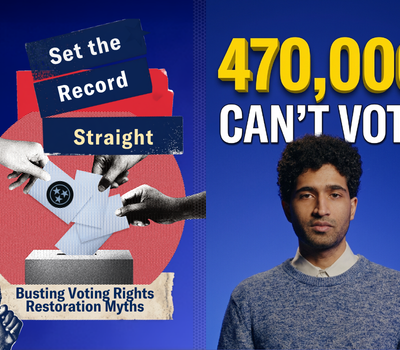
Thumbnail for the Set the Record Straight Series. Cover Reads: 470,000 Can't Vote

More from the Press


Placeholder image

Stay informed on civil rights issues. Discover our latest actions and updates in the Press Release section.

Punished for Reporting Sexual Harassment: How One Law School Almost Got a Student Survivor Banned From the Bar

George Washington University law student Dorea K. Batté saw the texts, missed calls, and voicemails pour into her phone by the hundreds. When she blocked the number they were coming from, her stalker found a way to use different numbers to contact her. She kept blocking the numbers; he kept reaching her using new ones. Feeling helpless and overwhelmed and after warning her stalker twice to stop contacting her — to no avail — Batté finally went to her law school’s Title IX office to get help. As a reminder, Title IX is the federal law that prohibits sex discrimination — including sexual harassment — in education. Batté wasn’t trying to get anyone in trouble; she just wanted the harassment to stop. So when her school offered a non‑disciplinary solution to her Title IX complaint — a mutual no-contact order, where neither student could interact with the other — she gladly accepted. The order was informal, requiring nothing more than agreement by both parties. It involved no disciplinary proceedings and no disciplinary findings. Batté was assured that the “administrative order” did not go into her academic record or appear otherwise in anything that would show up in a background check. The no-contact order worked: Batté had no further problems with the other student. Unfortunately, the same can’t be said for Batté’s interactions with GW. After applying for admission to practice as an attorney in 2020, Batté learned the university reported to the D.C. Bar that Batté had a disciplinary record: the no-contact order that she had sought to continue her legal education harassment‑free. Suddenly, Batté’s bar admission was in jeopardy, given the “character and fitness” portion of the process. The university also put a hold on releasing Batté’s transcript. University administrators declined to fix the problem they created — and one they had promised Batté wouldn’t happen from the start. Instead a GW administrator admitted that she “understood how the complaint started.” Yet she remarkably stood by her bar report, only telling Batté that she was free to “provide whatever explanation you believe to be appropriate to the D.C. Bar.” Batté was shocked that her law school had effectively recast her as a wrongdoer for doing nothing more than trying to continue her education free from harassment. Only when the ACLU of the District of Columbia got involved did GW finally write to the bar to clarify that a no-contact order is not a “disciplinary” action — not for students accused of wrongdoing, who have yet to go through a fair investigative process, and most certainly not for complainants, who have been accused of no wrongdoing at all. Despite this seemingly happy ending, Batté’s experience continues to present a cautionary tale. When the ACLU-D.C. asked GW to reform its reporting process to prevent future students from suffering adverse consequences for invoking Title IX, the school would not commit. In a recent story about Batté’s experience, a GW spokesperson told a reporter, “Mutual no-contact orders are not disciplinary actions, they are not reported to third parties as disciplinary actions, and they are not listed as a sanction on university conduct records.” This was news to us. It is unclear whether this isolated statement, given in response to a media request and unaccompanied by any formal policy document, represents a concrete change in GW policy or an empty talking point in response to negative publicity. Accordingly, future Title IX complainants or respondents could suffer the same consequences for agreeing to what they were led to believe was a non-disciplinary course of action. There is no telling how many students at GW — and at an untold number of other schools — are still saddled with undeserved disciplinary records for trying to have a harassment-free education. The

By aclutn

Placeholder image

Immigration Detention and Coerced Sterilization: History Tragically Repeats Itself

The recent news of a whistleblower’s allegations that a for-profit ICE detention center forced sterilization procedures on immigrant women shocked many people and drew comparisons to Nazi sterilization campaigns. The ICE detention story reflects a long pattern in the United States of the coerced sterilization of marginalized populations, particularly of Black, Latinx, and Indigenous peoples. In fact, the Nazi’s borrowed ideas for their sterilization regimen from eugenic sterilization laws adopted in the U.S. in the early 20th century. Over the course of this long history, both public and private actors in the U.S. targeted the poor, the disabled, immigrants, and racial minorities for forced sterilization. Spurred by the eugenics movement popular at the turn of the century, states enacted laws beginning in 1907 that authorized the sterilization of the “feebleminded.” More than 60,000 coercive sterilizations were performed throughout the U.S. pursuant to these eugenics laws. In Buck v. Bell, the Supreme Court legitimized early 20th century eugenic sterilization practices with Oliver Wendell Holmes’ notorious declaration: “Three generations of imbeciles are enough.”   It was not until Nazi Germany adopted American eugenic theory and practice that public opinion about eugenics ultimately shifted in the United States. The counter-movement against eugenic sterilization culminated in the Supreme Court’s 1942 decision in Skinner v. Oklahoma. While Skinner rejected eugenic sterilization as a valid state goal and recognized that procreation is a basic civil right, the Supreme Court has never explicitly overruled Buck v. Bell.      Although support for eugenics-based sterilization laws waned, new justifications for coerced sterilization arose. Following World War II, concerns about population control, immigration, and welfare costs emerged as new rationales for targeting marginalized populations. By the 1960s, a new era of sterilization abuse was born, which once again focused on the poor, immigrants, and people of color.   For example, in the 1974 case of Relf v. Weinberger, a federal court found that poor people in the South were being forced to agree to sterilization when doctors threatened to withhold welfare benefits or medical care, including for childbirth. Relf involved the forced sterilization of two Black sisters, just 12 and 14 years old, who were sterilized by a federally-funded family planning clinic in Alabama. Their mother signed an “X” on a consent form she could not read, discovering too late that she had inadvertently “consented” to the permanent sterilization of her daughters Mary Alice and Minnie Relf. The federal court in Relf emphasized that coercive medical practices crossed the line between family planning and eugenics.   On the other side of the country and during the same era as Relf, the case of Madrigal v. Quilligan exposed coercive sterilization at the Los Angeles County/USC Medical Center in the early 1970s. After a whistleblower leaked evidence of rampant sterilization abuse at the Medical Center, a group of women filed a lawsuit alleging that medical personnel systematically coerced Mexican American women into submitting to sterilization. The Madrigal case involved women whose primary language was Spanish and who had undergone a tubal ligation after childbirth by cesarean section. Hospital staff repeatedly approached the women for consent to sterilization while they were in the midst of labor — some after being heavily medicated — and pressured the women into signing English language consent forms that they could not understand.   A medical student who was a firsthand witness on the maternity ward testified about what she viewed as the Medical Center’s concerted effort to reduce the birth rate of racial minorities. The medical student detailed coercive practices she witnessed:

By aclutn

Placeholder image

How the ACLU is Flexing its Political Muscle in the 2020 Elections

This week, the presidential candidates will face off in their first debate of the general election. Voters will hear Donald Trump and Joe Biden talk about their views on the COVID-19 pandemic, the economy, and the Supreme Court vacancy created by the untimely passing of ACLU alumna Ruth Bader Ginsburg. The ACLU and our supporters will be listening closely for how their answers relate to key civil liberties issues, including racial justice and reproductive freedom, just as we have throughout the presidential campaign. This cycle, the ACLU has gotten involved in the presidential campaign in a serious way for the first time. During the primaries and caucuses, our volunteers spread across the early states to get commitments (on camera) from the candidates of both parties, on issues like access to abortion and immigrants’ rights. In fact, it was our volunteer, Nina Grey, who secured the all-important commitment from Joe Biden to end the Hyde Amendment, which has blocked access to reproductive health care to low income individuals for decades.  Now, as we enter the thick of the general election, we’re not backing down. Instead, we’re making sure every voter understands the civil liberties issues at stake, and knows how they can safely and effectively exercise their right to vote. Our message to voters: Vote like your rights depend on it. In Michigan, we’ve launched a voter turnout campaign for the Presidential election, to build on the success of last cycle’s Proposition 3 Promote the Vote ballot initiative, which brought no-excuse absentee voting and same day voter registration to the state. We are ensuring that voters — particularly Black Michiganders, young people, and other populations positioned to benefit from the ballot measure — are educated on their rights and options, and encouraged to get to the polls. We are running a parallel voter turnout program in the other important presidential battleground of Wisconsin. We are also continuing our commitment to down-ballot races that often have the greatest impact on policies and practices that affect civil rights. Our focus on hyper-local races, like sheriffs and district attorneys, has brought about crucial improvements on bail reform, reductions in prison and jail populations, protections in access to abortion, and the end of immigration detention agreements with the federal government. Voters have the opportunity to usher in even more change in this vein on Nov. 3. In the 2020 ballot measure space, we’ve made racial justice one of our top priorities for this election cycle. Our largest financial and personnel commitments have focused on three ballot referenda with strong racial justice implications. In California, the ACLU and its affiliates will invest approximately $1 million to lift a ban on affirmative action. In Oklahoma, we have spent more than $3 million to enact far-reaching criminal justice reforms that will help address racial biases and systemic inequality in the criminal legal system. In Nebraska, we’ve invested over $1 million to fight the extortionist practices of predatory payday lending institutions, which takes $28 million a year from low-income people, disproportionately people of color, in the state. Taken together and coupled with another ballot measure investments, the ACLU is flexing its political power to advance an agenda of systemic equality — one that gets at the root causes and persistent effects of systemic racism.   We are a nonpartisan organization, and we don’t endorse or oppose particular candidates for office. But we’re involved in elections because the stakes are incredibly high for civil rights and civil liberties issues in America. The ACLU aims to educate voters about the civil liberties and civil rights records of candidates — through paid and earned media and other forms of voter communication — and encourage voters to factor those records into how they vote. At the same time, we mobilize ACLU volunteers to ensure that Americans around the country understand the potential consequences of these elections, certainly the most consequential in generations in terms of civil liberties and civil rights. Our volunteers will make millions of phone calls and send millions of text messages to voters over the course of this election. And through our new platform, Let People Vote, we’re ensuring people know how and when to vote, as well as how to get involved in their state. The ACLU takes its nonpartisan status very seriously. We are not nonpartisan merely out of tradition or to protect our tax status; we are nonpartisan because our commitment to civil rights and civil liberties drives everything we do. We have an issue-based agenda, not a party-based one. We are nonpartisan because we have had allies from all political stripes and all political parties — and opponents, also, from all points on the political spectrum. Rather than judge politicians based on their party affiliation, we judge them on their civil liberties and civil rights records and stances. We thanked Chuck Grassley — the Republican senator from Iowa — for his leadership on the First Step Act with a full-page ad in his local newspaper. And yet, we are likely to clash horns with the same Senator Grassley for refusing to defer the confirmation process for Justice Ginsburg’s successor until after inauguration. We are an equal opportunity friend and foe, but a constant advocate for civil liberties and civil rights. When we engage in politics, we do so to highlight the issues that affect our daily work and the lives of millions of Americans. Success for us is infusing a higher profile discussion of key civil liberties issues into elections and into voters’ calculus when casting their votes. We engage in electoral work because this is when citizens are most engaged, our issues are most salient, and voters have the greatest power to affect policy. It is also when politicians are most likely to take seriously what voters care about. Our goal is to make sure candidates know civil liberties and civil rights issues matter to voters and move the needle on key policies and practices. We’re trying to change hearts and minds on civil liberties issues, and therefore we have short- and long-term goals. For instance, an anti-civil liberties candidate may very well win despite our best efforts to educate voters about that race, but we will have fulfilled our mission if we’re able to increase voters’ understanding and awareness of civil liberties issues.   We, therefore, have made and remain committed to the following assurances about our electoral work: The ACLU will not endorse or oppose specific candidates for elected office. Our goal is to ensure that voters are educated about the potential consequences of an election, not to support specific candidates. The ACLU will not tell people to vote for particular candidates. Educated voters can make their own decisions. The ACLU’s job is to provide voters with the information they need to know about what is at stake. The ACLU will not coordinate with any partisan organization in electoral work. While the ACLU believes deeply in working in coalition with other nonprofits, we have no interest in partisan coordination. Our aims are different from those of a political party, and are driven by issue-based goals. (We know, for instance, gerrymandered political maps that disenfranchise voters have been drawn by both Republicans and Democrats — and we have opposed them in both instances.) The ACLU will let civil rights and civil liberties issues drive its electoral work. The ACLU is not doing electoral work to affect the balance of political power, but to drive concrete policy outcomes that matter for people’s lives. We will choose to engage in electoral races where important civil rights and civil liberties issues are at stake. And we aim to establish a mandate for politicians to enact policies that expand rights and freedoms for all. For every election we participate in, we will be able to identify a set of concrete policies and practices that have changed because of our electoral engagement and the ultimate decision of the voters. The ACLU will aim to educate voters about the consequences of specific elections. This could include issuing scorecards, hosting ACLU-sponsored issue-based town hall meetings, doing issue-focused radio ads or TV, mailers, billboards, or transit ads. The goal is to infuse a discussion of civil rights and civil liberties into a political race and to communicate to the public how the choice of elected officials leads to differences in policies and impacts on people’s lives. The ACLU will urge voters to go to the polls. It does not matter how much voters understand about an election if they do not vote. In the end, the choices that people make on Election Day have great consequences. The ACLU will encourage voters to make their voices heard. The ACLU will defend election integrity and ensure that every vote is counted, regardless of the party affiliation of the voter. In addition to our advocacy to inform and turn out voters, we engage in advocacy and litigation to ensure that every vote counts. This includes 31 lawsuits in more than 20 states, as well as pressing for laws in states like North Carolina to ensure that voters who have their mail ballots rejected have an opportunity to “cure” or fix them. With offices in each and every state, and boots on the ground in every voting jurisdiction, the ACLU is uniquely situated to ensure that every vote is counted in this critical election.  Electoral work in this frame is a natural extension of the work we have been doing for 100 years. The ACLU has never shied away from a fight when civil liberties were at stake, whether that fight was in a courtroom, Congress or a state legislature, in the streets, or at the ballot box. We ask you to join us in this important endeavor.

By aclutn

Placeholder image

Wi-Fi is Another Way We Can Be Tracked 24/7

Wireless internet has become essential to modern life, enabling us to use our smartphones, tablets, and laptops as we move about in the world. Easy internet connectivity that comes from having Wi-Fi access points spread through office buildings, transit systems, parks, businesses, college campuses, and city streets is a public good. But Wi-Fi networks also collect information about when and where our devices connect to them, information that can precisely reveal our locations and movements. This is revealing data that shouldn’t carelessly end up in the hands of police.   That is why today, the ACLU, along with the ACLU of Pennsylvania and the Electronic Frontier Foundation, filed a friend-of-the-court brief in the Pennsylvania Supreme Court explaining why warrantless police access to people’s Wi-Fi-derived location information violates the Fourth Amendment.   The case, Commonwealth v. Dunkins, involves a police investigation into a 2017 robbery of marijuana and cash from a student’s dorm room on a Pennsylvania college campus. After receiving a report of the robbery, police went to the college IT department and got a list of all smartphones and other devices that were connected to the 80-90 different Wi-Fi access points spread across the residence hall around the time of the robbery. Because those access points each have a small broadcast radius, knowing which Wi-Fi access point a phone was connected to provides precise information about where that phone was.   Using that information, the police identified several dozen students who were in the building at the time, and then narrowed down the list to three students who lived in other dormitories. Two of those students were women, and were excluded because the suspected robbers were described as male. Police focused on the remaining student, Dunkins, and requested information about all his Wi-Fi connections on campus during a five-hour period on the night of the robbery, a detailed account of his movements over time.   The Wi-Fi location information was essential evidence at trial, tying Dunkins to the scene of the robbery. But it’s not hard to see how invasive the searches were for other students as well. By learning that two women were in someone else’s dorm rooms in the wee hours of the morning, police could infer private information about where they were sleeping and with whom. That’s none of the government’s business.   That’s why the ACLU is arguing that this sensitive location data is protected by the Fourth Amendment. And we have powerful Supreme Court precedent behind us.   In 2018, in an ACLU case called Carpenter v. United States, the U.S. Supreme Court ruled that police need a warrant to request a person’s historical cell phone location information from their cellular service provider. We have argued in other cases, including in a brief we filed in another Pennsylvania case last week, that the rule in Carpenter should apply to real-time cell phone tracking, automated license plate reader databases, long-term surveillance of homes with pole cameras, pervasive aerial surveillance, and requests for sensitive digital medical information. Today, we are arguing that this protection should apply to Wi-Fi-derived location information as well. Like the location information at issue in Carpenter, the data created whenever a phone connects to a Wi-Fi access point paints a detailed picture of a person’s “privacies of life,” and therefore deserves Fourth Amendment protection.   The prosecution argues that because Carpenter involved location information spanning days and months about one particular suspect, the shorter-term data about many people in the Dunkins case should be unprotected. But even short-term location data can reveal deeply private information about where a person goes and what they do there. And requesting information about all people who were in a particular building at a particular time will almost certainly sweep in bystanders who had nothing to do with any crime, making the search dangerously overbroad. Here, for example, two non-resident female students and their hosts were caught in the net, illustrating the privacy interests at stake.   The implications of the Dunkins case extend far beyond privacy on college campuses. Cities across the country, from Boston to New York to El Paso, have built free municipal Wi-Fi networks spanning significant geographic areas. Comcast has deployed “millions of hotspots” as part of its Xfinity service. On many of these networks, after a person connects their device the first time, they will automatically connect and reconnect to any Wi-Fi access point that is within range, generating a great deal of location information going back weeks, or even years.   Like the cell phone location data in Carpenter, Wi-Fi location information is “detailed, encyclopedic, and effortlessly compiled.” As we explain to the Pennsylvania court, it is dangerous to allow police access to this information without probable cause, narrow tailoring, and judicial supervision — in other words, police should have to get a warrant. And the Fourth Amendment might never allow a request that sweeps in precise location information about many bystanders. This case provides an important opportunity to ensure strong protections for privacy in the digital age.

By aclutn

Placeholder image

True Justice for Breonna Taylor Won’t Come From Criminal Charges Alone

This OpEd was first published in Slate. Americans have just completed another round of one of our grimmest national rituals: shaking our heads while cops who killed an unarmed Black person get away with murder. This time the victim is Breonna Taylor, whose name has galvanized nationwide protests for racial justice, but whose family will receive no justice themselves. Yesterday, Kentucky Attorney General Daniel Cameron announced a single charge from the grand jury against only one of the three officers involved in her shooting, and even that was for shooting a wall, not Breonna Taylor. The other two will walk. And a community that has already waited six months for closure will just keep waiting. Many are rightly pointing out that these cops should not avoid charges based on self-defense when they created the danger in the first place. Accordingly, whether the grand jury result makes sense under the criminal law will be hotly debated in the coming days. But even when there is substantial evidence of wrongdoing, police officers are almost never prosecuted, let alone convicted. And with each press conference announcing that an officer’s actions were justified, the public’s faith in the law — and in the prosecutors tasked with enforcing the law — erodes just a little bit more. Prosecutors often claim they are simply hamstrung by the law, which does confer a great deal of protection on police. But there are many actions a prosecutor can take to create lasting, systemic police accountability—if they want to maintain any credibility with the people they’re supposed to serve. Prosecutors—both the local elected versions and Attorneys General at the state level—can and must do so much more. The work starts well before an officer causes harm.  The everyday working relationship between police and prosecutors is inherently conflicted; prosecutors rely on police for case leads and in-court testimony, and police need prosecutors to win cases and boost clearance rates.  (Sadly, trial wins and not public health outcomes are still the coin of the criminal justice realm.)  Prosecutors must institutionally separate themselves enough from police to judge them objectively.  This means refusing police union donations during their own elections.  It means mandatory reporting of cops to ethics investigators when the cops screw up.  It means putting a hard stop on lobbying in lockstep with police unions to thwart reform, as prosecutor associations so often do.  Prosecutors who are serious about accountability should also lobby for efforts like civilian oversight of police, shrinking law enforcement—including their own offices—and reinvesting in communities. Second, prosecutors till the ground for police violence when they ignore or actively cover up misconduct or corner-cutting in everyday cases. This happens all. The. Time. For example, right after a suspect is arrested, prosecutors have to decide whether to take the case forward or “screen” it out. A substantial number of those cases involve uncorroborated police testimony, manufactured defendant resistance, outright violence or coercion, or just plain uncertainty.  If prosecutors go along to get along, taking virtually all those cases forward (even if they drop them later), this validates predatory police tactics that ought to be discouraged. As that case moves forward, a prosecutor may also offer the defendant a deal to plead guilty to lesser charges, which then avoids judicial scrutiny of police misconduct. The prosecutor may also knowingly allow the officer to lie on the stand, a practice so common it’s got a nifty portmanteau: testilying. Don’t believe that these underhanded tactics occur? Consider that Louisville prosecutors offered Breonna’s ex-boyfriend, Jamarcus Glover, a supremely lenient plea deal if he would just implicate Breonna in an “organized crime syndicate.” This was a dirty trick to smear her name and bolster the cops’ story—and it only failed because Glover, heroically and against his own interest, turned down the deal. These day-in, day-out violations of public trust are virtually impossible to catch, but help create the bond between police and prosecutor that makes independence so difficult. To stop it, elected prosecutors and legislators need to ratchet up the professional penalties for prosecutors who cover for their friends to the detriment of the community. And we need to create standalone legal proceedings—a sort of constitutional small claims court—for victims of police misconduct that don’t depend on the prosecutor to represent those victims. Finally, when police do commit violence against the American people, prosecutors at the local, state, and federal levels must inflict far more fulsome, lasting accountability that is not limited to criminal prosecution.  Of course, the local prosecutor and maybe even the state AG, who all work directly with the offending cops, should be recused from any criminal investigation; this much is table stakes.  Any appointed, independent prosecutor should also consider foregoing a secret grand jury so the community can be confident that they made the strongest possible case.  (We are already seeing calls for AG Cameron to release the grand jury evidence in Breonna’s case.) But then the state Attorney General or the US DOJ should open a mandatory civil rights investigation that results in both resignation and decertification of the individual officers plus systemic changes to the office. That settlement would also require the local prosecutors to put the officers on a standing, public list and commit not to call them to testify in any case going forward. Police chiefs and mayors often complain that union contracts and arbitration makes firing bad cops so hard. Prosecutors can and should do it for them. And they should do it regardless of whether a grand jury returns an indictment. Of course, prosecutors won’t altruistically take on all these reforms voluntarily. These fundamental changes would make churning out convictions much more difficult, would strain their mutually beneficial relationship with the cops, and create more red tape. But that strain and that red tape is worth preventing the senseless loss of another Black life. The people marching in the streets can push both police and prosecutors to to conjure a vision of justice broader and deeper than criminal prosecution.  Breonna Taylor deserves it.  We all do.

By aclutn

Placeholder image

How Ruth Bader Ginsburg Got Her Start at the ACLU

Half a century ago, in October 1970, I became the executive director of the ACLU. I had a wish list, and foremost on the list was the establishment of a Women’s Rights Project.   I had been involved in a few women’s rights cases in my previous post as director of the New York Civil Liberties Union. My wife, who was a young corporate executive at a time when not many women held such posts, encountered discrimination against women on a regular basis. Most importantly, a feminist movement had been reborn in the late 1960s, and I wanted the ACLU to be part of it and to contribute expertise in litigation. Though the era of the Warren Court had just ended, and our prospects for extending constitutional rights to those previously denied such protections were drastically curtailed, I thought the re-emergence of a feminist movement might be the chance we needed to succeed in promoting women’s rights.   The ACLU board readily endorsed the establishment of a Women’s Rights Project (WRP). The next hurdle was raising the funds for it. The ACLU had only recently established a tax-deductible entity that could receive foundation grants, and it took me a while to get funding.

By aclutn

Placeholder image

Two Steps Forward, One Step Back: A Cautionary Tale About Bail “Reform” in Georgia

It is now well known that our country’s widespread use of money to determine someone’s freedom after arrest — a practice commonly referred to as cash or money bail — is harmful, unnecessary, and against the core principles of our Constitution. Over the past several years, a massive wave of political and legal action has taken aim at addressing the tremendous suffering and bad public policy embodied in our cash bail systems. Just this summer, “ending cash bail” was one of the agreed upon policies in the platform released by Bernie Sanders and Joe Biden. Jails are among the most dangerous clusters of COVID-19 transmission, and cause further spread in surrounding communities. The work of diverting people from unnecessary incarceration is thus all the more urgent. While stakeholders across the ideological spectrum seem to care about addressing the evils of wealth-based pretrial jailing, it remains to be seen whether any of those efforts are actually working. Sadly, our recent study in the Georgia Law Review suggests we have a long way to go even after claiming reform victory. Alongside two law professors, two computer science students, and a cadre of amazing student and community volunteers, I studied whether bail reform has worked in a state that has heralded numerous “bail reforms” over the past few years. In 2018, Georgia passed legislation aimed at improving fairness in misdemeanor cases, which included requiring authorities setting bail to consider a person’s finances. Later that year, the 11th Circuit Court of Appeals issued a ruling in a class action lawsuit challenging Georgia jurisdictions’ use of money bail to incarcerate people who are unable to pay to secure their freedom. The court found “presumptively constitutional” a system in which all arrestees, including those too poor to post bail, were guaranteed release from jail within 48 hours of arrest and provided individualized hearings with the assistance of a lawyer. Our study examined whether the constitutional principles outlined by the 11th Circuit as well as the updated Georgia law were actually being followed in practice. Examining a representative sample of 51 Georgia counties through court observations, review of court records, interviews, and surveys of court and jail staff, we assessed each county’s compliance with legal mandates required by bail reform. What we found was disheartening: Not one of the counties studied was in full compliance with the law, as none of them practiced all four of the legal requirements we studied. Most counties only satisfied one or two of the requirements, and many failed on all four:

By aclutn

Placeholder image

Facebook’s Discrimination Against the LGBT Community

My wife and I have made music together for the past 8 years, in an independent band named Unsung Lilly. We are passionate about creating epic, empowering pop music. As a same-sex couple, we have been heartened recently by the improved representation of LGBTQ people on television, and we are grateful that most people we meet are accepting of our relationship. It’s enough to make you think that maybe society has fully accepted that ‘love is love.’ Unfortunately, our recent experience with Facebook suggests otherwise. When Facebook’s platform refused to allow us to fully express ourselves as both artists and a same-sex couple, it brought back painful memories of discrimination against the LGBTQ community. Like all musicians, COVID hit us hard. We lost all our income, and because we were in the United States on work visas, we were unable to claim unemployment benefits without risking our visas. We were in a difficult spot, and we turned to our community on Facebook for help. We asked our fans to join our Patreon community and go behind the scenes of the creation of our new album, in the hopes that their support would keep us afloat in these unprecedented times. We posted a video on Facebook, announcing our new album and encouraging fans to join our Patreon page. We made it a sponsored ad so we could reach as many of our fans as possible. The ad, unfortunately, was rejected. While this happens sometimes, I couldn’t believe it when I saw the reason: Facebook had labeled our video as containing “adult sexually explicit content.” Assuming there must have been a mistake, we sought multiple appeals and resubmitted the ad several times, but each time received the same rejection message. We wracked our brains wondering what could be sexually explicit about our video…and then realized that it might be the image of us early in the video. It’s a romantic image of us with our foreheads touching. We use the image for all our profile photos across all platforms because we believe it’s a beautiful artistic shot of two people in love. You can watch the video here. When we talked about what happened on our social pages, many of our friends and fans shared our outrage. Some people even came up with possible explanations for why the ad was rejected. These ideas included theories such as “Facebook doesn’t allow intimacy of any kind in their advertisements, it would have been the same with a hetero couple,” and “what about the nature of some of the dancing shown later in the video.” We wanted to understand why our ad was rejected. So, we ran a test. We posted another ad with the exact same video and copy, but we changed the photo of us to a ‘nonromantic’ photo. The ad was approved. Next, we tried the same video and copy but replaced the photo of us with a picture of a heterosexual couple in the same romantic pose. Guess what? The ad with the heterosexual couple was approved too.

By aclutn

Placeholder image

When will DeSantis listen to his own voters on ex-felons’ voting rights?

On Sept. 11, Gov. Ron DeSantis and state Republican leaders won their legal battle to disenfranchise hundreds of thousands of people with prior felony convictions. The U.S. Court of Appeals for the 11th Circuit embraced Republican politicians’ specious arguments that ex-felons should be required to pay all fines and fees before voting.   This decision dealt a blow to Floridians who care about racial justice and basic principles of democracy. The ruling also spited an unlikely and less discussed constituency: Republican voters.   This story starts in 2018, when DeSantis and Republican politicians campaigned against Amendment 4. The ballot measure abolished the permanent disenfranchisement of people convicted of most felonies. Vowing to be a “tough on crime” governor, DeSantis opposed the initiative.   Republican voters disagreed with him. Before Election Day, poll after poll showed a clear majority of Florida Republicans supported Amendment 4. Support among Florida Republicans climbed to 62%.   These numbers were not outliers. Nationally, 58% of people who voted for Donald Trump in 2016 support restoration of ex-felons’ voting rights.   On Election Day, the Sunshine State’s Democratic hubs turned out in force for the measure. So did the state’s most Republican regions. Amendment 4 won in 61 of Florida’s 67 counties. Conservatives, from the ruby-red Panhandle to the sea-green suburbs of Sarasota, voted for the measure.   Consider election results from individual counties. Voters in Gadsden and Broward counties, where Hillary Clinton received more than 65% of votes in 2016, supported Amendment 4. But so did a majority of voters in Dixie County, where Donald Trump garnered over 80% of votes in 2016. As did a majority of voters in Calhoun, Liberty, Walton and Washington counties, where Donald Trump earned more than 75% of votes cast in 2016.   In an era of rancorous politics, this resounding, bipartisan consensus over voting rights might seem unexpected. But attentive observers of Florida politics weren’t surprised.   The political strategists and grassroots activists behind Amendment 4 built an inclusive campaign that directly appealed to conservatives. Desmond Meade, a civil rights activist who spearheaded the campaign for Amendment 4, recruited a Republican staffer named Neil Volz to be the effort’s political director.   They enlisted Christian conservatives, who told voters that “redemption and second chances” were at the “heart of the Christian faith.” They recruited business executives who discussed the economic harms of permanent disenfranchisement and mass incarceration. They accepted support from liberal billionaire George Soros — but also from the archconservative Koch brothers and the religious right.   Together, this motley alliance — of the ACLU and the Christian Coalition, of libertarians and labor unions — won. And won big. A supermajority of Floridians supported Amendment 4, which amassed 1,072,740 more votes than DeSantis received on the same ballot.   Even before assuming office, DeSantis and his allies began plotting to undermine the will of Florida voters and, importantly, the will of Republican voters. They devised a scheme that conditioned ex-felons’ rights restoration on how much money they have. This “pay-to-vote system,” according to Judge Robert Hinkle of the Northern District of Florida, amounted to a modern-day poll tax.   Fast forward to Sept. 11, when the 11th Circuit sustained this poll tax. Commentators were quick to depict the ruling as a win for Republicans. In reality, the decision was a win for Republican party elites and a loss for voters of all partisan affiliations.   Sadly, this is not the first time that Republican party elites have ignored the wishes of regular Republican voters. A majority of Florida Republicans want the state to expand Medicaid under the Affordable Care Act. DeSantis refuses. 86% of Florida Republicans are concerned about climate change. DeSantis earns a “D” from the Sierra Club for his climate-change record. Blocking voting-rights restoration is just the latest episode of Republican leaders pandering to the far-right fringes and special interests at the expense of the majority of Republican voters.   It’s easy to look at this episode and get cynical about American politics. But that would be the wrong lesson to take from the Amendment 4 saga. At a time of bitter, partisan division, a supermajority of ordinary Democrats and Republicans joined forces to pass the most significant expansion of voting rights since 1965. Even if DeSantis scored a pyrrhic victory before the 11th Circuit, he can’t hold back this broad, bipartisan coalition forever.   This op-ed was originally published in the Orlando Sentinel.

By aclutn

Placeholder image