A smiling woman in an ACLU baseball cap and sunglasses sits at the top of a yellow and blue inflatable slide, holding up an “I ❤ Democracy” ACLU bumper sticker.

When Will Tennessee Certify the 2026 Midterm Election Results?

After High Turnout, ACLU-TN Thanks Tennessee Voters, Poll Workers, and Partners, Looks Ahead to an Orderly Certification

By Cathryn Stout, PhD.

Latest Publication


Citizenship Rights Restoration in Tennessee

Restoring your voting rights in Tennessee got easier in 2026. State Sen. Raumesh Akbari and State Rep. Karen Camper led the charge in the legislature to remove some of the biggest barriers standing between formerly incarcerated Tennesseans and the ballot box.

The Campaign Legal Center and Free Hearts, a Tennessee nonprofit led by formerly incarcerated women, have been on the ground helping people navigate this process and pushing for a fairer system. For eligibility requirements and step-by-step petition instructions, read the guide from Free Hearts and the Campaign Legal Center.

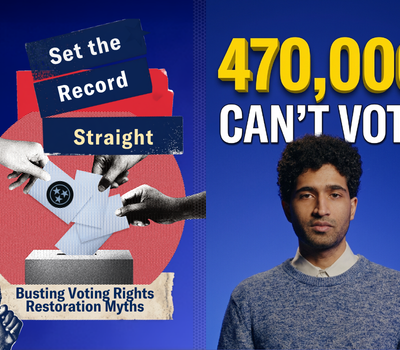
Thumbnail for the Set the Record Straight Series. Cover Reads: 470,000 Can't Vote

More from the Press


Placeholder image

Stay informed on civil rights issues. Discover our latest actions and updates in the Press Release section.

The Supreme Court Rulings You’re Not Hearing About

This past June, many breathed a sigh of relief when the U.S. Supreme Court rose above partisanship in controversial cases involving abortion, LGBTQ+ rights, the rights of DREAMERS, and the president’s tax returns. In those cases, conservative justices relied on legal reasoning, rather than party loyalty, to guide their decisions. But lurking in the shadows is a concerning new trend in the Supreme Court to grant an unprecedented number of emergency orders with little transparency and no opportunity for recourse. These cases comprise the court’s aptly named “shadow docket.” And under the Trump administration, this shadow docket has grown exponentially, with the Supreme Court disproportionately ruling on the side of the administration. On the podcast this week, we’re joined by the ACLU’s legal director David Cole, who explains this trend and digs into why it’s so concerning. We spoke with David before Justice Ginsberg’s death, and before President announced Amy Coney Barrett as his pick to replace her.  It is safe to say that the trends we discussed with David are unlikely to shift course — and could even worsen in the wake of these events.

By aclutn

Placeholder image

The Law That Sent a Man to Prison for Life for Stealing a Pair of Hedge Clippers – and What Prosecutors Can do About It

Last month, the Louisiana Supreme Court refused to review the life sentence of Fair Wayne Bryant, who was sentenced to life in prison for attempting to steal a pair of hedge clippers more than 20 years ago. Bryant’s sentence was the result of Louisiana’s extreme “habitual offender” law, which allows people to spend life in prison for minor offenses. While the court should have reviewed the sentence, the legislature should abolish this law, and until then, Orleans prosecutors should refuse to seek it. Habitual offender statutes, known in some states as “three strikes” laws, are a relic of failed “tough on crime” policies that have had devastating consequences for families and communities across the country. Both racist and punitive in their nature, these enhancements drive out of control prison populations in states that have some of the highest incarceration rates in the world, Oklahoma and Louisiana among them.  Under these statutes, a person who is convicted of more than one felony crime faces longer and longer sentences for each subsequent conviction — no matter how minor or how much time has passed since. Not only are these laws racist, they are also ineffective and unnecessary from a public safety perspective. The majority (64 percent) of people serving time in Louisiana prisons under the law are there for nonviolent crimes, and Black people represent nearly 80 percent of those convicted as habitual offenders. The sheer cruelty and unfairness of Mr. Bryant’s sentence is enraging and inexcusable, but it is no anomaly: It is part and parcel of a system designed to perpetuate racial injustice and white supremacy.  Louisiana’s extreme sentencing law has condemned thousands of Louisianans to life imprisonment for minor offenses, helping make Louisiana the world’s leading incarcerator. And its longevity is a prime example of how our legal system continues to oppress, brutalize, and imprison Black and Brown people. In a scathing dissent to the decision, Louisiana Supreme Court Chief Justice Bernette Johnson traced the law to the Black codes and “Pig Laws” during the post-Civil War era, which attempted to re-enslave newly-freed Black people.  “These laws remained on the books of most Southern states for decades,” Justice Johnson wrote. “And this case demonstrates their modern manifestation: harsh habitual offender laws that permit a life sentence for a Black man convicted of property crimes.”  Bryant’s outrageous and unjust sentence is a reminder of the urgent need for state legislators to repeal this extreme sentencing law before it needlessly destroys more people’s lives. Ballot initiatives like Oklahoma’s Yes On 805 campaign seek to put an end to the destructive power of habitual sentencing enhancements through the electoral process. Fortunately for Louisiana, our district attorneys don’t have to wait.  Prosecutors — right now — have the discretion to stop seeking enhanced penalties under the habitual offender law, and all of us have a responsibility to hold them to it.  There are dozens of district attorneys on the ballot across Louisiana this year — including in Orleans Parish, where District Attorney Leon Cannizzaro is stepping down after 12 years of pushing ineffective “tough on crime” policies.  The ACLU of Louisiana is proud to be among more than 30 organizations in the People’s DA Coalition, which, among other reforms, is calling on Orleans Parish District Attorney candidates to commit to ending all use of the habitual offender law. Prosecutors have a vital role to play in helping ensure Louisiana finally sheds its title as the prison capital of the world, and declining to seek harsher sentences under this unjust law would be one important step in that direction. 

By aclutn

Placeholder image

Voting by Mail is Easier and Safer than You Think. Here’s how.

Millions of people are planning to vote by mail in this election, and for most, it will be the first time. COVID-19 has made voting by mail more popular than ever because it’s the safest way for many to cast a ballot. But some voters still have questions about the safety and security of this method, and whether their mail-in ballot will be counted. Contradictory messages from President Trump add to the confusion — even though the president, and many of his cabinet members, vote by mail themselves.  All voters are able to make an informed decision on how to cast a ballot — and that means cutting through the confusion to debunk common misperceptions about vote by mail.

By aclutn

Placeholder image

Safe at Home: Fighting Against Sexual Harassment in Housing

Rita, a single mother, was desperate to find an affordable home in Palm Beach County, Florida, after suffering a foreclosure a few years earlier. After searching for some time, she finally found an apartment within her price range but there was one huge problem: Soon after she moved in, the property manager began to sexually harass her.   He took advantage of Rita’s financial circumstances — and his position of power over her — to extort sexual acts from her in exchange for reduced rent. The harassment escalated, as he tracked her whereabouts, monitored her guests, and installed surveillance cameras facing her home. After Rita refused to continue with the “quid pro quo” arrangement, the property manager retaliated. He served her with fraudulent violation and eviction notices, filed an eviction action against her even though she owed no rent, and asked the police to arrest her for trespassing.  Rita filed a lawsuit against the property manager, arguing that his harassment of her and retaliatory acts once she rejected his sexual behavior violated the federal Fair Housing Act, which protects people from discrimination based on sex, including sexual harassment. In a shocking decision, the trial court dismissed her case at the earliest stage, concluding that even if she could prove all of her allegations, the property manager’s conduct would not qualify as either harassment or retaliation.  Yesterday, the ACLU Women’s Rights Project, along with the National Fair Housing Alliance, National Women’s Law Center, Relman Colfax PLLC, and other groups, filed an amicus brief in support of Rita’s appeal to the U.S. Court of Appeals for the 11th Circuit. The brief lays out the consistent case law that shows sexual harassment in housing violates civil rights guarantees. It also underscores the inherent power imbalance between a housing provider and a tenant, arguing that an owner or property manager violates the Fair Housing Act when he conditions a tenant’s rental payment on her submission to sexual acts as well as when he retaliates against her when she refuses. Unfortunately, Rita’s experience is far from anomalous. Sexual harassment in housing remains a widespread and insidious issue for women and LGBTQ tenants across the country. And the COVID-19 pandemic has only made tenants more vulnerable to harassment and abuse by landlords and property managers who abuse tenants’ financial insecurity and shelter-in-place orders. Sexual harassment in the home in uniquely violative and threatening, as the home is supposed to be one’s place of refuge. Victims of sexual harassment have reported severe and often immobilizing emotional and physiological consequences, including shame, depression, sleeplessness, headaches, and anxiety. In many cases, individuals are forced to move out of their homes to escape the abuse. But such displacement is expensive and often results in financial hardship due to steep moving costs, loss of security deposits, and even job loss. Critically, women of color are especially vulnerable to sexual harassment and its lasting consequences due to the intersecting experiences of racism and sexism. The testimony of Black women, Indigenous women, and other women of color often reveals that they have been sexually harassed or targeted precisely because of their race and stereotypes about women of color. Moreover, the harmful impact of sexual harassment is magnified for women and gender-nonconforming tenants who hold other marginalized identities. Women with disabilities, for example, face higher rates of sexual harassment and violence than those without disabilities. Transgender women and other LGBTQ-plus tenants also experience significant barriers to housing access due to harassment and abuse based on sexual orientation or gender identity. Yet despite the devastating consequences of discrimination on tenants, landlords lag far behind employers and schools in ensuring that they and their staff are held accountable when they perpetrate sexual harassment, or when they know of harassment committed by other tenants. Courts should hold landlords accountable when they fail to address harassment, including sexual harassment, committed by tenants — just as employers are responsible for responding to sexual harassment at the workplace, and schools are responsible for responding to complaints by students. We recently filed an amicus brief in Francis v. Kings Manor Park — a case before the U.S. Court of Appeals for the Second Circuit — arguing that a housing provider should be held liable under the Fair Housing Act for refusing to respond to discriminatory tenant-on-tenant harassment. Enforcing the Fair Housing Act’s protections against sexual harassment — whether by landlords, property managers, or other tenants — is a crucial step. It has been established time and again that this nation’s civil rights statutes broadly protect against sexual harassment in every major facet of one’s life. The courts must apply the Fair Housing Act’s protections to ensure equal housing opportunity for women and all marginalized communities.

By aclutn

Placeholder image

At the Polls, Episode 3: The Role of the Courts in Election 2020

Election Day is fast approaching, and while we’re doing everything we can to prepare, some questions remain unanswered.  Dale Ho, director of the ACLU Voting Rights Project, and University of Michigan law professor Leah Litman join the At the Polls podcast this week to discuss litigation across the country that could impact who gets to vote and how.

By aclutn

Placeholder image

CBP Wants to Destroy Records of Misconduct. We Can’t Let Them.

Customs and Border Protection (CBP), the nation’s largest federal law enforcement agency, operates with

By aclutn

Placeholder image

We Are Not Okay

We, your Black friends, family, and colleagues, are not okay. A Black woman, asleep in her bed, was murdered in cold blood and the system didn’t just find her killers innocent — they found their crime, the crime of ending the life of a Black woman, unworthy of even being charged. We work alongside you at the American Civil Liberties Union, fighting for a country that’s never loved us and forced to fight within a system built to harm and kill us. A legal system that says explicitly that Black lives do not matter. A system that calls for more accountability for putting bullets into drywall than into a Black woman. I ask you to imagine how the system would have responded if these police had murdered a white woman EMT (during a global pandemic) in her sleep. Does anyone think it would have taken six months to convene the grand jury? Does anyone think there wouldn’t even be a trial? Does anyone think that this country reacts and punishes the harm done to Black women with even a semblance of the outrage and protection we reserve for other communities? If you are not Black and you’re asking yourself, “How can I help my Black friends, family members, and colleagues?”, here is a non-exhaustive list of what you can do today: 1. Offer your Black staff and colleagues the opportunity to take time off and help redistribute their workload. Do not just send a note that says, “It’s okay if you need to take some time.” Send a note that says, “I want to support you in taking time off. What can I take off your plate? What meetings can I attend in your place? How can I make that happen?” 2. Be mindful of when/how you are processing your feelings. If you’re not Black, this is the time to be especially mindful of how, when, and with whom you are processing your grief, pain, and anger. Do not put additional emotional labor on your Black friends and colleagues.  3. Do acknowledge the impact of this tragedy. Carve out space in agendas you create to address the trauma and be clear not to move on with “business as usual” without holding that space.  4. Call each other in and call each other forward. Be in solidarity by spending your political capital on racial justice at work and find a way to do it without virtue signaling or centering yourself. Most of your allyship should take place “backstage,” out of the spotlight. Continue educating yourself, amplifying Black voices, donating to Black leadership causes, protesting and demanding justice for Black lives. Those actions matter. At the very same time, support and uplift Black people — on your teams, in our organization, and in your life. For every public, external action you take for racial justice, I invite you to take an action inside our walls with that same spirit. To my Black colleagues: I know you’re not okay. I’m not okay either. We have been fighting for justice every day for 400 years and today we are grieving, we are enraged, and we are exhausted. I see you, I’m with you, I am you. We are not alone in our grief, not abandoned in our anger, not uncared for in our exhaustion. We are in this with each other, with the legacies of our ancestors and the vision of our youth. With the wisdom of our elders and the unwavering guidance of our leaders.

By aclutn

Placeholder image

Ten Questions College Students Should Ask About Their Schools’ COVID-19 Apps

As colleges and universities around the country attempt to resume some semblance of in-person education this fall, many schools are requiring their students to download COVID-19 apps as a condition of returning to campus. These apps vary in what they do, but we are highly skeptical of, or outright opposed, to many of them. It is unlikely that any of these apps will make a significant difference in stemming the spread of the coronavirus on campuses, and it appears that many such apps invade students’ privacy. Many of them, as professor of sociology and technology Zeynep Tufekci argues, are merely “performative” on the part of college administrators — an effort to make a show that they are doing something — and will likely prove to be actively counterproductive.   In public institutions, these app installation requirements represent a government demand that citizens install a particular piece of software on their personal phones. It is true that the current outbreak constitutes an extraordinary situation, but we don’t want this to open the door to a future where people become prisoners of their phones, as various government agencies use compulsory app installation rules to turn them into enforcement devices for all kinds of legal and administrative rules.   It is difficult for us at the ACLU to track what is happening at thousands of schools across the United States, but we encourage returning students and staff being asked to download apps onto their personal devices to ask some sharp questions of school administrators.   1. What does it try to do? Does it administer daily health surveys, remind you to get tested, or provide daily exposure notifications? Does it connect to testing or treatment regimes? Will it help you get in touch with campus health services, or inform you where you can get tested? Does it record your movements or the people that you are near? (We are skeptical and have raised many questions about both location tracking and

By aclutn

Placeholder image

Victory: After Three Years of Battling in Court, the Trump Administration Abandons its Policy of Banning Abortion for Unaccompanied Immigrant Minors

As a direct result of the immense courage of our clients and three years of litigation, the Trump administration has officially abandoned its policy of preventing young immigrants in its custody from accessing abortion care. Yesterday, the administration adopted a new policy that prohibits Office of Refugee Resettlement (ORR) staff and staff employed by any ORR-funded shelter from blocking or interfering with unaccompanied pregnant minors’ access to abortion. ORR’s adoption of this new policy was a condition of our agreement to dismiss our case, which we have done today. It was three years ago that our heroic client Jane Doe — who at the time was 17 and was seeking refuge in the United States on her own — took on the Trump administration. In September 2017, we learned that ORR was trying to stop Ms. Doe from having an abortion through her fierce guardian ad litem, Rochelle Garza, and Texas-based Jane’s Due Process.  Pursuant to the orders of then-ORR Director Scott Lloyd, Ms. Doe was effectively held hostage in the shelter where she was residing for over a month. The federal government prevented her from leaving the shelter to attend any abortion-related appointments; forced her to undergo a medically unnecessary ultrasound and to receive religious “counseling” from an anti-abortion crisis pregnancy center, where they also prayed over her; and she was kept under intensive surveillance. Lloyd also instructed staffers to inform Jane Doe’s parents of her pregnancy and abortion request against Ms. Doe’s express wishes, and despite the fact that she had already obtained a court order permitting her to proceed with her abortion without involving her parents. We rushed into court on behalf of Ms. Doe, and after weeks of court battles, obtained a court order allowing her to access abortion. Since then, we have fought alongside Ms. Doe and on behalf of our other plaintiffs, Jane Poe, Jane Roe and Jane Moe, who were also subjected to ORR’s coercive, anti-abortion tactics, to stop the federal government from commandeering the reproductive decisions of all young immigrants in its custody. Today, we are able to proudly declare that justice has finally been served. Our success is especially meaningful for Ms. Doe, who fearlessly represented hundreds of others to ensure that what happened to her would never happen to anyone else. In response to our victory, she said, “I am happy to know that my fight means that other young women like me will be able to make the decision about whether to become a parent for themselves.” We are certainly taking a moment to celebrate, but the fight for Ms. Doe’s vision of “reproductive freedom for all” is far from over — including for others currently in immigration detention. Indeed, the recent allegations from the Irwin County Detention Center that a government-contracted doctor performed unwarranted gynecological procedures on women in ICE detention are very disturbing, especially in light of our country’s long history of forcibly sterilizing Black and Brown people. These reports follow weaponize the COVID-19 crisis to prohibit abortion under the guise of protecting public health, a terrifying preview of what would happen if Roe v. Wade were overturned. And with the devastating passing of Justice Ruth Bader Ginsburg, the balance of the Supreme Court could soon be shifted against the constitutional right to abortion. In light of President Trump’s vow to only appoint justices that would overturn Roe v. Wade, it is no exaggeration to say that the future of legal abortion is at stake. So, we celebrate with one eye on the Supreme Court, and the other on the road ahead. We’ll continue to fight for access to reproductive health care for people in federal custody and beyond to ensure that the Jane Doe’s victory does not become hollow and her vision for the future is realized: that all people are able to access reproductive health care, including abortion, without obstacles, shame, or stigma.

By aclutn

Placeholder image