
A smiling woman in an ACLU baseball cap and sunglasses sits at the top of a yellow and blue inflatable slide, holding up an “I ❤ Democracy” ACLU bumper sticker.

When Will Tennessee Certify the 2026 Midterm Election Results?

After High Turnout, ACLU-TN Thanks Tennessee Voters, Poll Workers, and Partners, Looks Ahead to an Orderly Certification

By Cathryn Stout, PhD.

Latest Publication


Citizenship Rights Restoration in Tennessee

Restoring your voting rights in Tennessee got easier in 2026. State Sen. Raumesh Akbari and State Rep. Karen Camper led the charge in the legislature to remove some of the biggest barriers standing between formerly incarcerated Tennesseans and the ballot box.

The Campaign Legal Center and Free Hearts, a Tennessee nonprofit led by formerly incarcerated women, have been on the ground helping people navigate this process and pushing for a fairer system. For eligibility requirements and step-by-step petition instructions, read the guide from Free Hearts and the Campaign Legal Center.
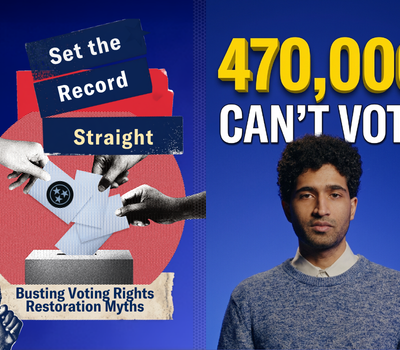

Thumbnail for the Set the Record Straight Series. Cover Reads: 470,000 Can't Vote

More from the Press


Placeholder image

Stay informed on civil rights issues. Discover our latest actions and updates in the Press Release section.

Why Are Police the Wrong Response to Mental Health Crises?

Over the last months on our podcast, At Liberty, we’ve explored different conversations on the subject of policing: abolition, violence and accountability, protest, and activism. This week, we dug into a topic that has gained more attention in the wake of Daniel Prude’s death in March at the hands of the Rochester Police Department: the startling connection between mental health-related 911 calls and police brutality.  Studies show that nearly 50 percent of victims of police brutality are living with a disability, predominantly a mental health disability. In many ways, 911 has become the only option for people looking for mental health crisis intervention. And police often arrive at the scene armed with deadly weapons and a lack of mental health training, with devastating results.   But there is hope. There are alternatives to policing that can provide real care for people in mental health crises, if we invest in them. Joining us on this episode to break down the issue is Gregg Bloche, a professor of law at Georgetown University and a mental health care policy expert, and Ellie Virrueta, an organizer with Youth Justice Coalition. 

By aclutn

Placeholder image

Learn About the Charleston County Sheriff Candidates

The election for Charleston County Sheriff on Nov. 3 can help shape the county’s policies on the role of policing in our community, immigrants’ rights, and law enforcement accountability. The Charleston County sheriff can adopt policies that will make our community safer and more just for all.

By aclutn

Placeholder image

The Trump Administration is Banning Talk about Race and Gender

In the latest attempt to silence conversations about race and gender equity deemed “anti-American,” President Trump issued an executive order last week banning federal entities and contractors from providing employees with training on “divisive concepts” and “harmful ideologies” related to race and gender. What Trump deems “harmful ideologies” are actually concepts diversity trainings use to educate individuals on the systemic barriers and discrimination people of color and other marginalized groups still face in this country today across our institutions — from our workplaces and schools to our criminal legal system. The recent Black Lives Matter and #MeToo movements have shown that people across the country fully acknowledge the realities of systemic racism and sexism are still alive and well, and the need to dismantle the systems and pursue change is more important than ever. But rather than engage with these conversations taking place across the country, the Trump administration seeks to silence individuals and impose an alternate version of American history — one that erases the legacy of discrimination and lived experiences of Black and Brown people, women and girls, and LGBTQ+ individuals.   Our country needs to acknowledge its history of systemic racism and sexism and reckon with present day impacts of racial and gender discrimination. Slavery and its legacy of oppression are parts of American history that Black people are still facing today. Women, especially women of color, continue to be segregated in lower-status and lower-wage fields in the workplace, and are paid less than men across the board. Halting all diversity training could set back progress in addressing these systemic issues, among others — including in the workplace. Talking about racism and sexism is not harmful to employees. Many employers host trainings on these issues precisely because they contribute to a workplace that is more equitable and inclusive. Instead, President Trump’s authoritarian leaning executive order presents the real danger, and takes us steps backwards in achieving full equity in this country. It also violates our First Amendment right to free speech. President Trump’s executive order unconstitutionally requires every single individual or company with a federal contract to certify that they won’t provide trainings on so-called “divisive concepts,” even on the contractor’s own time and dime. In other words, the order effectively gags federal contractors from talking with their own employees about issues of the most profound national importance, such as the impact of systemic racism and sexism in our society. This is a blatant attempt to leverage the federal government’s vast financial resources to suppress speech about race and gender that the Trump administration disfavors. Trump’s executive order borrows from a long-discredited playbook. In the McCarthy era, many states passed laws requiring public employees to certify that they were not members of the Communist Party or other “treasonous,” “seditious,” or “subversive” groups. In response to numerous legal challenges, including several cases brought by the ACLU, the Supreme Court firmly established that the government cannot require people to disavow participation in constitutionally protected speech or association in order to keep their jobs. Whatever power the government may have over its employees and contractors, it does not have the power to dictate their private expression on matters of public concern, including discussions about race and gender discrimination. The Supreme Court has also rejected attempts to categorically ban or burden private expression by government employees and contractors. Such categorical bans present the gravest threat to First Amendment freedoms because they directly suppress an extraordinarily large amount of protected speech, chill even more speech before it happens, and distort discussion on matters of public concern. Of course, President Trump’s executive order is expressly designed to suppress and distort public discussion about issues that Trump considers “divisive,” such as race and gender justice. The Trump administration does not trust people to think for themselves on these issues, and so it has decided to think for them. Fortunately, the Constitution does not give President Trump that authority.

By aclutn

Placeholder image

Reproductive Freedom is on the Ballot: Cast an Informed Vote for Montana Governor

Our next Governor can determine whether doctors are punished for providing reproductive care. Some Montana legislators have attempted to threaten health care providers with criminal punishment — including prison time — for providing reproductive health care. Reproductive freedom in Montana will be in the hands of our next governor. We do not support or oppose candidates, but we urge you to cast an informed vote.

By aclutn

Placeholder image

Mental Health Treatment is on the Ballot: Cast an Informed Vote for Montana Governor

More than 90 percent of Montanans with substance use disorders do not receive treatment. In fact, lack of treatment and services is a big reason that people on probation or parole return to jail instead of to their family, jobs, and communities. Providing access to treatment for mental health or a substance use disorder is less expensive than putting people in jail, reducing the burden on taxpayers while keeping our communities safe and healthy.  Since 2016, Medicaid expansion has helped almost 100,000 Montanans receive access to health care, including funding and increasing access to substance use disorder treatment in Montana. We do not support or oppose candidates, but we urge you to cast an informed vote.

By aclutn

Placeholder image

Overhauling Our Immigration System Begins with Citizenship for All

As we approach the end of President Trump’s first term, it’s important to understand why and how he has inflicted such damage on our nation’s immigration system and advanced his anti-immigrant, racist agenda. Trump has been able to systematically undermine our immigration laws and principles of fundamental fairness because our immigration system is fundamentally broken. It has been for decades. 

By aclutn

Placeholder image

At the Polls, Episode 4: What Does it Take to Get Younger Voters to the Polls?

The younger you are, the less likely you are to vote. At least, that’s been the enduring trend in American politics for decades. But that trend is beginning to shift — today’s young voters are more engaged than ever before, and if they turn out in 2020 like they did in 2018, they could significantly impact the outcome of the election. So what does it take to get younger voters to the polls?  We take on this question in the latest episode of At the Polls, alongside Michael McDonald, a voter turnout researcher at the University of Florida, and Harvard University student and youth activist David Hogg, a survivor of the Parkland school shooting in 2018. 

By aclutn

Placeholder image

Learn About Where the Cobb County Sheriff Candidates Land on Civil Liberties Issues

The Cobb County Detention Center is in crisis. Fifty people have died in custody since 2003, and others have experienced deadly neglect, misconduct by deputies, inhumane conditions, extended lockdowns, and inadequate medical care. The sheriff’s office also works with Immigration and Customs Enforcement on a program to detain immigrants who live in Cobb County, splitting apart families and promoting racial profiling. To make an informed decision, make sure you know where the candidates land on the issues.

By aclutn

Placeholder image

Learn About Where the Gwinnett County Sheriff Candidates Land on Immigration

Thousands of immigrant families who call Gwinnett County home have been split apart by the sheriff office’s participation in a program with Immigration and Customs Enforcement. This program, know as 287(g), costs taxpayers millions of dollars every year, erodes community trust, promotes racial profiling, and redirects local resources to federal immigration enforcement. The election for Gwinnett County Sheriff on Nov. 3 will help determine the county’s future collaboration with ICE. To make an informed decision, make sure you know the candidates’ positions on key immigration issues.

By aclutn

Placeholder image