A smiling woman in an ACLU baseball cap and sunglasses sits at the top of a yellow and blue inflatable slide, holding up an “I ❤ Democracy” ACLU bumper sticker.

When Will Tennessee Certify the 2026 Midterm Election Results?

After High Turnout, ACLU-TN Thanks Tennessee Voters, Poll Workers, and Partners, Looks Ahead to an Orderly Certification

By Cathryn Stout, PhD.

Latest Publication


Citizenship Rights Restoration in Tennessee

Restoring your voting rights in Tennessee got easier in 2026. State Sen. Raumesh Akbari and State Rep. Karen Camper led the charge in the legislature to remove some of the biggest barriers standing between formerly incarcerated Tennesseans and the ballot box.

The Campaign Legal Center and Free Hearts, a Tennessee nonprofit led by formerly incarcerated women, have been on the ground helping people navigate this process and pushing for a fairer system. For eligibility requirements and step-by-step petition instructions, read the guide from Free Hearts and the Campaign Legal Center.

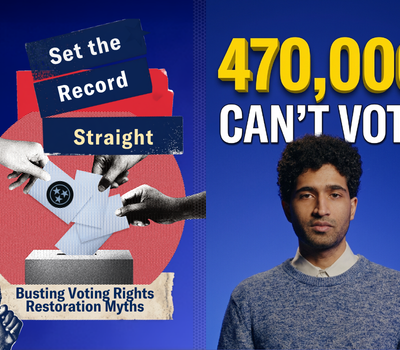
Thumbnail for the Set the Record Straight Series. Cover Reads: 470,000 Can't Vote

More from the Press


Placeholder image

Stay informed on civil rights issues. Discover our latest actions and updates in the Press Release section.

Not Even a Global Pandemic Could Stop the Federal Government from Pursuing a String of Back-to-Back Executions This Summer

Tonight, the federal government plans to execute Lezmond Mitchell, a Navajo man, despite the objections of the Navajo Nation and the family members of the victim in the case, and despite a federal statute intended to prevent federal executions of indigenous people over the objections of Native American tribes.     Mr. Mitchell is the fourth person set for execution this summer alone. By carrying out this execution, Barr’s Justice Department will have executed more people this summer than in the last 57 years combined. Daniel Lee, Wesley Purkey, and Dustin Honken were executed within four days in July, the first federal executions since 2003, greenlit after the Justice Department proposed a new execution protocol last year. The DOJ has scheduled three more executions before October. This record-breaking string of back-to-back executions occurs during a global pandemic. In all three executions carried out so far, the government sidestepped due process, public health recommendations, and legal precedent in its rush to kill. In flouting these important procedures, the government is treating human lives — and our laws — like they don’t matter. This should raise serious alarm.  The consequences of the government’s rush to execute will not only affect those on death row. Executions are potential super-spreader events during the COVID-19 pandemic, involving the travel and congregation of hundreds of people from across the country. That the government is choosing to resume federal executions now — at a time when much of our daily lives have ground to a halt — shows an alarming disregard for the lives of all involved, in addition to the inhumanity and the disturbing lawlessness of the capital punishment system.  COVID-19 swept through prisons, where it

By aclutn

Placeholder image

Adel’s Hidden Agenda: ACLU Exposes Maricopa Prosecutor’s Hypocrisy

In 2018, we did a simple but radical thing: asked a prosecutor to tell us how their office runs. Through an Arizona Public Records Request, we sought basic public information from the Maricopa County Attorney’s Office (MCAO), like who is prosecuted, which crimes are charged, and how long people are sent to prison. We also sought general office policies governing prosecutions in the county. This is fairly basic stuff, and the public has a right to know how the largest and most powerful prosecuting agency in Arizona operates. Yet MCAO, like many prosecutors’ offices nationwide, has operated for years as a black box, fighting any attempt at transparency. Because of this entrenched culture of secrecy, MCAO ignored our Public Records Request for almost a year. So we did another radical thing that rarely happens to prosecutors: We sued.

By aclutn

Placeholder image

Hundreds of Thousands of People in Limbo as They Wait for Justice

Every day, nearly 400,000 people in America with Temporary Protected Status (TPS) wake up wondering whether today will bring news of a court ruling that could effectively end their immigration status and put them at risk for deportation. Perhaps worse is the impact the decision could have on their U.S. citizen children. Thousands of young Americans could face an impossible choice: leave the U.S. to stay with their parents or lose their parents if they choose to stay in the only country they’ve ever known. They can’t have both, at least if the Trump administration has its way.   The court case on which the fate of these thousands of people rests is Ramos v. Nielsen, in which the ACLU, the National Day Laborer Organizing Network, and Sidley Austin LLP argue that the Trump administration broke the law when it attempted to strip people with TPS of the lawful immigration status they have held in this country for years — often for decades. After a district court ruled in favor of those with TPS, the Trump administration filed an appeal that has now been pending for nearly two years.   Congress created TPS 30 years ago to allow people to stay in America when they cannot return safely to their country of origin. Since its adoption, every administration before this one has invoked it to give humanitarian protection to people when natural disaster, war, or other political, economic, or environmental instability rendered their countries unsafe. When Trump came into office, his administration inherited TPS designations that had granted protection to nearly 400,000 people from 10 countries: El Salvador, Haiti, Honduras, Nepal, Nicaragua, Somalia, South Sudan, Sudan, Syria, and Yemen.   But the Trump administration had different plans for TPS. Individuals from anti-immigrant, white supremacist organizations, which had long targeted this program, came to work at the White House after Trump took office and quickly implemented their agenda. By January 2018, the administration had terminated TPS for 98 percent of the people who held that status when he came into office — all those from El Salvador, Haiti, Honduras, Nepal, Nicaragua, and Sudan. The administration also failed to re-designate TPS for Somalia, South Sudan, Syria, and Yemen, thus denying protection to thousands of people already here, simply because they arrived after Trump came to power.   Fortunately, the courts so far have risen to the challenge of protecting people with TPS from the Trump administration’s cruelty. We filed the Ramos lawsuit in 2018 on behalf of those with TPS from El Salvador, Haiti, Nicaragua, and Sudan on the basis that the administration (1) acted out of racial animus against non-white, non-European immigrants and (2) used a new and extremely narrow interpretation of TPS without adequate justification, thereby violating the Administrative Procedures Act. A few months later, we filed a parallel lawsuit to protect people with TPS from Honduras and Nepal. The lower courts’ decisions on this issue have uniformly agreed that the administration’s TPS decisions violated federal law, issuing decisions that protect the 400,000 people with TPS and their families, for now.   But a decision from the court of appeals is due any day now. An appellate ruling in the government’s favor could leave people with TPS at risk of losing their status once again.   However, an adverse decision would not necessarily mean the end of the road, as we could ask the Supreme Court to intervene. Even if the Supreme Court declines that request, the administration would be required to continue TPS for at least six months, during which the 400,000 TPS holders would continue to maintain their right to live and work here.   That six-month period turns out to be awfully important — we are writing this in August 2020. Six months from now takes us into January 2021. By then, a new administration might be evaluating TPS determinations, perhaps applying the TPS statute as it was intended. There might also be a Congress interested in enacting legislation that puts TPS holders on a pathway to citizenship, such as the Dream and Promise Act, which would also help Dreamers and those with Deferred Enforced Departure.   That window of time brings a bit of hope — for the 400,000 people who hold TPS status, for the hundreds of thousands of children in their homes, and for so many other immigrant communities. And for us, as we wait with them — continuing our struggle for justice.

By aclutn

Placeholder image

What’s it Like to be in Immigration Lockup During a Pandemic?

In the 1980s, fewer than 2,000 people were locked up in an immigration detention facility on an average day in America.  Since then, that number has skyrocketed, quadrupling from 7,475 to 32,985 people detained by ICE per day between 1995 and 2016. Under the administration of President Donald Trump, the numbers have shot up even higher — at one point last year, a staggering 56,000 people were behind bars each night in an ICE detention facility. When asylum-seekers and other migrants in Customs and Border Protection facilities are included, the total figure rises to nearly 80,000 people detained by the U.S. government per day. This explosive growth of the U.S. immigration detention system tracks the rise of mass incarceration in America, prompted by punitive legislation resisted efforts to secure their release for public health reasons. A combination of lawsuits and public pressure eventually forced ICE to release more than 1,000 people from detention because of concerns over the spread of COVID-19 between mid-March and early May. Legal actions brought by the ACLU have secured the release of more than 450 people so far. But there are still more than 21,000 people in immigration detention — a drop since last year’s high that is largely attributable to a near-total shutdown of the southern border.   Whenever a new administration takes office, it will inherit an immigration detention system that has become an out-of-control, wasteful, and cruel behemoth. Drastically reducing the number of people trapped inside that system will be a crucial first step towards establishing a more humane and responsible immigration policy.   In recent weeks, the ACLU interviewed a number of immigrants who were released from detention due to concerns over the COVID-19 crisis. They shared the following stories of what it was like to be incarcerated in an immigration detention facility during the pandemic.   *Note: interviews have been condensed and edited.

By aclutn

Placeholder image

How Conservatorship Threatens Britney Spears’ Civil Rights

Britney Spears did it again — the pop singer has recently been in the news for her ongoing conservatorship and civil liberties battle with her father, Jamie Spears. This past week, Britney asked a California court to keep her father from being her conservator and having broad control over her life decisions and career. But what exactly is a conservatorship, and what are the implications of it? We sat down with Zoe Brennan-Krohn, staff attorney with the ACLU’s Disability Rights Project, to discuss Britney, conservatorship, and why this is a disability rights issue on our radar.  Q: Can you briefly explain Britney Spears’ situation, and the implications of her conservatorship case? Britney Spears is subject to a court-imposed conservatorship (in most other states this structure is referred to as a guardianship). This means that a court has determined she is unable to provide properly for her food, clothing, or shelter. The court has then granted other people — her conservators — the legal right to make decisions for her. News reports indicate that this has been the case for Britney since 2008. While we do not know the details of Spears’ conservatorship, in general, conservators like those in her case have the ability to make decisions about all aspects of her life — where she lives, where and how she spends her money, what medications she takes, who she spends time with, and other decisions. Q: Can you please break down, what is conservatorship? What does it mean?  Conservatorship means the court is taking away the civil liberties from one person and giving them to someone else. Sometimes it’s ALL of that person’s civil rights and civil liberties, and sometimes it’s partial. But it is the court weighing into the person’s life and saying you, as a person with a disability, are no longer able to make decisions about yourself and livelihood — such as where you live, and how you support and feed yourself — and we are putting someone else in charge of making those decisions. Because it’s such an extreme step to take, it’s really supposed to be a last resort. And once a court has put a person under a conservatorship, only a court can lift that conservatorship.  Q: Why is the ACLU just weighing in on this now? The ACLU has a long history of advocating for the rights of people with disabilities to live independent, self-directed lives as active members of their communities. Our concerns about conservatorship and guardianship are part of that commitment: ensuring that people with disabilities retain their civil rights and liberties and a belief that disabled people are protected through the exercise — rather than the removal — of these rights.  This issue is getting attention right now because of Britney Spears’ fame. But she is only one of untold thousands nationwide under or at risk of guardianship or conservatorship.The ACLU has advocated for expanding supported decision-making, an alternative to conservatorship or guardianship where people with disabilities can choose trusted support people to help them direct their lives, without court intervention or loss of civil rights. Q: Why is conservatorship a disability rights issue?  People only end up under conservatorships or guardianships if a court identifies them as having disabilities. This includes people with psychiatric disabilities, developmental or intellectual disabilities, age-related disabilities like dementia, and other types of disabilities.  Fighting against the unnecessary and dangerous removal of disabled peoples’ civil rights and civil liberties is a core belief of the ACLU’s disability rights work. This is not to say that all conservatorships are bad or wrong or unnecessary — conservatorships are complex and individual processes. But the ease with which disabled people can be stripped of their rights, and the extraordinary difficulties they face getting those rights back, is a systemic disability rights issue about which we have serious concerns.   Q: How do people get into conservatorships? How does conservatorship limit a person’s civil liberties/rights?  Typically a conservatorship happens when somebody comes into court saying they think this person needs guardianship or conservatorship. Often, it can be the parents or relatives of a person with a disability, or sometimes it can happen after a school or doctor tells the parents that they should get a conservatorship. What’s especially dangerous about conservatorships is they are typically viewed as harmless, including by courts and judges who impose them routinely. This is part of society’s paternalism and infantilization of people with disabilities. But in fact, conservatorships are a serious and often permanent arrangement.   Conservatorships limit a person’s civil liberties, which we at the ACLU of course view as a core concern. But beyond that, conservatorships don’t necessarily actually make people safer: They can result in financial, physical, or emotional abuse.  Q: What laws or policies exist that protect someone from a conservatorship of this kind? What would the legal process to lift the conservatorship look like?  Most state laws have some safeguards in place. In California for example, the court is supposed to consider which less restrictive alternatives to conservatorship have been tried before imposing a conservatorship. The judge should ask a person seeking conservatorship, “What else have you tried? Have you tried supported decision-making? Have you tried joint bank accounts or money management classes? Have you tried a system of text reminders to make sure  the person gets to their medical appointments?” And if the person seeking conservatorship hasn’t tried these options, the judge should deny the conservatorship. There should only be a conservatorship if these other options have been tried in good faith and really aren’t working. But in reality, conservatorships are often imposed even when other supports and alternatives might work.   To lift a conservatorship, the laws are different state by state, but a conservatee can go to the court to say they want this changed or lifted, and the court should consider it. However, it’s very difficult. Judges are very reluctant to lift conservatorships, and only the judge has the power to do so. You aren’t necessarily entitled to a lawyer to help you get out of a conservatorship either. And in many cases, it is virtually impossible for a person to access the courts, especially if their conservator doesn’t agree that the conservatorship should be lifted. How would the person — who cannot choose where they live or where they go or who they associate with — figure out how to get before a judge to challenge that they cannot make these decisions? It can be a Catch-22. As a general matter, it’s much easier to get into conservatorships than to get out of them.  Q: We don’t know Britney’s diagnosis or details about her particular situation. How do we know this case is a civil rights/liberties issue? We don’t know if Britney Spears identifies herself as a person with disabilities, or what, if any, diagnoses she has received. But by virtue of being under a conservatorship, we know that the court has determined that she is disabled, and has stripped away her civil rights because of that disability. So it’s inherently a civil rights/civil liberties issue.  What we don’t know is what the info the court had, what Britney has said about what she wants specifically, what other options have been tried, or what her lawyers have said. So while it’s possible that this is an example of a thoughtful conservatorship that was implemented as the last resort and is being reviewed carefully, thoroughly, and regularly, that is not the norm for conservatorships, and it appears inconsistent with what we see of Britney publicly. Our view is that in general, conservatorships should be viewed with skepticism and used as a last resort.  In most cases, it’s done routinely and without substantive engagement.  Q: Are there alternatives to conservatorship that can help keep a person with a disability and others safe, without limiting their rights?  Yes, there are plenty of alternatives to conservatorship, and they are important. Everyone — with and without disabilities — uses supports to make decisions. We ask friends for advice, research issues, and make lists of pros and cons. These same options should be available to people with disabilities. Powers of attorney, advanced medical directives, shared control over finances, and supported decision-making are all options for disabled people to keep their rights and get support in making decisions, just like nondisabled people do.  Q: What would you say to people that think the conservatorship in Britney’s case is for the best? And that the risks of harm (emotional/material/physical) to herself and/or others are too high? We don’t know all of the risks and benefits at play, so we can’t speak to the specifics of her case. But we do know that the conservatorship itself also has risks. The risks in conservatorship can include financial, physical, and emotional abuse. And even when there is no abuse, conservatorships limit a person’s ability to advocate for themselves, learn from their decisions and mistakes, and grow and develop. There is a risk in being told that your opinions, your likes and dislikes, don’t matter — it makes it harder to stand up to abuse or neglect. So in any conservatorship, including this, we would want to know that the real risks (and benefits) of both conservatorship and its alternatives have been seriously weighed.   Q: Do ALL people with disabilities have a right to lead self-directed lives and retain their civil rights? Shouldn’t it be on a case by case determination? All people with disabilities have a right to lead self-directed lives and retain their civil rights as much as possible. What that looks like will be different for different people — some have significant support needs for some or all of their lives. But as a society we need to find ways to support people with disabilities and recognize that they are individuals with a full range of human experiences and preferences who have the right to exercise their civil liberties. 

By aclutn

Placeholder image

Stop the Police Surveillance State Too

In the wake of George Floyd’s murder, protestors throughout America march to demand an end to police abuse. Advocates for the compelling movement to divest from the police and reinvest in communities convincingly argue that significant portions of the tax dollars we spend on policing would be better spent supporting the needs of communities of color and on alternatives to policing itself. Continuing to rely on overfunded police departments, which seem all too happy to continue to enforce laws in a racist manner and unwilling to limit aggressive uses of force, does not advance public safety. Consider how the racial disparities in the enforcement of marijuana laws have contributed to the mass incarceration of persons of color, or how the enforcement of trivial criminal infractions – like selling loose cigarettes or driving with a broken tail light – have repeatedly led to the murder of Black people. These practices more than adequately illustrate the devastating scope and impact of America’s policing problem. But even where defund/divest efforts succeed, police departments may be able to undermine some of this movement’s most important objectives. Certain achievements, such as creating non-police infrastructures for mental health crisis responses, will be difficult to circumvent, but when it comes to the over-policing and over-surveillance of communities of color, a foreseeable problem awaits. In response to a loss of funding, police departments are likely to consider shifting from more expensive, racist, human policing to more cost-efficient, racist, technology-driven policing. Should this play out, we will be left an altered but equally dangerous beast to fight. And there is a very real risk of that happening. It is a risk the Movement for Black Lives has focused upon at length, and it is time we all do the same. Surveillance Technologies and Racism Like policing itself, investigations into surveillance technology deployments have revealed, time and again, that they are overwhelmingly unleashed against communities of color. These technologies include:

By aclutn

Placeholder image

Justice Wins in Michigan

When voters resoundingly chose Karen McDonald in the August 4 primary to become her party’s nominee for Oakland County prosecutor, the ACLU of Michigan considered it a major win. Not for a particular candidate, but for the policies that can help us end our community’s overreliance on incarceration and eliminate racism within our criminal legal system. Voters are increasingly seeking the kinds of policies at the heart of our Smart Justice Campaign, as illustrated by this race and many others across the country. Oakland County is one of the state’s largest counties. It has Michigan’s second-largest jail population and some of the greatest racial disparities in the criminal legal system statewide. For instance, Black people are six times more likely to be admitted to the Oakland County Jail than white people — even though they only make up about 14 percent of the county’s total population. There is no doubt that the recently ousted prosecutor played a significant role in getting the county into this shameful predicament, and a prosecutor committed to reform can help get us out. The prosecutor’s role is uniquely powerful. No single person has as much control over the fate of individuals caught up in the criminal legal system than the local prosecutor. Elected as their county’s chief law enforcement officer, prosecutors must strive to reflect the views and priorities of their community members, who are increasingly supporting measures to end mass incarceration and demand transparency in decision-making. Michigan is among the many places where this is happening. Earlier this month, a story in the The Intercept took note of the growing momentum behind the movement to elect progressive prosecutors: “On Tuesday night [Aug. 4], the movement realized a major step forward, with reformist prosecutors . . . winning Democratic primaries in counties covering at least 3 million people in four states.” One of the people featured in The Intercept’s story was McDonald, a reform-minded candidate who defeated 12-year incumbent Jessica Cooper in what was described as a huge upset to win her party’s nomination for the Oakland County prosecutor job. Part of what makes the win so heartening is the margin of victory. Voters soundly rejected Cooper. In doing so, they also rejected years of tough on crime policies. For instance, after the U.S. Supreme Court ruled that people sentenced as juveniles to life without parole should be resentenced, and that life sentences should be sought only in “rare and unusual circumstances,” Cooper responded by contending that 90 percent of the children her office had locked up for life should never be released. In other words, in her view, nearly every case represented a “rare and unusual circumstance,” demonstrating an extreme lack of both compassion and common sense. Cooper moreover was notorious for her harsh prosecution of medical marijuana cases, refusal to participate in drug treatment courts, and an overall lack of transparency from her office. McDonald, on the other hand, campaigned on ending cash bail, investing in alternatives to incarceration, and holding police accountable. The primary election outcome was also encouraging in Washtenaw County, MI, where progressive candidate Eli Savit won the Democratic nomination for county prosecutor with more than 50 percent of the vote in the three-way race. “Savit ran on eliminating cash bail, ending coercive plea bargaining, focusing on rehabilitation and reintegration for people who’ve completed criminal sentences, and moving away from a ‘jail-first’ mentality by prioritizing diversion and treating mental health, trauma, and addiction outside of the criminal system,” The Intercept reported. The National ACLU and several of its state affiliates, including Michigan, have been deeply committed to these reforms. As a nonpartisan organization, the ACLU does not support or endorse candidates. Instead, we worked hard to make sure voters knew the policy positions of prosecutorial candidates on a variety of issues related to racism and over-incarceration by launching our “Power of Prosecutors” campaign in June. We then sent a briefing guide to all 114 county prosecutor candidates throughout the state. That guide, “The Power of Prosecutors: A Platform for Smart Justice,” outlines the critical policy reforms we think are needed to end mass incarceration. Moreover, we asked each candidate to submit a survey outlining their positions on combatting racism, police accountability, clearing marijuana convictions for now legal amounts, investing in alternatives to incarceration, and other factors key to overhauling the criminal legal system. We invested greatly in making sure Oakland County voters, in particular, knew the candidates’ positions on key issues. To that end, we spread our message through a television ad that reached more than 98 percent of voters, digital ads that reached more than one million people, direct mail to 80,000 households, nearly 40,000 calls and more than 400,000 texts to voters about the candidates. This work paid off. Along with informing voters about the platforms of candidates in the primary, we significantly built our capacity by recruiting about 1,200 new volunteers, which will allow us to continue this push into the November general election. We will continue educating voters about the importance of prosecuting attorneys, and about candidates’ positions on reform. Most importantly, we will be there reminding voters to make their voice heard — our criminal legal system and democracy depend on it.

By aclutn

Placeholder image

The Democratic Platform Heads in Right Direction on Criminal Justice, but Still Misses the Moment

As Democrats gather this week to nominate their presidential candidate, they will also adopt the party’s proposed platform. On criminal justice reform, the platform continues to move the party away from its harmful tough-on-crime past. But it also misses an opportunity to respond to Americans’ desire to seek transformational changes in the criminal legal system.   For the past 60 years, presidential politics have played an outsized role in criminal justice policy-setting, despite this issue being largely the domain of states and localities. Of the 2.3 million people incarcerated in the United States, 90 percent are under state or local jurisdiction.   Barry Goldwater was the first national politician to focus on criminal justice issues as part of a presidential election, invoking tough-on-crime rhetoric and racist attacks on the civil rights movement. The five-term U.S. senator from Arizona was the 1964 Republican presidential nominee and ran on a law-and-order platform that denounced the civil rights movement as lawless and equated it with criminal behavior. He lost the 1964 presidential election, but his candidacy provided a boost for future law-and-order candidates.   In the 1968 elections, Richard Nixon made law-and-order a central theme of his winning campaign, dedicating 17 speeches to the topic. He deployed the “Southern strategy” to appeal directly to Southern white working-class voters who opposed racial desegregation and the advances being made by the civil rights movement.   It was during the Reagan administration that the full development of the law-and-order strategy began to take hold. While Nixon called for a war on drugs in 1971, President Ronald Reagan brought Frankenstein to life — dramatically increasing law enforcement budgets and slashing funding for drug treatment, prevention, and education.   By the early 1990s, Democratic politicians wanted to wrest control of criminal justice issues and began a bidding war with Republicans on who could impose harsher penalties. In 1992, presidential candidate Bill Clinton vowed that he would never permit any Republican to be perceived as tougher on crime. Weeks before the New Hampshire primary, he flew home to Arkansas to oversee the execution of Ricky Ray Rector, who was mentally incapacitated. During Clinton’s tenure, he slashed funding for public housing by 61 percent while boosting corrections funding by 171 percent, made it easier for public housing to exclude anyone with a criminal history, and signed into law the infamous 1994 Crime Bill.   By 1996, the Democratic Party platform invoked law-and-order rhetoric that differed little from what Republicans expressed two decades earlier:

By aclutn

Placeholder image

Votes for Women — and Everyone — Now!

When the 19th Amendment, ratified on August 18, 1920, finally allowed women to vote, ACLU founder Crystal Eastman, an ardent suffragist, was not interested in a victory celebration. She wanted women to use their newly minted political power to promote true freedom and equality, regardless of sex. “Now We Can Begin,” she urged, in a still-renowned speech.  But the adoption of the 19th Amendment did not actually enable all women to vote. Black women and other women of color still had to confront laws and practices designed to keep them from voting —despite the fact that the 15th Amendment, in 1870, had already prohibited the denial or abridgment of the right to vote on the basis of race, color, or previous condition of servitude. And today, 150 years after the 15th Amendment’s declaration of equal rights, racist voter suppression is still rampant. It’s wonderful to celebrate the 19th Amendment’s centennial, but it’s not enough. We need to finish the job of the voting rights activists who fought for both the 15th and 19th Amendments. Let People Vote The Constitution says clearly that women and people of color have a legal right to vote. But theory is not practice.  For many decades, the ACLU has been battling laws that outright disenfranchise some people — like people who are incarcerated and people with certain criminal convictions — or create insurmountable barriers for others, especially Black and Brown women and men, Native Americans, and people with disabilities. We’re

By aclutn

Placeholder image