A smiling woman in an ACLU baseball cap and sunglasses sits at the top of a yellow and blue inflatable slide, holding up an “I ❤ Democracy” ACLU bumper sticker.

When Will Tennessee Certify the 2026 Midterm Election Results?

After High Turnout, ACLU-TN Thanks Tennessee Voters, Poll Workers, and Partners, Looks Ahead to an Orderly Certification

By Cathryn Stout, PhD.

Latest Publication


Citizenship Rights Restoration in Tennessee

Restoring your voting rights in Tennessee got easier in 2026. State Sen. Raumesh Akbari and State Rep. Karen Camper led the charge in the legislature to remove some of the biggest barriers standing between formerly incarcerated Tennesseans and the ballot box.

The Campaign Legal Center and Free Hearts, a Tennessee nonprofit led by formerly incarcerated women, have been on the ground helping people navigate this process and pushing for a fairer system. For eligibility requirements and step-by-step petition instructions, read the guide from Free Hearts and the Campaign Legal Center.

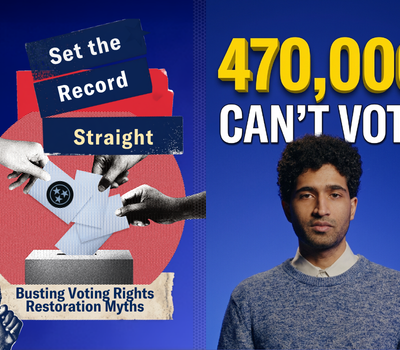
Thumbnail for the Set the Record Straight Series. Cover Reads: 470,000 Can't Vote

More from the Press


Placeholder image

Stay informed on civil rights issues. Discover our latest actions and updates in the Press Release section.

An Abortion Advocacy Movement for Everybody

Abortion is legal in Texas and across the United States, but that doesn’t stop anti-abortion politicians from doing whatever they can to interfere with access to reproductive healthcare. Local governments have added fuel to the fire by passing anti-abortion ordinances that confuse residents about their rights and increase the ever-present stigma around seeking abortion care. That’s why, for the first time, reproductive rights, health, and justice groups in our state are joining forces to expand essential health care access for all Texans by creating the Texas Abortion Access Network. Join us for TAAN’s launch on Thursday, August 20 at 6 PM CT, to become a founding member of TAAN and hear about how you can get involved.  In the last year alone, 13 cities in Texas have passed so-called “sanctuary cities for the unborn” ordinances. These ordinances attempt to ban abortion in those cities if Roe v. Wade is overturned, and some even attempt to ban contraception. At one point, many of these ordinances even declared abortion providers and other advocacy groups to be “criminal organizations.” We sued and successfully pushed those cities to remove the most harmful parts of those ordinances — but those laws are just one example of the many ways Texas politicians have attacked reproductive freedom. For years, Texas politicians have piled restriction after restriction on abortion access. From enacting 2013’s House Bill 2, which led to the closure of half of all Texan abortion clinics, to banning abortions during the early COVID-19 pandemic, elected officials in Texas continually work to block essential healthcare. But together, we are fighting back for the right to determine our own lives and destinies. The Texas Abortion Access Network (TAAN) is a new collaboration between the ACLU of Texas, AFIYA Center, NARAL Pro-Choice Texas, Progress Texas, Texas Equal Access Fund, Texas Freedom Network, Jane’s Due Process, and Whole Woman’s Health Alliance. We’re building community among Texas residents who are fed up with attacks on their reproductive freedom.  Through TAAN, we are building grassroots power across Texas. We will not only defend against further restrictions but also empower activists to dive into action and put proactive, protective laws on the books in their hometowns. We are building a diverse base of volunteers that represent every corner of the state and equipping them with the tools they need to be leaders in their communities.    A key component of TAAN is the Texas Abortion Access Academy, an 8-week online training program led by abortion access experts. The academy will cover a comprehensive array of topics to build each person’s capacity to become an effective abortion rights advocate. We’re including a crash-course on the status of abortion in Texas, how to talk to others about abortion, background on reproductive justice, and how to advocate and organize for abortion access. At the end of the program, cohort members will have gained the skills to lobby their local government, have difficult conversations about abortion, and get others involved in the movement.  Let’s be clear: Attacks on abortion care won’t stop Texans from needing, and seeking, abortion care. They’ll just ensure that the most vulnerable Texans have a much more difficult and costly experience accessing it. We’ve seen it again and again — restrictions to abortion care disproportionately harm Black and Brown people, people struggling to make ends meet, those who are already parenting, folks in rural areas, undocumented immigrants, LGBTQ folks, and young people.   Without access to reproductive health care, our communities can’t thrive. And while abortion remains legal, the fact that the Supreme Court nearly allowed a Louisiana law— one

By aclutn

Placeholder image

Chad Wolf’s Desperate Attempt to Rewrite History

For weeks, federal agents with the Department of Homeland Security laid siege to the city of Portland to suppress the voices of those demanding justice for Black lives. The militarized agents used sharpshooters to maim people, swept protesters away in unmarked cars, and brutally attacked journalists, legal observers, and medics with sonic weapons and tear gas. They didn’t spare moms, dads, veterans, nurses, or even the city’s mayor.   The agency’s lawlessness was so profound that a federal court in Portland issued a restraining order against the agency after the ACLU filed suit. Congress held numerous hearings. The agency’s inspector general opened an investigation. Even former leaders of the Department of Homeland Security decried its abuses. Richard Clarke, who served on the National Security Council for Presidents George H.W. Bush, Bill Clinton, and George W. Bush, called for dismantling DHS.    The administration’s effort to use its response to the protests in Portland as some twisted campaign prop miserably backfired, and the agents were forced to retreat. Now, recognizing that he’s in hot water, Chad Wolf, who was illegally appointed as head of DHS, is on a media tour in an attempt to rewrite history. But the truth was caught on video for the world to see. No press interview, no op-ed, and no statement by any administration official can undo the fact that DHS agents beat a Navy veteran for simply asking them questions. They can’t hide the viral video of unmarked federal agents — later identified to be with DHS — hauling a protester off the streets of Portland into an unmarked vehicle. They can’t make us forget the sight of DHS agents firing tear gas at individuals simply exercising their right to protest, or beating and dragging off medics providing aid to an unconscious bystander. They also can’t erase the decades of abuse, civil rights violations, killings, and discriminatory surveillance of Black, Brown, and immigrant communities.   Wolf did get one fact right: “Courthouses uphold everyone’s rights.” The federal court in Portland did uphold the people’s rights when DHS brought its police state tactics there. It ordered the agency to stop arresting and attacking journalists and legal observers. But DHS didn’t comply with the court order — even after the court issued its restraining order, the agency continued to attack journalists and legal observers.   An agency claiming to defend the courthouse should, at a minimum, obey the orders coming out of it.   As we have for a century — much longer than DHS has been around — the ACLU will continue to unapologetically defend the Constitution from all those who undermine it. This includes the Department of Homeland Security. DHS is too powerful, too abusive, and too much of a threat to America’s democratic values. As ACLU Executive Director Anthony Romero and former Bush administration official Richard Clarke put it, it’s time to go back to the drawing board.

By aclutn

Placeholder image

We’ve Filed 400 Legal Actions Against Trump

Immediately after Trump’s election, we put the president and his administration on notice: If they enacted unconstitutional and illegal policies, we would see them in court. We meant it. As of today, we’ve filed 400 legal actions against this administration. Our 400th filing was a class-action lawsuit that seeks to block the removal of children seeking asylum at the border. 

By aclutn

Placeholder image

Don’t Ban TikTok and WeChat

President Trump’s executive orders threatening to ban TikTok and WeChat, two of the most popular messaging and social media apps in the world, are an unprecedented abuse of emergency powers. No president has ever taken actions like these against platforms that tens of millions of people in the United States use. Selectively banning platforms does little to protect our personal data from abuse — comprehensive surveillance reform and consumer privacy legislation would actually help accomplish that goal. Instead, the bans could cut off the flow of information, art, and communication that social media provides, interfering with communities and connections users in the United States have with each other and with people around the world. This interference with freedom of expression and association violates the First Amendment. Trump’s executive orders are vague and don’t explain the “emergency” purportedly at issue. They also leave important details unclear for 45 days — like the definition of “transactions” to which the bans apply, and how the prohibitions will apply to WeChat’s parent company, Tencent, which has investments in a number of U.S.-based businesses, including Reddit and Riot Games. But here is what we do know:

By aclutn

Placeholder image

The Black Women Behind the Ongoing Fight for Suffrage

The 19th Amendment inked women’s suffrage into American history, a culminating moment in an effort to win political power. But as the 100th anniversary of its ratification fast approaches, it’s essential to reflect on who the 19th Amendment excluded in practice if not on paper, and what the popular historical record of this movement leaves out. “Black women know as 1920 unfolds that many of them are still going to be disenfranchised,” professor and author Martha S. Jones tells At Liberty. “That’s not a secret. That’s an open premise of the 19th Amendment. Jones joined the podcast this week to discuss how the history of voting rights has led us to this moment. She is the Society of Black Alumni Presidential Professor and a professor of history at Johns Hopkins University. Jones is also the author of the new book, Vanguard: How Black Women Broke Barriers, Won the Vote, and Insisted on Equality for All. The ordained heroes of women’s suffrage — such as Elizabeth Cady Stanton, Susan B. Anthony, and later Alice Paul — often tossed out the leadership and movement-building of Black women. The absence of those voices from the popular historical record has obscured the centuries-long role that Black women have played, and continue to play, in expanding voting rights for all. In writing a book that attempts to capture “200 years of voting rights history in the U.S. from the perspective of African American women,” Jones says, she realized “that there really is no golden age of voting rights in the United States.” “What was remarkable and important for me to discover was that the history I was telling lives inside many of the women whom we recognize as of our own movement, like Stacey Abrams or Ayanna Pressley,” says Jones. “When I heard Stacey Abrams crediting Shirley Chisholm, Barbara Jordan, Sharon Pratt Kelly, Sojourner Truth, and Harriet Tubman as helping to shape her political consciousness in her imagination, I realized there really was a story to tell.”

By aclutn

Placeholder image

Why The Fight for Paid Sick Leave is a Civil Rights Issue

Six months into the COVID-19 pandemic, it’s clear that among those suffering the most are those who typically get paid the least: the “essential workers” who tend to the sick, care for our elders, grow our food, stock our supermarket shelves, and operate the public transit necessary for these and other frontline workers to get to their jobs. These mostly Black and Latinx workers, also disproportionately women, already live in a state of economic precariousness. For months now, they have been asked to literally risk their lives for their paychecks. In this way, the pandemic has further exposed and deepened our nation’s fault lines of racial and gender inequality. Among the frontline workers in harm’s way are the nearly 1 million people who continue to serve up Egg McMuffins, Big Macs, and fries at the nation’s 14,000 McDonald’s restaurants. Despite the company’s vast resources — it has already paid nearly $2 billion to shareholders since the pandemic began — McDonald’s has rewarded the sacrifices of its low-wage cashiers and cooks with indifference to their safety and — when they and their loved ones get sick — refusal to grant job-protected,

By aclutn

Placeholder image

“The Very Prescription is to Stay Home”: What it’s Like to be Evicted During a Global Pandemic

One of the first and most fundamental safety precautions during the COVID-19 pandemic is to shelter in place. But that may soon become impossible for millions of people as eviction moratoriums begin to lift across the country. Tens of millions have lost their jobs due to the pandemic itself, and many are still unemployed.   Kansas City resident Tiana Caldwell is one of them. In March, she was laid off from her job teaching business skills at a local community college. Her husband, Derrick, lost his job around the same time. Both had dedicated years of hard work to their jobs, which they loved, but in the face of this global pandemic, that wasn’t enough.   The family would have lost their home if not for the Jackson County moratorium on evictions. The moratorium brought them some peace of mind, but that peace was limited. It expired on May 31, allowing landlords to resume evictions of those unable to afford their monthly rent. Now Tiana, Derrick, and their 13-year-old son A.J. may soon be without a roof over their heads. Nationally, many more families also face the possibility of eviction after the federal moratorium expired on July 25. 

By aclutn

Placeholder image

The U.S. Postal Service Was Never a Business. Stop Treating it Like One.

When the Continental Congress appointed Benjamin Franklin as the first Postmaster General, our nation had not yet been founded. The Bill of Rights would not be drafted for another 16 years. Yet nearly two and a half centuries later, the United States Postal Service’s ability to provide every person in America with a private, affordable, and reliable means to exchange information transformed it from a mail delivery service into a baseline for the exercise of American constitutional rights. Recent news that the Postal Service’s financial condition is being used as a pretext for degrading its service – including allowing mail to go undelivered for days and scaling back the hours of or closing post offices – threatens to degrade that constitutional baseline as well. In an early response to novel coronavirus, Congress allocated $10 billion to help shore up the Postal Service’s finances, but the Treasury Department has held up those funds without explanation. Instead, Postmaster General Louis DeJoy is preparing to make dramatic service cuts, treating the USPS like a private business facing bankruptcy. This should draw universal condemnation. The U.S. Postal Service was never a business. It is an essential government service guaranteed to the American people by the U.S. Constitution and it should be preserved accordingly. To understand how the Postal Service became so central to America’s national identity and the actualization of our constitutional rights, one needs to examine its history. In the earliest days of our nation, Americans were more likely to identify themselves as citizens of their home states than of the United States. For our nation’s first generation, the Postal Service was often the only reminder the U.S. had a federal government at all. As America expanded westward, the Postal Service enabled new states like California, which otherwise would have been isolated by America’s vast Western Territories, to forge its connection with the rest of the country. Ultimately, the roads, rail stations, and rural post offices that were built or subsidized by the Postal Service drove our nation’s physical unification. Even more important were the nationwide communications the Postal Service enabled. Prior to the invention of the telegraph, the absence of a local post office made exchanging ideas with the rest of the country impossible. In America’s early decades, one of the most vital steps taken by newly established towns was to request a post office. Recognizing that receiving information was as critical to our national unity as communicating it, Congress mandated the Postal Service deliver newspapers for free or at a minimal cost. As George Washington wrote in 1788, “I entertain a high idea of the utility of periodical publications … spread[ing] through every city, town and village in America. I consider such easy vehicles of knowledge, more happily calculated than any other, to preserve the liberty, stimulate the industry, and meliorate the morals of an enlightened and free People.” Low-cost newspaper delivery endured until the Congressional Postal Reorganization Act was adopted in 1970. Prior to the 1850s, the delivery of free newspapers and of mail to isolated frontier towns caused the Postal Service to lose money. It likewise strained the Postal Service’s financial resources when, in the mid-19th century, it decided to charge the same price for all first-class letters sent within the U.S. regardless of their destination. These choices were possible then because the Postal Service was not burdened with financial self-sufficiency. Its sole mandate was to enable everyone in America to communicate affordably. In that respect, the Postal Service’s public benefit mission is more akin to the Armed Forces’ than FedEx’s, and no one is suggesting the military should pay its own way or face bankruptcy. Another important piece in the Postal Service’s preservation of civil liberties came in 1877, when the Supreme Court, in Ex Parte Jackson, ruled that “No law of Congress can place in the hands of officials connected with the postal service any authority to invade the secrecy of letters and such sealed packages in the mail.” As a result, the privacy of communications sent via the USPS is constitutionally guaranteed. Good luck getting that with Gmail. The year 2020, perhaps more than any other in American history, illustrates why Postal Service’s centuries-old mission must be upheld. The U.S. Census Bureau, which is presently racing to complete the 2020 census, is relying on the Postal Service for much of its data collection. Government health agencies are depending on the USPS to provide critical COVID-related health information and supplies. Elected officials are using the Postal Service for cost efficient and sometimes free communications with their constituents, including about support programs during the ongoing economic crisis. And as we approach the November election, state and local election boards will be relying more than ever on the USPS to conduct voting by mail, which is critical to guaranteeing the right to vote during the ongoing pandemic. Troubling though it may be, it is impossible not to worry that our unpopular president, who has already called for the delay of his own re-election vote, is seeking to degrade the Postal Service’s ability to timely deliver ballots, particularly in communities that are unlikely to vote for him. Earlier this year President Trump called the Postal Service “a joke,” but there is nothing funny about the steady degradation of an institution that breathes unimaginable life into our constitutional rights. At this critical time, Congress should do everything in its power to ensure the USPS remains vibrant and strong, and that burden falls largely on the Senate Committee on Homeland Security and Government Affairs and its chair, Sen. Ron Johnson, and the House Committee on Oversight and Reform, and its chair, Rep. Carolyn Maloney. Every member of Congress and every American, regardless of political party or philosophy, should be grateful that for 245 years “neither snow, nor rain, nor heat, nor gloom of night stays the [Postal Service’s] couriers from the swift completion of their appointed rounds.” We should ensure that “nor politically-motived cost savings” is added to that list.

By aclutn

Placeholder image

Dismantle the Department of Homeland Security. Its Tactics are Fearsome

This piece originally appeared in USA Today. As an organization dedicated to civil liberties, civil rights, and the rule of law, we at the American Civil Liberties Union believe that the government has both the authority and responsibility to enforce its laws — laws that promote justice, equality, and the general welfare. In recent weeks, the actions of federal agents have shown us all that the Department of Homeland Security isn’t capable of acting consistently with the Constitution, and should no longer exist in its current state. The scenes unfolding in Portland, Oregon, and elsewhere are a reminder of the red flags many have raised about DHS throughout its history: that its powers are too great, and that it lacks the oversight and management to be effective. We can preserve our freedoms and our security better by dismantling DHS and beginning anew. People across the political spectrum watched in disbelief as federal agents were deployed to American cities — despite objections by mayors and governors — to escalate violence against protesters. Paramilitary forces abducted people exercising their constitutional rights in Portland, placed them in unmarked vehicles, and took them to undisclosed locations. The tactics deployed by DHS agents are unlawful and shocking, but they are no surprise: Back in 2002, we at the ACLU called the initial blueprints for the behemoth bureaucracy “constitutionally bankrupt.”

By aclutn

Placeholder image