A smiling woman in an ACLU baseball cap and sunglasses sits at the top of a yellow and blue inflatable slide, holding up an “I ❤ Democracy” ACLU bumper sticker.

When Will Tennessee Certify the 2026 Midterm Election Results?

After High Turnout, ACLU-TN Thanks Tennessee Voters, Poll Workers, and Partners, Looks Ahead to an Orderly Certification

By Cathryn Stout, PhD.

Latest Publication


Citizenship Rights Restoration in Tennessee

Restoring your voting rights in Tennessee got easier in 2026. State Sen. Raumesh Akbari and State Rep. Karen Camper led the charge in the legislature to remove some of the biggest barriers standing between formerly incarcerated Tennesseans and the ballot box.

The Campaign Legal Center and Free Hearts, a Tennessee nonprofit led by formerly incarcerated women, have been on the ground helping people navigate this process and pushing for a fairer system. For eligibility requirements and step-by-step petition instructions, read the guide from Free Hearts and the Campaign Legal Center.

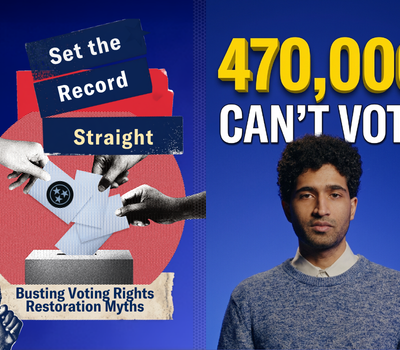
Thumbnail for the Set the Record Straight Series. Cover Reads: 470,000 Can't Vote

More from the Press


Placeholder image

Stay informed on civil rights issues. Discover our latest actions and updates in the Press Release section.

Not Just a Bad President, Trump is a “Holmesian Bad Man.” Act Accordingly.

“If you want to know the law, you must look at it as a bad man does, who cares only for the material consequences,” wrote legendary Supreme Court Justice Oliver Wendell Holmes, “Not as a good one, who finds his reasons for conduct, whether inside the law or outside of it, in the vaguer sanctions of conscience.”    Donald Trump is a Holmesian bad man, and an even worse president, pushing the bounds of corruption and authoritarianism, unbound by norms, the rule of law, a sense of shame, or even care for others. To deal with such a bad man and bad president — one who truckles to adversaries like Russian President Vladimir Putin, flouts Congress, swims in self-enrichment, and fails to take meaningful action as Americans die by the tens of thousands on his watch — will require more than the ordinary processes, checks and balances, and honor that have guided and constrained other presidents.   Fortunately, Trump’s most recent egregious trial balloons (or warning shots) about subverting the election drew pushback from even his supporters, such as the co-founder of the Federalist Society, who called Trump’s tweet “fascistic” and “itself grounds for … immediate impeachment.” But his regime’s many efforts to repress the vote and discredit and undermine the election continue unchecked, abetted by Senate Majority Leader Mitch McConnell’s refusal to take up election security and funding bills passed by the House, and his Postmaster General’s ongoing sabotage aimed at impeding the mail-in voting that will surge because of the pandemic Trump has exacerbated.   Calm may return now to Portland, Oregon, as Trump has begun to withdraw the federal paramilitary storm troopers who just recently were sowing chaos, seizing protesters off the streets, and using force, such as rubber bullets and tear gas, without probable cause or the consent of local authorities. But Trump and his confederates, including Attorney General William Barr and Acting Homeland Security Secretary Chad Wolf, continue to threaten this unconstitutional use of force in even more cities, ginning up images for Trump’s campaign ads and perhaps even road-testing tactics to remain in power in the event Trump loses the presidential election.   This is “performative authoritarianism,” according to historian Anne Applebaum. “That these tactics are not ‘totalitarian’ doesn’t make them legal, acceptable, or normal … Citizens’ rights [were] violated in Portland. People have been hauled off the streets into unmarked vehicles.”   Trump has shown again and again that, as a Holmesian bad man, he will do whatever he can get away with. It is a lesson Trump learned from his lawyer and mentor, Roy Cohn, as testified to by his lawyer and fixer Michael Cohen (now “Individual-1’s” nemesis). The tactics were honed during Trump’s career as a discriminatory and abusive developer and landlord: When dealing with tenants, contractors, and investors, do not honor your agreements and legal, let alone ethical, obligations. Don’t worry whether you have a legitimate cause of action or defense. Rather, flout norms and fairness, manipulate deadlines, drag out payments and processes, force litigation, make remedies and responses costly and cumbersome, overwhelm with falsehoods and fatigue, grind people and institutions down with the system — in short, break the law as you please, while using the law and legal procedures themselves as tools of abuse and evasion of accountability.   Civil society groups like the ACLU and Protect Democracy have been doing what they can through public denunciation and lawsuits that challenge Trump’s abuses in Portland and nationwide, exposing illegal surveillance of Americans and Trump’s use of unaccountable officials such as Wolf. But it is not enough to deplore, to protest, or to litigate. Trump’s tactics, whether in New York or in Washington, will not be defeated solely by appeals to moral or legal obligations. Nor is Trump acting alone. The attorney general, the Senate (in the grip of McConnell and a cowed and complicit Republican majority), and too many “acting” officials, conscienceless collaborators, and pliant enablers have abetted Trump in straining and eroding our democratic system.   “Democracy is not a state. It is an act,” our late hero John Lewis exhorted from his deathbed. To confront and defeat authoritarianism, performative democracy requires all patriotic defenders of the Republic to act — and that means act effectively. We should be mindful, as Holmes wrote, that “A man who cares nothing for an ethical rule which is believed and practiced by his neighbors is likely nevertheless to care a good deal to avoid being made to pay money, and will want to keep out of jail if he can.” The power centers at every level in our constitutional system must show they mean business by pushing back and imposing costs using the full measure of their powers under the law.   What, then, should those with political authority and power do?   In cities like Portland, when federal paramilitaries seize people off the street or use violence against them, they commit crimes. State and local officials should charge them and arrest them, as prosecutors in Baltimore and Philadelphia have said they would do. Would Trump challenge such efforts in court? Probably. Might these efforts lead to standoffs between local police and the paramilitary? Perhaps. But criminal charges would shift the burden on to the forces of authoritarianism and send a message that those who violate the law in Trump’s name are themselves vulnerable to prosecution.   In Washington, it’s way past time to meaningfully assert congressional oversight and power. Regrettably, the Republican Senate has stood silent during, and the Democratic House of Representatives has too often allowed, Trump’s disregard of Congress’ spending enactments, the Senate’s role in confirming officials, and even the most basic requests for information necessary to congressional oversight. Even on the rare occasion when the House has defended Congress’ constitutional authority, these exertions have been ineffective and dilatory, leaving it to courts to adjudicate, let alone enforce its halting assertions.   Congress should wield its power of the purse to strip funds for illicit operations by corrupted agencies. Going further, why shouldn’t the House hold Trump’s defiant henchmen in contempt, fine them, and have the House’s Sergeant at Arms place them under arrest? Would the power of Congress be challenged in court? Probably. Might there be confrontations between the Sergeant at Arms and Trump’s minions? Perhaps. But full use of Congress’ lawful powers to stand up to a bully and his gang, to push back against a bad man, is the only way for Democratic and even Republican members of Congress to show that they give a damn about liberal democracy, and are not merely sputtering ineffectually at shameless and unconstitutional obstruction.   Nor is it only our members of Congress, governors, state attorneys general, mayors, and local prosecutors, who must act. It is we, the people who are the necessary and ultimate defenders of democracy. Like the diverse patriots protesting under the banner of Black Lives Matter, or the “Wall of Moms” in Portland, we must stand up, speak out, demonstrate, and put pressure on decision-makers. And, above all, we must vote.   Finally, there must then be a lawful reckoning — a full exposure of the corruption, complicity, and lawbreaking that have marked this regime from day one. It must be made clear to all who enable this bad man and bad president that they will be held accountable; shamed in history, in their social circles, and in the eyes of their fellow citizens; obliged to disgorge tax returns, campaign finance records, emoluments, and ill-gotten profits and prestige; prosecuted and fined or jailed where appropriate; and made to pay the price of betrayal of the American people, our values, and the rule of law that our Republic depends on.   Any hope of deterring Trump and his accomplices and enablers now — and even more importantly, building America back better when he is repudiated and gone — requires acting effectively in ways that a bad man can understand, and that the good demands.

By aclutn

Placeholder image

Amendment 4 is Back in Court as Florida Fights Our Victory Over its Modern-Day Poll Tax

Betty Riddle, a grandmother and university graduate, explained to the ACLU the unfairness did not hit her right away: “I didn’t realize that it wasn’t right until I asked myself, ‘Why are we paying to vote?’”   What’s worse, Florida requires returning citizens seeking to register to swear under penalty of perjury they are eligible to vote. If they cannot determine their eligibility, they risk criminal prosecution for registering. Given how difficult — even impossible — it is for returning citizens to determine if they have any outstanding LFOs, policies like these undoubtedly prevent countless people from even registering out of fear of prosecution.   Florida has proven incapable of administering its poll tax. Voters should not have to pay the price for Florida’s unworkable system. SB 7066’s system is irrational, cruel, and unfair. It is also unconstitutional.   Before Amendment 4, Florida was one of four states that permanently revoked the right to vote for all people with past felony convictions. One in 10 voting-age Floridians could not vote for life, including

By aclutn

Placeholder image

Tracking Apps are Unlikely to Help Stop COVID-19

Proposals to use the tracking capabilities of our cell phones to help fight COVID-19 have probably received more attention than any other technology issue during the pandemic. Here at the ACLU, we have been skeptical of schemes to use apps for contact tracing or exposure warnings from the beginning, but it is clearer than ever that such tools are unlikely to work, and that the debate over such tracking is largely a sideshow to the principal coronavirus health needs.   We have said from the outset that location-based contact tracing was untenable, but that the concept of “proximity tracking” — in which Bluetooth signals emitted by phones are used to notify people who may have been exposed — seemed both more plausible and less of a threat to privacy. Indeed, a number of serious institutions began working on this concept early in the pandemic, most notably Apple and Google, which have already implemented a version of the concept in their mobile operating systems.   Some of the problems with tech-assisted contact tracing have been apparent from the beginning, such as the social dimensions of the challenge. Smartphone ownership is not evenly distributed by income, race, or age, threatening to create disparate effects from such schemes. And even the most comprehensive, all-seeing contact tracing system is of little use without social and medical systems in place to help those who may have the virus — including access to medical care, testing, and support for those who are quarantined. Those systems are all inadequate in the United States today.   Other problems with technology-assisted contact tracing have become more apparent as the pandemic has played out. Specifically, such tracing appears to be squeezed from two directions. On the one hand, a tool shouldn’t pick up every fleeting encounter and swamp users with too many meaningless notifications. On the other, if it is confined to reporting sustained close contacts of the kind that are most likely to result in transmission, the tool is not likely to improve upon old-fashioned human contact tracing. Those are the kinds of contacts that people are likely to remember. And those memories, relayed to human contact tracers, are more likely to identify a patient’s significant past exposures than an automated app that can’t determine, for example, whether two people were separated by glass or a wall.   A difficult disease to trace   The first problem — the danger of generating far too many “exposure notifications” — is considerable. As one commentator put it, “actual transmission events are rare compared to the number of interactions people have.” Swamping users with false notifications would be useless and annoying at best, and seriously disruptive and counterproductive at worst. Ultimately, people will stop taking the notifications seriously, or just uninstall the app.   That problem is made worse by the fact that COVID-19 is a more difficult disease to trace than many. As a group of prominent epidemiologists from the University of Minnesota explained in a report on contact tracing, contact tracing is less effective when:   1. Contacts are difficult to trace, such as when a disease is transmitted through the air. Respiratory transmission appears to be the primary way COVID-19 is transmitted. Compared to the kind of contact tracing that has long been done with shut down within 72 hours of its launch, and another one had not led to any contract tracing a month after its launch. An app in North and South Dakota ran into trouble quickly when it was revealed to be sharing data with a private location-data company. Overall, state efforts so far have been plagued by “technical glitches and a general lack of interest by their residents.” A survey by Business Insider found that only three states planned to use the Apple/Google technology. Others had not decided, but 17 states reported that they had no plans to use smartphone-based contact tracing at all.   Those who have worked on privacy-preserving exposure notification apps should be commended for stepping up. They have dedicated their skills toward trying to save lives and restore people’s freedom, and they did a very good job creating a privacy-preserving approach that was not only the most likely to be trusted and effective, but also the least likely to permanently change our world for the worse.    Nevertheless, it does not appear to be working out. “A lot of this is just distraction,” Osterholm concluded of all the talk over digital contact tracing. “I just don’t see any of this materializing.” Given what we know about the technology, we are inclined to agree.

By aclutn

Placeholder image

Retired Federal Probation Officer: Stop Sending People to COVID-Filled Prisons Unnecessarily

In early April, the Rikers Island jail complex in New York City suffered its first coronavirus death: Michael Tyson. Mr. Tyson, 53, had been arrested in late February not because he had committed a crime, but for a technical violation of his parole. As a retired federal probation officer, I can tell you that incarcerating someone for a technical rule violation should be a last resort. But during a pandemic, it should be ceased completely. Our federal, state, and local probation and parole systems should act immediately to protect public health and safety and choose alternatives to unnecessary incarceration.  For 22 years of service as a probation officer, I saw first-hand how difficult it is for individuals to follow all the technical rules of supervision. These conditions range from adhering to a curfew to abstaining from cigarettes and alcohol, meeting with parole or probation officers regularly, keeping treatment appointments, and maintaining employment. They regulate daily behaviors that most of us take for granted, which in many cases leads to failure. People with drug addictions are required to test negative, even though experts agree that it is normal to relapse multiple times before successfully entering recovery.  Mr. Tyson is not the only person who may have received a death sentence for a technical violation. In Arizona, where the ACLU has filed COVID-related lawsuits against both a federal and a local jail, many of the detainees are there for these types of technical violations. One person at the CoreCivic federal facility in Florence, Arizona was sent back to prison for smoking a cigarette in the hallway of their halfway house.  Probation and parole officers are taking a heavy-handed response to minor infractions in Arizona and across the country. One recent study found that 45 percent of all state prison admissions were a result of probation and parole violations, and 25 percent were due to technical violations — the same kind Mr. Tyson allegedly committed. In normal times, these are troubling statistics. In the middle of a pandemic, they are deadly. Social distancing and other important safety practices like handwashing and wearing masks are not happening in correctional facilities. Jails and prisons account for most of the country’s worst hotspots for COVID-19. Unnecessary incarceration is dangerous not only to incarcerated people and corrections officers but to all of us. People in jail are usually there less than a month, plenty of time to contract the virus and bring it home with them. The phenomenon has been documented: In Illinois, one in six of all coronavirus cases were linked to people who were jailed and released from the Cook County jail in Chicago. This is a fixable problem. Parole and probation officers have vast discretion in responding to technical violations. Now more than ever, officers should not register formal violations that result in incarceration for technical violations. We can also stop issuing violations for minor infractions and work with our agencies to design a series of graduated responses that do not jump straight to incarceration.   The current approach to community supervision is putting all of us at risk. To stop more avoidable deaths like Mr. Tyson’s, probation and parole officers and our agencies should take immediate action and suspend the use of incarceration for technical violations. It is our responsibility and duty to guard against the unique dangers of this pandemic and to protect the community. 

By aclutn

Placeholder image

Clemency, Redemption, and Justice: A Personal Story

In 1998, at the age of 21, I was sentenced to life without parole plus 320 years for drug-related offenses that were committed mostly in my teens. In 1998, 16 years into my sentence, I received clemency from President Obama after writing a letter to him asking for forgiveness, asking for mercy, asking for understanding that I wasn’t a bad kid, just a kid who made a bad decision. That I wasn’t that person who roamed those streets long ago or the same person who stood in front of the judge and received a life sentence, and as a result I shouldn’t die in prison.   President Obama agreed.   I was extremely fortunate. Those who sought a commutation of their sentence before Obama’s presidency, when George W. Bush was in office, had a 1 in 1,000 chance of success. While conducting research as I prepared my own clemency application, I learned that only one other person serving life without parole for a drug offense had ever been granted clemency. Because of this, I have always compared my clemency to hitting the lottery. But instead of winning millions of dollars, I won my freedom.   Unfortunately, I am just one of the thousands upon thousands of people who after years or even decades in prison, have matured and changed their way of thinking. But because of mandatory minimums and truth in sentencing laws(another supposedly “tough on crime” sentencing scheme that is really just tough on people), and the inaccessibility or unreliability of parole, there are no judicial remedies to acknowledge the transformations of these individuals.   However, there is an extraordinary executive power that allows a show of mercy to be made: clemency.   Clemency has historically been relied upon in America as an olive branch extended to those unduly harmed by our system of mass punishment. It has been used as a tool to heal people, communities, and our very nation, and in doing so, has engendered reconciliation among its citizens. Clemency is a corrective measure that counteracts some of the effects of a flawed system. But the degree to which it can do so is mirrored by the degree to which it is used. Though it may often be overlooked today, clemency has been a key facet of our republic since its founding.   Alexander Hamilton, who played a pivotal role in ratifying the Constitution, saw the value of investing in the office of the presidency the ability to grant clemency to groups during periods of national crisis. Hamilton outlined this in the Federalist Papers: “In seasons of insurrection or rebellion, there are often critical moments, when a well-timed offer of pardon to the insurgents or rebels may restore the tranquility of the commonwealth; and which, if suffered to pass unimproved, it may never be possible afterwards to recall.”   Not long after this statement, President George Washington would use his pardon power after the suppression of the Whiskey Rebellion of 1794. The President pardoned two people who were considered leaders of the rebellion and had been sentenced to death. Washington’s legacy was later echoed in President Lincoln’s choice to issue 64 pardons for war-related offenses. They were part of his Proclamation of Amnesty and Reconstruction, his blueprint for the reintegration of the South into Union.   In the century that followed, between 1918 and 1920, more than 2,000 people were convicted of sedition and other violations of the Espionage Act for speaking out against the American involvement in World War I. In 1921, President Warren Harding reacted by issuing blanket pardons to all those convicted under the Espionage Act. Still decades later, attempting to bring a close to the era of American conflict in Vietnam, President Jimmy Carter offered a blanket pardon to any American who had dodged the draft during the war. These are all examples of how Presidents exercised their clemency power during and after periods of war to bring the nation together so that it might move forward in unity. That legacy must be resurrected again today to combat the legacy of another war: the war on drugs and related “tough on crime” policies that have actually been a war on Black and Brown communities.   These pervasive modern wars have left about 80 million people in this country with arrest records, 8 million with felony convictions, and more than 2 million people currently in our jails and prisons. With statistics like these, and decades of harsh crime policies in place, we can debate which policies should have been implemented and which shouldn’t have. But one thing is clear: America’s “tough on crime” movement was misguided, ill-advised, and has hurt the communities it intended to help.   From former President George Bush to current President Donald Trump, and from Govs. Tom Wolf of Pennsylvania to Kevin Stitt of Oklahoma, elected officials have exercised their clemency power to give individuals back their freedom, many of whom have been in prison for years or decades under “tough on crime” laws enacted in the 1980s.   I was one of those fortunate souls, and my release granted me more than freedom. It was a chance at redemption.   Clemency is not and should not be viewed as a tool used by officials who are “soft on crime.” Instead, it is a tool whose use signals an official’s wisdom about our nation and the nature of our mass punishment system, whose roots lie in slavery but whose functions are present in the lives of too many people today. These punishments that may have appeared necessary and just at one time, but their lie has been exposed: Putting too many people in prison for too long does not keep people safe, and it certainly does harm to the loved ones of those who are incarcerated.   In a 2003 speech, former Supreme Court Justice Anthony Kennedy referred to pardon power as a necessity to ensure justice is administered and adjusted over time:   “A people confident in its laws and institutions should not be ashamed of mercy. The greatest of poets remind us that mercy is ‘mightiest in the mightiest. It becomes the throned monarch better than his crown.’ I hope more lawyers say to chief executives, ‘Mr. President,’ or ‘Your Excellency, the Governor, this young man has not served his full sentence, but he has served long enough. Give him what only you can give him. Give him another chance. Give him a priceless gift. Give him Liberty.’”   I know personally that when the gift of clemency is given to a person, it reverberates throughout our souls that we are not only a nation of opportunity, but also of second chances, of mercy and hope — even for those who may have done wrong — even for those in prison. For as Justice Kennedy said in his closing remarks on clemency, “[S]till, the prisoner is a person. Still he or she is part of the family of humankind.”

By aclutn

Placeholder image

In Pompeo’s New Hierarchy of Rights, Religion and Property, Not Humans, Are at the Top

The Trump administration is advocating for a new hierarchy of rights that would elevate religion and property over basic human rights. Secretary of State Mike Pompeo is leading this dangerous endeavor through his Commission on Unalienable Rights, which published a 60-page draft report and initiated a two week public comment period following the proposal. Sec. Pompeo then delivered a preposterous speech to support the ideological initiative. The commission and its glossy report are designed to lend a veneer of legitimacy to an endeavor that is both dangerous and a waste of taxpayer money — at a time when the government should be focusing on responding to the public health and economic crisis. This commission isn’t fooling anyone. Its main purpose is to weaken international human rights protections and propose a new, politically-charged framework of rights that elevates a specific vision of religious freedom and ignores well-established, globally accepted norms. This was already evident last year, when we warned that the commission would diminish the progress made to advance the universal rights of women and LGBTQ people, as well as socioeconomic rights, especially of vulnerable and historically marginalized populations.  The report asserts that the United States should “vigorously champion human rights in its foreign policy,” and that “America can only be an effective advocate for human rights abroad if she demonstrates her commitment to those same rights at home.” Yet the report is stunningly silent about the racist policies and xenophobic rhetoric of the Trump administration, which have been widely condemned by international human rights bodies. It also fails to account for the Christian stated, “There is an obligation to adapt fundamental principles of liberty and equality to the needs of an evolving social culture.” It seems that the 11 members of the commission have missed the fact that our constitutional rights are evolving, not static.  Sec. Pompeo’s commission ignores the bedrock principle that all human rights have equal status, and they are not hierarchical. The consistent refrain in the report, and from Sec. Pompeo, is that “[f]oremost among the unalienable rights that government is established to secure … are property rights and religious liberty.” This is in fact a new and novel hierarchy of rights, designating religious freedom and property rights as the most important. This is a political and ideological decision that contravenes international law, and ignores lived experiences and structural inequities. It’s also counterproductive to democratic participation and fundamental freedoms because it excludes certain types of people from all human rights, including people living at or near the poverty line, such as low-wage workers.    We must reject any proposal that prioritizes religious liberty over equal rights and human dignity. All too often, religion has been invoked to sanction violence and discrimination against people of color, including those of African descent and Indigenous peoples, women and girls, and LGBTQ people. A recent report by the United Nations Special Rapporteur on freedom of religion and belief documents how this dynamic has taken place in all regions of the world. The Special Rapporteur concluded that “[i]nternational law is clear that the manifestation of religion or belief may be limited by States in situations where doing so is necessary to protect the fundamental rights of others, including the right to non-discrimination and equality, a principle upon which all human rights, including the right to freedom of religion or belief depends.”  While religious freedom must be protected and faith organizations are entitled to autonomy, such deference should be extended within a holistic conception of rights grounded in the universality, indivisibility, and interdependence of the full range of human rights.  The right to property has long been wielded as a justification for atrocities committed against people of African descent and Indigenous peoples in the U.S. The report attempts to wash over most historical rights violations, though it curtly acknowledges slavery as a wrong. In an effort to further rationalize its rights hierarchy, the authors link property rights to freedom from slavery: “…only by becoming property owning citizens could former slaves exercise economic independence and so fully enjoy their unalienable rights.”  While the report acknowledges that historically states’ rights have been invoked to prevent freedom and justice for enslaved people, it fails to mention that this has also been true for Indigenous peoples. This practice continues to this day, despite the latest U.S. Supreme Court decision in Mcgirt v. Oklahoma regarding tribal lands in Oklahoma. The commission’s report asserts that economic and social rights are best compatible with America’s founding principles when they serve as “minimums that enable citizens to exercise their unalienable rights, discharge their responsibilities, and engage in self-government.” The commission bizarrely concludes that guaranteeing a basic social safety net and fundamental human rights such as the right to health, education, and housing, would “curtail freedom — from the rights of property and religious liberty to those of individuals to form and maintain families and communities.”  Additionally, the report sets up the premise that social and economic rights create a “clash of claims” with other rights like religious liberty. If anything, the correct interpretation is that social and economic rights are complementary and enabling rights. People cannot exercise freedom — political or otherwise — if their social and economic rights are in jeopardy.    While the report rightly considers the Universal Declaration of Human Rights (UDHR) as a foundational document for the modern international human rights framework, it fails to mention that the U.S. has continuously undermined the UDHR by ignoring and selectively enforcing basic universal rights. Different groups throughout American history, including Indigenous peoples, enslaved African people, and women, among others, have all suffered from America’s double-standard and failure to practice what it preaches.  Notably, the U.S. is one of a handful of nations that has not yet ratified the Convention on the Elimination of All Forms of Discrimination against Women, and is the only country in the world that has yet to ratify the Convention on the Rights of the Child. More importantly, the report glosses over the government’s failure to uphold its legal obligations under ratified treaties including the International Covenant on Civil and Political Rights and the International Convention on the Elimination of All Forms of Racial Discrimination. Ongoing poverty, and racial disparities in health and economics, are some of the clearest indicators of the impact of failing to prioritize rights on equal footing.  Last week, the ACLU joined 230 human rights organizations, faith-based groups, activists, academics, former senior U.S. government officials, and others to object to the commission’s mandate as well as the fundamentally flawed analysis and recommendations contained in the report. As the coalition letter concludes, the report “undermines American commitments to human rights and provides cover for those who wish to narrow certain categories of rights protections, resulting in a weakening of the international human rights system and its protections in the process.”  At a time when the Trump administration is resorting to authoritarian measures to suppress Black Lives Matter protests, and failing to protect our basic human rights during the COVID-19 crisis, we must fight any attempt to shake the foundations of our global humanity. Pompeo’s ideologically motivated initiative aims to quash equal protection of human rights and dignity, and we must reject it.

By aclutn

Placeholder image

ACLU Seeks Information on Government’s Aerial Surveillance of Protesters

In the midst of nationwide protests against police brutality, local, state, and federal law enforcement agencies have reacted with brutal force and widespread surveillance. Not only are many agencies suppressing protest and intimidating protestors with batons and tear gas on the ground — they are also circling overhead. The government is using a deeply invasive, coordinated aerial surveillance campaign to monitor Black Lives Matter protests, gather information, and surveil people exercising their First Amendment rights.   Today, we submitted Freedom of Information Act (FOIA) requests to the Federal Aviation Administration, Department of Homeland Security, and the Department of Justice calling for more information on the use of aerial surveillance on protesters.   The government has deployed helicopters, airplanes, and border drones over American cities to systematically monitor peaceful protests . An investigative report by the New York Times found that the Department of Homeland Security alone had logged at least 270 hours of surveillance footage on these racial justice protests this spring and summer. The collected footage was ultimately channeled into a digital network — accessible by federal and local law enforcement agencies for use in future investigations — with the ominous name “the Big Pipe.” Other law enforcement and military agencies, including the FBI, National Guard, and local police departments also requested deployment of private or government-owned aircraft for the purpose of surveilling protests. This widespread surveillance has been carried out across the country — from the big-city protests in NYC, Portland, Chicago and LA, to 20-person protests in small towns across the country.   This surveillance has also been carried out with an

By aclutn

Placeholder image

Undocumented Youth Won on DACA, but Trump’s a Sore Loser. So What’s Next?

After a rebuke from the Supreme Court, President Trump is again trying to end the Deferred Action for Childhood Arrivals (DACA) program — a program that protects over 700,000 people from deportation and allows them to work and attend school in the United States, their home. The White House is replacing the full DACA program with a skeleton program that will accept no new applicants and renew protection for only one year, instead of two.  I served in the Obama administration at U.S. Citizenship and Immigration Services, the government agency responsible for creating and launching DACA. It was the result of over a decade of brave advocacy by undocumented youth, who rallied the country’s support by sharing their stories and demanding that the United States see them as the Americans that they are. While we were proud of the program, we knew that DACA was not the end goal for this movement. While critically important, it would only temporarily protect Dreamers for two years at a time. Without permanent, legislative protections, the fate of Dreamers and their families would continue to be at risk.  When President Trump took office, our fears came true. In the first year, his administration threw the lives of DACA recipients into limbo and attempted to end the program, leaving Dreamers unable to plan for their futures, living under a constant threat of potential deportation. As the country waited for a DACA decision from the Supreme Court, ICE promised to start deporting DACA recipients if given the opportunity.  But on June 18, 2020, DACA recipients — and America — won. The Supreme Court sided with the lower courts and the American people by declaring the Trump administration’s process of rescinding DACA illegal, “arbitrary, and capricious.” The Trump administration was ordered to accept DACA renewals and new DACA applications, and restore the DACA program to its original state. Instead, the White House is hell-bent on ripping the rug out from underneath 700,000 Americans in waiting, even though he knows that the American people, including most Trump supporters, support Dreamers. Trump’s recent changes to DACA shut hundreds and thousands of immigrant youth out of the program’s protections, leaving them at continued risk of deportation. We know and fear that his next step is a complete end to DACA.   Our immigration system remains unjust, inhumane, and irrevocably broken, and the ACLU will continue to fight in Congress for permanent legislative protections for all undocumented youth. We will also keep fighting for automatic extensions of DACA and Temporary Protected Status (TPS) work permits during the pandemic. The Senate must act now to take up and pass the American Dream of Promise Act, which would provide protection from deportation and a fair path to citizenship for Dreamers and immigrants eligible for TPS and Deferred Enforced Departure (DED). While the ACLU remains troubled by provisions in the bill that run counter to basic due process principles, it would nonetheless benefit more than two million people and represent a crucial step toward fundamental reform of an unjust system.  And as Black and Brown communities fight for historic, overdue reforms to state and local law enforcement, it is critical not to forget that ICE and Customs and Border Protection sow fear and uncertainty in communities of color every day. Congress must divest funding from the federal police forces within these agencies that threaten DACA recipients, their families, and our communities writ large. We will also be fighting for so much more. States must take steps to vastly improve the wellbeing of undocumented youth and protect them from the Trump administration’s anti-immigrant crusade. States should remove barriers that prevent Dreamers from pursuing their education and careers by allowing access to in-state tuition, financial aid, and professional licenses for all, regardless of immigration status. They must also reject the administration’s promise to deport Dreamers and refuse to do ICE and CBP’s bidding. Governors should take steps to restrict their states from spending any resources to collaborate with immigration enforcement agencies.  As long as Congress refuses to provide a path to citizenship for undocumented youth, we will advocate for broad administrative relief that expands the number of people eligible for protection. DACA was designed narrowly, and forces recipients to spend enormous resources — $495 for the application, plus legal fees —  to renew their status originally every two years, and now every year. We will advocate for DACA to provide longer periods of protection between renewals and for application fees to be truly affordable. And finally, we will keep fighting for a fair, humane, and affordable path to citizenship in Congress so that DACA recipients, their undocumented family members, and all immigrant communities can access full citizenship.  While Dreamers won in the Supreme Court, Trump continues his anti-immigrant crusade. The fight for permanent protections and a humane immigration system continues.

By aclutn

Placeholder image

Police Divestment Efforts Must Include Universities

Despite their intended role as peacekeepers, private university officers are often responsible for violence against students and local residents alike. In July 2015, a University of Cincinnati police officer fatally shot unarmed 37-year-old Sam DuBose. Tyrone West, a 44-year-old Black man, was killed by Morgan State University police in 2013 during a traffic stop. And in 2018, a University of Chicago police officer shot fourth-year student Charles Thomas.  Sam DuBrose, Tyrone West, and Charles Thomas are just three names on an ever-growing list of people who have been injured or lost their lives at the hands of private police officers. Student dollars go toward the upkeep of these oppressive institutions, which are responsible for the violence and mutilation of bodies. The presence of these forces on and off campus is not welcome — not by students, and not by the communities at large.  More than one third of four-year colleges across the country are equipped with their own well-funded, private, and armed police forces that make arrests every day. Yet despite functioning as full-fledged law enforcement, these departments are able to evade public record laws, allowing countless cases of police abuse and force to go unseen and unpunished. In most states, public record laws apply to private organizations that employ government authority to perform a governmental function. There is no question that campus police fall into this category. But universities continue to argue their private status makes them exempt from such records requests, protecting themselves and displaying a flagrant disregard for accountability.  The Clery Act, signed in 1990, aimed to create accountability for campus police forces. But the law does not go nearly far enough. For example, while it requires the maintenance of a daily crime log, campus forces often provide little detail and are easily able to withhold information. This statute is the sole measure in place to ensure the accountability of armed campus police officers.  The majority of these private forces are not just policing their respective campuses, but also have jurisdiction deep in local cities. For example, the University of Chicago is home to one of the largest private police forces in the world. The student body numbers under 15,000, but the UC Police Department puts boots down in surrounding neighborhoods, placing 65,000 city residents under the watch of a force with virtually no accountability.  This arrangement is not unique to Chicago. In cities like Detroit, New Orleans, Philadelphia, and South Bend, Indiana, campus police departments also patrol in the city, often in predominantly Black neighborhoods which already suffer from devastating structural inequalities. People of color, especially Black folks, feel afraid of the people meant to make them feel safe. Educational institutions and the spaces around them can be emancipatory; yet, people of color find themselves in chains. Young people have started to take notice, and have called for the end to private police on campus. Last year, students at Johns Hopkins University in Baltimore demanded the university reverse its decision to create its own police department. Coalitions of students, faculty members, and neighbors at Harvard University, University of Virginia, Columbia University, and Ohio State University have also called for the removal of private police forces.  But let’s be clear: Universities without private police forces are not spared from the horrors of police brutality. Partnerships with local police are also bringing unwanted publicly funded officers onto campuses.  While these forces may not run into the same issues with open-record laws, they come with their own array of atrocities. Public police departments with known patterns of corruption, excessive use of force, and racial profiling are welcomed onto campuses with open arms by university administrators.  Following demands organized by students, the University of Minnesota recently agreed to cut ties with the Minneapolis Police Department. Northwestern University, Columbia University, and New York University students are also calling on their administrators to cut ties with local police. Administrators should follow the lead of student activists and institutions like the University of Minnesota and cut ties with local police departments. Universities are responsible for the safety of their students and the surrounding community  — and police have proven time and time again to pose a threat to safety, rather than promote it. As calls to defund the police grow, it is imperative that private police forces with no accountability are prioritized. Heavily armed police forces with no transparency are inexcusable, and university administrations must move to defund them. On college campuses, our nation’s playgrounds for research and discovery, we must protect our young minds and the precious communities that surround them at all costs. Any other choice is a blatant denial of safety and justice to people across the country 一 those who pay to attend these institutions, and those who live in the communities intruded upon by them. CORRECTION: An earlier version of this article incorrectly stated that all three students were killed by university police. Charles Thomas was injured, not killed. We regret this error.

By aclutn

Placeholder image