A smiling woman in an ACLU baseball cap and sunglasses sits at the top of a yellow and blue inflatable slide, holding up an “I ❤ Democracy” ACLU bumper sticker.

When Will Tennessee Certify the 2026 Midterm Election Results?

After High Turnout, ACLU-TN Thanks Tennessee Voters, Poll Workers, and Partners, Looks Ahead to an Orderly Certification

By Cathryn Stout, PhD.

Latest Publication


Citizenship Rights Restoration in Tennessee

Restoring your voting rights in Tennessee got easier in 2026. State Sen. Raumesh Akbari and State Rep. Karen Camper led the charge in the legislature to remove some of the biggest barriers standing between formerly incarcerated Tennesseans and the ballot box.

The Campaign Legal Center and Free Hearts, a Tennessee nonprofit led by formerly incarcerated women, have been on the ground helping people navigate this process and pushing for a fairer system. For eligibility requirements and step-by-step petition instructions, read the guide from Free Hearts and the Campaign Legal Center.

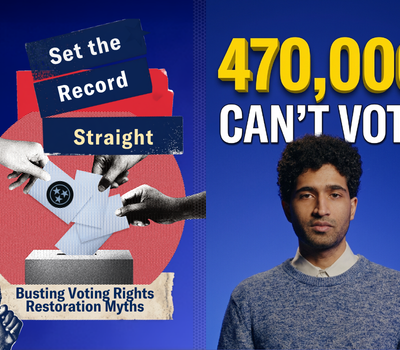
Thumbnail for the Set the Record Straight Series. Cover Reads: 470,000 Can't Vote

More from the Press


Placeholder image

Stay informed on civil rights issues. Discover our latest actions and updates in the Press Release section.

Permission Required to Change Your Tampon

After three grueling years of law school, aspiring attorneys have one last hurdle to overcome in order to practice law: the bar exam. In normal times, the bar exam is daunting, as the multi-day test determines the professional fates of lawyers-to-be. This year, with the COVID-19 pandemic raging, the bar exam has gone from being unnecessarily burdensome to unnecessarily deadly. Some states have granted bar admission to graduates of accredited law schools — a policy known as “diploma privilege.” But others are plowing ahead with exams — in-person or remote, on time or delayed. The policies and procedures for these exams are in constant flux. And the civil rights and civil liberties issues presented by this year’s bar exams are extensive. This year, states are limiting law grads’ access to menstrual products and opportunities to pump breastmilk during the bar exam. This policing of when someone can change their tampon or if and when someone can pump raises serious sex discrimination concerns.  Take the West Virginia bar exam, for example. “Feminine hygiene products” are explicitly prohibited in the testing room. Instead, the West Virginia Board of Law Examiners (WVBLE) requires those who are menstruating go to proctors to retrieve tampons or pads during the all-day exam. In response to rightful confusion from West Virginia bar examinees, the WVBLE has since stated that “there is no prohibition on bringing menstrual products to the test,” but it remains unclear if test takers can have the products with them in the testing room or not.  Montana’s policy is even worse: Menstrual hygiene products are not included in the list of permitted items (although “medical items” are allowed), and the exam instructions do not otherwise indicate that these products will be provided to test-takers. And in Nebraska, one examinee was told that she needed permission in order to change her tampon more often than every two hours. The notion that anyone can use a tampon to cheat would be laughable if it weren’t being used to disadvantage menstruating test-takers. In any event, other states have allowed examinees to bring menstrual products into exam rooms for years without incident. States are also putting up unnecessary roadblocks for test-takers who are lactating. For example, administrators in Oklahoma refused to extend the 15-minute break for one woman to pump, even though that isn’t nearly enough time to prepare the equipment, pump, and clean and sanitize the equipment. Sadly, this problem isn’t unique to the pandemic: exam administrators have long created roadblocks for menstruating and breastfeeding test takers. But this creates further barriers to new parents entering the legal profession who are already facing an unprecedented lack of childcare. Blocking access to menstrual products and opportunities to pump breastmilk during the bar exam is also a gender equity issue. First, more often than not, menstrual products are placed in women’s restrooms only. Failing to provide menstrual products in facilities that are accessible to everyone who needs them, including some transmen and non-binary people, leaves some test takers with no access to necessary products at all. Also, what products will be provided? Menstruation is different for everybody, and those who menstruate know the products that work best for them. Not to mention the privacy concerns raised by needing to disclose personal medical information to proctors. Test takers who are breastfeeding are similarly negatively affected when exam administrators refuse to allow them to safely express breastmilk during the exam at an appropriate time and place, effectively preventing many new parents from sitting for the bar. Bar examiners should be working to make the legal profession more accessible to those who already face barriers to success in the legal profession — including women, trans and non-binary people, and new parents — not less. Fortunately, some states have already reversed course in response to public outcry. But it shouldn’t take going viral on Twitter for all students to be able to sit for the bar exam in safety and dignity.

By aclutn

Placeholder image

Should We Abolish the Police?

Since the protests decrying the murder of George Floyd began in May, the institution of American policing has taken center stage. Activists are calling for change, and the phrase “defund the police” can be heard in cities across the country. As the concept of slashing police budgets and reinvesting those resources into Black and Brown communities goes increasingly mainstream, a more radical call is also gaining attention: Abolish the Police. On At Liberty this week, attorney, author, researcher, and organizer Andrea Ritchie and senior staff attorney for the ACLU’s Trone Center for Justice, Carl Takei, joined us to talk abolition, divestment, and what a world without police might look. “[Abolition is] about recognizing the instinct in all of us to punish people who hurt us, or to seek retribution instead of repair, and to acknowledge that actually in order to create a society that is free from violence, we have to move away from mobilizing the state and giving the state a monopoly on violence to respond to violence,” says Ritchie. “Instead, we need to dig to the root causes of violence and transform those conditions and causes, such that we can all have an opportunity to live in a world free of violence, not just people who are in positions of privilege in the current political, social, economic structure.”

By aclutn

Placeholder image

Border Patrol Violently Assaults Civil Rights and Liberties

In the past week, unidentified federal officers in camouflage fatigues, labeled only “police,” abducted people off the streets of Portland in unmarked vehicles and threatened the “Wall of Moms” standing up for our Constitution. The administration later confirmed the unidentified officers were Border Patrol agents.   This blatant demonstration of

By aclutn

Placeholder image

As Overdoses Spike During Coronavirus, Treating Addiction in Prisons and Jails is a Matter of Life and Death

As the Coronavirus pandemic continues to sweep through the country, especially in prisons and jails, the opioid epidemic has also seen a resurgence. The Washington Post reported that suspected overdoses jumped nationally by 18 percent in March, 29 percent in April, and 42 percent in May. This fits a nationwide pattern of excess deaths — deaths above the typical number anticipated by the CDC — unrelated to Coronavirus, such as the increased toll from heart attacks, strokes, and cancer, all as our medical infrastructure is pushed to its limits. There has never been a more critical time to provide medication for addiction treatment (MAT) for people with opioid use disorder (OUD). MAT consists of three FDA approved medications — methadone, buprenorphine, and naltrexone — that treat OUD, the disease at the root of opioid addiction. MAT is basic healthcare and a cornerstone of care for tens of thousands of people in our communities who have OUD. The need for MAT is particularly strong in jails and prisons: Without access to their medication, recently incarcerated people are left with few tools to battle their addiction. If provided with MAT, they are 74 percent less likely than people who are deprived of MAT to die of any cause while they are still incarcerated, and 85 percent less likely than people who are deprived of MAT to die of an overdose in the weeks after their release. Yet in the face of these stark numbers, 98 percent of jails and prisons still deny this lifesaving treatment to incarcerated people. The small but growing number of prisons and jails that have implemented programs to provide MAT to incarcerated people with OUD have seen success. One study of the Rhode Island prison system, which was among the first to implement a robust MAT program, found that providing MAT reduced post-release deaths by 60 percent, and all opioid related deaths in the entire state by 12 percent. Sheriff Chris Donelan in Franklin County, MA reported a reduction in recidivism, overdose deaths, disciplinary concerns, and contraband after providing access to MAT. In addition to saving lives, courts have found that providing MAT is a constitutional and civil right for incarcerated people. The Eighth Amendment to the U.S. Constitution bans “cruel and unusual punishment,” which the Supreme Court has interpreted as prohibiting “deliberate indifference to serious medical needs.” Further, the Americans with Disabilities Act (ADA) prohibits discrimination in public services, such as health care in jails, based upon a recognized disability, like OUD. Last year, the First Circuit affirmed a ruling in the District of Maine under the ADA that a jail could not deny a woman serving a 40-day sentence access to the MAT prescribed to her by a doctor. This followed a decision by the District of Massachusetts that required a jail to provide an incarcerated individual with his prescribed MAT dose throughout his time in custody, holding that the denial of his medically necessary MAT was likely cruel and unusual punishment in violation of the Eighth Amendment as well as unlawful disability discrimination under the ADA. As of July 22, more than 100,000 incarcerated people have been infected with COVID-19 and more than 760 have died. Even in the best of times, incarcerated people often receive substandard medical care, or no care at all. As COVID-19 cases make a resurgence in parts of the U.S. and continue to dramatically spike in jails, prisons, and detention facilities across the country, it has never been more important to provide evidence-based care for people with opioid use disorder in order to conserve hospital resources and save lives. Our prisons and jails aren’t designed to be drug rehab centers, and we must stop using them as such. Keeping people out of jail in the first place by making sure that they have reliable access to MAT both inside jails and prisons, and when they are out in the community, will help stop the rampant spread of COVID-19 and reduce the burden on our medical system. Further, as researchers have pointed out, the symptoms of opioid withdrawal and COVID-19 can overlap. Without access to MAT for OUD, there is an increased danger that prison officials will miss suspected cases of COVID-19, assuming that the symptoms exhibited are a result of opioid withdrawal, when in fact they are symptoms of COVID-19. This creates a danger that a positive COVID-19 case could be missed by a correctional facility, allowing a positive individual to spread the disease to others with whom they share close quarters. The answer to this problem should never be solitary confinement. Denying incarcerated people access to MAT adds a strain on the American health care system, even in the best of times. Nearly one quarter of America’s prison and jail population of 2.2 million have OUD. During this crisis, it is even more imperative that people with OUD get access to the MAT they need. Instead of letting unlawful and scientifically unsound jail policies fill our hospital beds with people experiencing post-release overdoses, let’s provide MAT to incarcerated people and use our hospitals to fight the COVID-19 crisis at hand. We’ve already seen the federal government take some positive steps once thought impossible. This includes letting MAT patients take home their buprenorphine for twenty-eight days in order to limit social contact while maintaining MAT treatment. While the federal Bureau of Prisons (BOP) has taken steps to expand access to MAT, the Department of Justice has supported recommendations from the Government Accountability Office aimed at making BOP improve the implementation of its MAT program so that it can serve everyone in need. It is time for Congress and state legislatures around the country to follow the lead of states like Rhode Island, and require MAT in all jails and prisons for everyone it is clinically appropriate for.

By aclutn

Placeholder image

This Canadian Company is Bankrolling the Predatory Bail Industry

In recent months, we have witnessed a historic wave of Black Lives Matter protests for racial justice — examining the racism in the criminal legal system and every other aspect of society, from education, to healthcare, to housing. A number of corporate leaders in the United States, Canada, and around the world have recognized the growing public anger at systemic racism and have made historic statements committing to change. We commend these statements — and also recognize how important it is that these words are backed up by action.   Take, for instance, Prem Watsa. Watsa is the CEO and chairman of Fairfax Financial and is often referred to as “Canada’s Warren Buffett.” Earlier this month, he joined as a co-chair of the “Canadian Council of Business Leaders Against Anti-Black Systemic Racism” and issued a statement that: “[t]he time for passing the buck is over. As business leaders in Canada, we have a responsibility to not only recognize that anti-Black systemic racism exists in this country but also take meaningful steps to end it.”   On Monday, Watsa spoke at the BlackNorth Initiative Summit where he and other Canadian business leaders committed to take substantive actions to end anti-Black systemic racism. Watsa’s leadership on this issue is important and should be celebrated. It also calls into question the business practices of Fairfax Financial, which is by far the largest insurer of the for-profit bail industry in the U.S.   The ACLU and Color Of Change have called on Watsa to immediately exit the predatory bail insurance industry in the United States, which disproportionately impacts communities of color, prolonging incarceration for those who cannot afford bail, and trapping others in cycles of debt.   Every day, hundreds of thousands of people sit trapped behind bars in the United States — innocent in the eyes of the law, yet incarcerated because they cannot afford bail. There is no path to ending mass incarceration in the United States without ending this current system of wealth-based, pretrial detention.   The U.S. is one of just two countries in the world where a for-profit bail system allows private corporations to be the arbiter of freedom, basing decisions on who to set free and who to detain on the ability to pay. This criminalizes poverty and reminds us that our “justice” system is more often designed with profit in mind. A 2017 report unmasked a small group of insurance companies — of which Fairfax Financial is by far the largest — that sit behind the thousands of storefront bail bond agencies, taking a cut of each bond.   But the tide is shifting. The recent divestment of three of the four largest companies backing the for-profit bail industry — Endeavour Capital, Tokio Marine, and Randall & Quilter — suggests that companies are starting to realize it is financially and politically untenable to stake their profits on the exploitation of people by the criminal legal system.   Fairfax continues to hold out, expanding its bail presence, and fighting reforms, even as the industry shrinks and becomes rightfully marginalized. The Canadian insurance conglomerate has become the largest backer of bail bonds in the U.S. Not only has it refused to divest from the predatory industry, it has expanded, stepping in to take the place of others that have made the responsible decision to exit. The website of Fairfax Financial’s US subsidiary features a “Fight Bail Reform” page, and Fairfax has spent hundreds of thousands of dollars to fight bail reform.   It’s companies like Fairfax Financial that are keeping the bail bonds industry alive in the United States, despite the fact that for-profit bail is not even legal in Canada and behavior that mimics it is met with harsh punishment. In Canada “selling bail bonds can earn you two years in prison on a charge equivalent to bribing a juror” and is considered an obstruction of justice. We’re calling on Fairfax Financial and its founder Prem Watsa to stop participating in this shrinking pariah of an industry.   The mass exodus from bail by most major financial actors comes after the industry has been repeatedly exposed for the ways it exploits Black and Brown communities, props up injustice, and often relies upon extortion, conspiracy, and other illegal practices in order to conduct its business. It comes after bail bond advertising was banned from Google and Facebook due to the industry’s role exploiting desperate families. And it comes as states and counties across the United States —  with the help of legislators, courts, and progressive prosecutors — are dramatically reducing or ending the use of money bail altogether.    As important as Fairfax is to the U.S. bail industry, bail insurance represents a tiny part — 0.16 percent — of its overall insurance business. It could divest easily and quickly. Doing so would put Prem Watsa’s money where his mouth is.   We applaud Watsa’s commitment to taking meaningful action to end anti-Black systemic racism. He should begin by ensuring that his company halts its efforts to fight bail reform and exits the predatory bail insurance industry.

By aclutn

Placeholder image

The Looming Unspoken Crisis: How a Pandemic Exacerbates the Unjust Exclusions Wrought by the Criminal System

For Black and Brown people, individuals with disabilities, and the LGBTQ community, any contact with the criminal legal system can be a life sentence of punishment. It is not just the precious time taken away from families and communities and turned over to a maze of arrests, convictions, or incarceration. That lifetime of punishment also includes the 48,000 systemic consequences triggered by those mechanisms, each of which creates nearly insurmountable barriers to housing, education, healthcare, family support, or other basic human needs.  Each year, approximately 5 million people are arrested in the United States, and between 70-100 million people have a criminal record. All of these people are routinely blocked from accessing stable housing, medical benefits, employment, financial support, food assistance, and even getting a driver’s license. And that was true before this country was overwhelmed by a global pandemic and the ensuing economic catastrophe.   The COVID-19 crisis has made people with criminal system contact more vulnerable by exacerbating these problems. The restrictions that already make reintegration to the community following incarceration difficult under regular circumstances create an impenetrable barrier to successful reintegration during a pandemic — a crisis that has created mass unemployment, a looming housing crisis, and stretched health care systems thin.   Despite what many have said, this pandemic and the generational harm it has exposed are not equal opportunity disasters. Because people of color, people with disabilities, and LGBTQ individuals are disproportionately targeted by the criminal legal system, they are also disproportionately and devastatingly impacted by underlying community frailty and systemic consequences. The longstanding exclusion of Black and Brown communities from quality and affordable health care, education, employment, and housing has been laid bare and worsened by the devastation that COVID-19 has unleashed on these communities. It is imperative to take immediate action to support people who have had criminal legal system contact, particularly those who are exiting detention facilities amidst the COVID-19 crisis with limited access to supportive services.   Consider the experience of a person leaving a jail or prison facility, or even a police station after their mug shot is shown to the public by the local media. Perhaps their health has worsened since they went to jail. They may have had a physically or mentally traumatic experience while in detention. This person, away from their family, the larger community, society, and certainly the job market, has had to learn to survive in a cage. Upon release, they may be given a few dollars and are forced to navigate a world that may look very different from what they remember.   In the midst of the COVID-19 pandemic and with the potential of a second surge of the virus in the fall, people leaving detention facilities are more vulnerable than ever. Given that most people exiting the criminal legal system have not had income for months or even years and are without a job, they must be able to access affordable and safe housing, food, mental, emotional and physical health care, and employment. Importantly, they will need a mentor or peer-to-peer support person who can help them successfully transition back into the community.   People leaving the criminal legal system also have to learn how to survive despite the thousands of restrictive laws, regulations, and other limitations applied to them. As a start, to address the harmful effects of this longstanding exclusion, state and local governments should offer people immediate access to transitional housing, health care, financial and food benefits, and other resources. This should include lifting restrictions on access to services based on an arrest, an open criminal case, or a criminal record. Additionally, every detention facility should collaborate with transitional services organizations, housing providers, and reentry organizations well in advance of a person’s expected release date. Funding should be directed to those community-based organizations specializing in reentry so that they can expand their efforts.   None of this is impossible. The lack of structural support that currently exists is the consequence of decades of deliberate decisions by policymakers and system actors, and society’s unwillingness to hold them accountable. It can be undone, and it must be. The criminal legal system exploits and exacerbates the gaps created in communities by generational divestment in local services and supports. In the long term, building or renewing our focus on filling those gaps is an absolute necessity if we are going to undo the harm the system has caused. In the immediate term, taking direct action to support people returning to the community through peer-to peer services, stable transitional housing, access to medical care, financial benefits, and food assistance is imperative. There are no perfect or quick solutions to these systemic challenges, but collective progress cannot wait.

By aclutn

Placeholder image

Let Me Vote: My Voting Rights as a Blind Man are the Same as Everybody Else’s

The first time I voted was in 1968. As a blind man, I needed the assistance of a poll worker to cast my ballot. I’ll never forget the moment the poll worker looked at my ballot and said loudly, for everybody to hear, “You want to vote for who?”   The poll worker’s comment left me shocked, embarrassed, and wondering whether she marked the ballot the way I wanted. Years later, I would ask my wife to mark my ballot. She would joke with me, “I know you love me, but now I know you really trust me.” I knew my wife would mark my ballot the right way.   I’m lucky to have the help of someone I trust, but I shouldn’t need to rely on somebody else to exercise my constitutional right to vote. People with disabilities have the same legal right to a private, independent vote as anybody else. By forcing people with disabilities to compromise these rights, election officials are disenfranchising us and sending the message that our votes don’t matter — and breaking the law.   In the 50 years since I cast my first vote, there has been some progress in increasing accessibility for people with disabilities, due to reforms included in the Americans with Disabilities Act and the Help America Vote Act, which aim to ensure accessibility. But our voting system will never be truly accessible until people with disabilities can vote without the assistance of another person, and without compromising their right to privacy. Unfortunately, that’s still not the case for the 35 million-plus eligible voters with disabilities, who face barriers that vary from state to state.   Here’s how I vote today as a Washington, D.C. resident: I request my ballot online and mark it electronically, using my screen reader. Then I must print the ballot, stamp it, and put it in the mail. The last part is feasible for me, but it may not be feasible for someone with paralysis or another disability that impedes mobility, or for someone without the financial means for a printer or computer. Due to hurdles like these, many people have to rely on a family member, poll worker, or even a stranger to cast their vote. Expanding access to vote by mail has been a major step toward accessibility because it allows people with disabilities to avoid the challenges of getting to the polls, waiting in line, and facing physical barriers at a polling place. It should also be an option for all voters, especially due to the dangers posed by in-person voting during the COVID-19 pandemic. But for true accessibility, people with disabilities who vote by mail must be able to mark, verify, and cast their ballots privately and independently.   We should also have the choice to vote in person. In fact, voting in person can be the more accessible option for some voters, such as those with print disabilities. But it’s still far from being truly accessible. Too many times, I’ve encountered poll workers that don’t know how to operate accessible machines, even when they are available. This makes the process of voting take much longer than necessary. I don’t want to have to hold up a whole line of voters just because the poll worker isn’t properly trained on how to use a machine. I want to vote efficiently, and in secret.   Voting is one of our oldest, foundational rights, but voting laws are constantly changing. In some cases, it’s for the better. For example, a dozen states have expanded access to vote by mail for some elections this year. But there’s still more work to be done to make sure the right to vote applies to everyone, including people with disabilities.

By aclutn

Placeholder image

McDonald’s is Hiding Policies That Perpetuate Systemic Racism Behind Woke-Washing

Corporate anti-racism is all the rage these days. We’ve exposed the hypocrisy of companies from Amazon to Airbnb that have taken to social media in recent weeks to speak out against systemic racism and express support for the Movement for Black Lives, but refuse to adopt corporate policies to back up their claims. McDonald’s is the latest company we’ve called out for joining the chorus of brands releasing hollow solidarity statements and launching a full on woke-washing marketing campaigns to profit from the Movement for Black Lives, while doing nothing to change worker policies that perpetuate systemic racism. After the killing of George Floyd, McDonald’s produced a digital ad to honor Floyd and six other victims of police brutality. “We do not tolerate inequity, injustice, or racism,” reads the text that flashes momentarily on the screen before it ends with “Black Lives Matter.” 

By aclutn

Placeholder image

A Constitutional Crisis in Portland

I’ve been documenting violent and militarized police responses to protests in Portland for more than four years, but nothing prepared me for the unrestrained brutality I’ve witnessed and experienced in recent days.  Night after night, since the police killing of George Floyd, people have been taking to the streets to demand an end to racist policing and a new vision of public safety for our community, one that protects the safety of our Black community members. Police in Portland, who have their own history of killings, have been meeting those demands with violent attempts to silence the protests.

By aclutn

Placeholder image