A smiling woman in an ACLU baseball cap and sunglasses sits at the top of a yellow and blue inflatable slide, holding up an “I ❤ Democracy” ACLU bumper sticker.

When Will Tennessee Certify the 2026 Midterm Election Results?

After High Turnout, ACLU-TN Thanks Tennessee Voters, Poll Workers, and Partners, Looks Ahead to an Orderly Certification

By Cathryn Stout, PhD.

Latest Publication


Citizenship Rights Restoration in Tennessee

Restoring your voting rights in Tennessee got easier in 2026. State Sen. Raumesh Akbari and State Rep. Karen Camper led the charge in the legislature to remove some of the biggest barriers standing between formerly incarcerated Tennesseans and the ballot box.

The Campaign Legal Center and Free Hearts, a Tennessee nonprofit led by formerly incarcerated women, have been on the ground helping people navigate this process and pushing for a fairer system. For eligibility requirements and step-by-step petition instructions, read the guide from Free Hearts and the Campaign Legal Center.

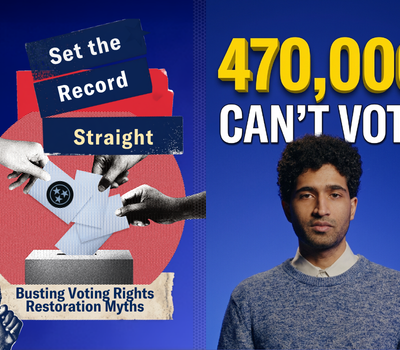
Thumbnail for the Set the Record Straight Series. Cover Reads: 470,000 Can't Vote

More from the Press


Placeholder image

Stay informed on civil rights issues. Discover our latest actions and updates in the Press Release section.

Padma Lakshmi on Immigration, Food, and Authorship

Recently, we’ve seen a reckoning in the culinary world around the whitewashing and co-opting of ethnic food. The industry has long been controlled by a limited number of people — many of them white — who have authored and then profited from the foods we eat and the stories we share. But the tide is turning. And our guest for this episode, Padma Lakshmi, is part of that movement. You’ve likely seen her tasting and critiquing some of the best chefs in the U.S. on Top Chef, sharing her favorite recipes across social media and advocating for immigrants rights and women’s rights. Padma has a long list of accomplishments. She sits on the Jane Spirit Leadership Committee, is an Emmy nominated host and executive producer, a New York Times best-selling author, founder of the Endometriosis Foundation, and is an ACLU artist ambassador for women’s rights and immigrants’ rights. She joined us on At Liberty this week to talk about her new Hulu show, “Taste the Nation,” where she breaks down important questions about the influence of immigration on American food and culture. “This show is about allowing assimilation while still giving credit, and letting those originators of those foods speak about the food themselves,” says Lakshmi.

By aclutn

Placeholder image

While Trump Protects His Cronies, Governors can Use That Same Power to Protect the Most Vulnerable

Since Roger Stone’s commutation first made news, politicians on both sides of the aisle have been quick to condemn Donald Trump’s grant of clemency to his long-time confidant. House Speaker Nancy Pelosi has even gone so far as to threaten legislation that would curtail the president’s clemency powers, and other elected officials have shared similar outrage.   Their scorn is well-founded. “This is the most corrupt and crony-istic act in perhaps all of recent history,” legal expert Jeffrey Toobin told CNN, with his ire centered in part on the notion that Roger Stone will never have served any time in prison.   Yet for as livid as both the public and elected officials are with the president’s persistent amoral flouting of judicial norms and democratic ideals, part of that anger should stem from the fact that Trump could use his clemency powers to actually do good — to actually save lives by liberating people who, unlike Roger Stone, are trapped in prison. So, too, could governors.   Many governors possess the same clemency powers as the president, yet far too few have exercised that power to save the lives of people incarcerated in state prisons during the COVID-19 pandemic. When clemency is exercised at the state level, it is often done in much the same way President Trump has done it: on an individualized, case-by-case basis, where only a lucky few are offered the shot at redemption that clemency uniquely offers. That must change, and the change starts with an honest assessment of what we have seen play out over the past few months.   The lack of gubernatorial response to the spread of COVID-19 in jails and prisons is a policy failure made all the more noticeable by the voice and volume of those who shed light on this issue. Since the outset of the pandemic, public health experts unequivocally stated that getting people out of jails and prisons must be part of any state’s response to the Coronavirus. Research proved that ignoring COVID-19 in carceral facilities would have

By aclutn

Placeholder image

Students, Colleges, and Universities Win Against the Trump Administration’s Latest Anti-Immigrant Attack

After a week of chaos, international students were able to relax after the Trump administration agreed to rescind its latest attack on immigrants: an attempt to ban international students whose classes would be entirely online this fall. The administration has normalized chaos, fear, and trauma over the last few years, beginning with airports all over the country during the Muslim ban and tearing children apart from their parents to attempting to terminate the Deferred Action for Childhood Arrivals and Temporary Protected Status programs. In the last several months, the administration has repeatedly used the pandemic as a reason to further grind the immigration system to a halt, issuing orders to terminate more immigration programs and options. The administration’s reckless disregard for human life has been highlighted by its failure and unwillingness to address the pandemic — instead, President Trump focuses on ways to exploit the pandemic.   On July 6, the Trump administration took a swing at students, and missed. Immigration and Customs Enforcement, under the government’s purview, announced that international students at universities and colleges that were exclusively online this fall would be denied visas, and those already in the United States must transfer schools, leave, or face removal. This announcement attempted to pull back a previous COVID-19 government policy, which indicated that students could attend classes remotely “for the duration of the emergency.”   Students’ lives and futures were shattered with just a short press release by ICE, the arm of the Department of Homeland Security charged with overseeing this student visa program. The announcement raised questions regarding why an enforcement agency oversees a student program, instead of USCIS, the immigration benefits agency. The short answer is that this program was legislated into a securitized monitoring system after 9/11 and eventually landed at ICE’s doorstep. This is yet another reminder that the over-policing of communities of color has been repeatedly embedded into our systems, resulting in lifetimes of unjust policies.   There are over 1 million international students in the U.S. who began to scramble after the announcement, worried about their next step. Students were left with impossible questions: Do they risk their safety in order to stay by attending in-person classes? Is their home country allowing entry for people coming from the U.S.? Will they have access to internet to attend online courses? Is their home country safe for them? What if they are placed in removal proceedings and into the U.S.’ horrific immigration detention centers, putting them at heightened COVID-19 risk?   The American-Arab Anti-Discrimination Committee spent the week helping students around the country, many consumed with fear and uncertainty. One student from Lebanon, a country in the midst of an economic meltdown and on the brink of a humanitarian disaster, realized online learning would be a non-starter if he returned. Many parts of the country currently have no or limited access to electricity. That student was not alone, as others from Yemen, Syria, Palestine (Gaza), and other countries expressed similar concerns. Students from Haiti, Jamaica, Equatorial Guinea, Pakistan, Colombia, Russia, Vietnam, Chile, and Brazil also raised a range of hurdles such as civil war and hostilities, lack of essential services such as electricity and internet, and inability of their local government to provide the safety and security necessary for a safe learning environment.   Students, whose families worked for years to save money for them to study in the U.S., confronted the extreme strain and burden on their families if they were to return. Many students were also afraid to go back home, fearing repercussions for their lifestyles or political views. With COVID-19 infections raging in the United States, some also wondered how they could comply with the current travel restrictions.   International students have long been a part of our history and a part of educational learning for all students. They also constitute a significant portion of enrolled students at many educational institutions — reportedly as high as 30 percent of the student population at one institution in 2018. Their classmates, shocked by the administration’s ban, launched petitions for hybrid models and many professors and institutions shifted their practices to try to allow their students to continue their studies here. Several even filed lawsuits to protect their students from these attacks. In one of these court proceedings, the government announced it would rescind its announcement.   A victory for over 1 million students in the United States, their loved ones here and abroad, and educational institutions nationwide. These victories are rare, but the upheaval and uncertainty are not. As rumors surge about President Trump taking another shot at upending the lives of DACA recipients, international students wonder if the government will try again to take away their security too. Trump-manufactured crisis after crisis, impacting the well-being, safety, and peace of mind of so many.   President Trump will likely continue in his failure to protect the people in America by exploiting the pandemic for his hateful agenda to dismantle our immigration system, rather than creating a coordinated response for the future of our nation. Though at times we might lose ourselves in the darkness of these failures, this week reminds us that there are no small wins. Every victory is immeasurable in its ability to help someone.   When we all fight together, those numbers grow — this week, to over 1 million.

By aclutn

Placeholder image

During a Global Pandemic and Period of Nationwide Protests for Racial Justice, Does the Biden-Sanders Platform Meet the Moment?

In just over 100 days, Americans will vote not just for an individual candidate to occupy the Oval Office, but for a vision of the next era of the United States. That vision will hold answers to a range of key questions: Will we continue to restrict access to abortion for the most vulnerable? Will we continue to force local law enforcement to do the job of Immigration and Customs Enforcement (ICE), regardless of the consequences? Will we continue our racist system of mass incarceration that has harmed Black and Brown communities for decades? Since March 2019, the ACLU’s Rights for All campaign has sought answers to these questions, getting presidential candidates on the record on key civil liberties issues and educating voters on their responses.  Our view is that it’s not enough for presidential candidates to talk generally about their values and offer platitudes on the campaign trail. We need to know what their specific policies would be, and how they would institute those policies — and advance rights for all — if they secure the presidency.  One indication we have on how Joe Biden, the presumed Democratic nominee, might perform is found in the recently released Biden-Sanders policy recommendations. While not a definitive plan, it provides us with key insights into what a Joe Biden presidency would prioritize — and the results are mixed in terms of rights for all. Take reproductive rights for instance. Back in May 2019, an ACLU volunteer asked Biden if, as president, he would end the Hyde Amendment, a ban on abortion coverage for people enrolled in Medicaid that has denied care to people with low incomes — disproportionately women of color — for more than 40 years. Biden said “yes.”   Biden’s pledge to our volunteer to end Hyde was a reversal from his decades-long held position. Now, the Biden-Sanders task force recommendations reaffirm that promise to repeal Hyde, but don’t offer much on how exactly he’ll do that.  And the details matter. That’s why we’re holding Biden’s feet to the fire on this commitment, and pushing him to move the nation forward and expand access to abortion. We want Biden to clearly outline how he’ll eliminate abortion coverage restrictions and ensure that people can access abortion, no matter how much money they have or how they get their insurance. For starters, we need him to make a firm commitment to remove all abortion coverage restrictions from his first budget, and tell Congress he won’t sign bills with abortion coverage restrictions, if he is elected.   Advancing rights for all also includes the 2.3 million individuals who are incarcerated in local, state, and federal prisons and jails nationwide. Everyday, our nation’s leaders deny millions of Americans their humanity and justice, further securing the United States’ title as the biggest jailer in the world.  So where’s Biden on ending mass incarceration? Just two months after Biden promised to end the Hyde Amendment, he also pledged to an ACLU volunteer to cut the country’s prison population in half. Reducing our incarceration rate by 50 percent is a long overdue step towards liberation for millions of Americans trapped in an oppressive system. And it should very much be a priority for Joe Biden, given his role in pushing the 1994 Crime Bill, which helped create this crisis. Unfortunately, this commitment is missing from the released Biden-Sanders recommendations.  The Biden-Sanders platform takes positive steps by recommending the end of private prisons, which create perverse incentives for increased incarceration. It discusses the elimination of cash bail, and terminating mandatory minimum sentences. But it is silent on the concrete  commitment to cut incarceration by 50 percent, and the component pieces referenced in the platform are unlikely to get us there. The nation is demanding transformational leadership in the aftermath of the murder of George Floyd, and we need Biden to send the right signals. Without reaffirming a north star of 50 percent decarceration, one is left to wonder what will be the impact of Biden’s agenda.  Moving the nation forward also requires a commitment to equality for our nation’s immigrants, who are ensnared in a racist system designed to target people of color. Our vision of rights for all calls for an immediate end to collaboration between ICE and local law enforcement. In July 2019, an ACLU volunteer asked Biden where he stood on this issue, and he pledged to remove local law enforcement from federal immigration enforcement, including by ending the use of detainers. In the Biden-Sanders platform, there is a call to reverse the unjust use of 287(g) and similar programs that force local law enforcement to take on the role of immigration enforcement. We need follow-through on this agenda. Especially in the face of a devastating pandemic, we need all members of our communities to trust local government officials, and that cannot happen if immigrants are constantly in fear that local government actors are immigration agents in disguise.   The Biden-Sanders platform moves the fight to ensure rights for all an important step forward, but it doesn’t go far enough. If we want to end Hyde and all abortion coverage restrictions, get to 50 percent decarceration, and cut forced collaboration between immigration enforcement and local police, we need to keep the pressure on the Biden campaign. We must demand that the Biden campaign adopt these policy recommendations and articulate how it intends to institute them. Anything short of a clear roadmap is unacceptable. America deserves leaders who will act with urgency to make the dream of freedom and justice for all real for every person in this country.

By aclutn

Placeholder image

After Years of Advocacy, the House of Representatives Finally Cuts Funding to Trump’s Deportation Force

The Trump administration is infamous for its attacks on immigrants and their loved ones. The administration’s cruelty has no bounds, as we’ve seen from its separation of families, obliteration of our historical commitment to protecting asylum seekers and migrant children, and exploitation of a global pandemic to advance the xenophobic dismantling of the immigration system. We are rightly horrified. For far too long and on far too many occasions, Congress has been funding this anti-immigrant agenda under the radar, with your taxpayer dollars. For years, we’ve pushed back, and now, Congress is listening with a scaled back funding proposal for the Department of Homeland Security — the arm of Trump’s deportation force. We are inspired by the fierce, coordinated, and growing movement to divest from police forces across the country to put an end to racist policing and the epidemic of police violence in Black and Brown communities. This movement calls us to hold the system of immigration enforcement accountable too. We see similar surveillance, over-militarization, and violence inflicted on Black and Brown communities by the Department of Homeland Security. DHS was created after 9/11, and its sub-agencies Immigration and Customs Enforcement (ICE) and dangerous and unnecessary detention of immigrants by ICE and CBP. Most alarming, the bill still supports DHS grants for state and local law enforcement agencies, which can be repurposed by police to buy military-grade equipment and to collaborate with CBP. And it inexplicably increases funds for Homeland Security Investigations (HSI), an agency that is emblematic of Trump’s brutal immigration agenda, including working closely with local law enforcement to erroneously label immigrants as gang members and upend their lives. While we will continue to fight for the strongest possible funding bill, with deeper cuts to harmful programs and more accountability and oversight, we are also energized by the progress you helped us achieve. The bill significantly reduces ICE detention, takes meaningful steps to hold ICE and CBP accountable for their wasteful spending, and rescinds money for Trump’s border wall. Congress is finally appreciating its immense “power of the purse” under the Constitution and its role in reining in Trump’s extremist agenda.

By aclutn

Placeholder image

Dallas Police Killed My Unarmed Son. Their Brutality is a Global Problem.

In 2013, I founded Mothers Against Police Brutality (MAPB) after my only son Clinton Allen was extra-judicially murdered by a Dallas police officer. Clinton was unarmed. He was just 25-years-old, and had grown from being a delightful and curious child into an avid reader who dreamed of becoming the fifth generation of our family to be a rancher. His dreams were extinguished with his life. He should be alive today.   The officer shot my son seven times, once at close range in the back. Clinton’s death at the hands of police is far from uncommon. Rather, it is something almost commonplace in communities of color, and the public outcry against police violence makes it clear that the nation is waking up to that tragic reality more and more.   Each year, thousands of people are killed by U.S. law enforcement. For the most part, no one says their names except for their own family and friends. Every so often a handful of these thousands who have been murdered are cherry-picked as being worthy of attention for a variety of reasons: the killing was caught on compelling video; it’s particularly vicious; or because the victim is especially sympathetic. The reality is that all people killed by law enforcement should have their names heard, and their stories told. Outside of the handful of cases that the public is aware of, the consistent loss of life at the hands of police is almost invisible. The lack of extensive media coverage of all police killings spreads the illusion worldwide that police brutality in the U.S. is an anomaly. We know that instead, it is the rule, and a source of fear, death, and anguish for communities of color in general and Black people in particular.   A common retort is that we are dealing with “a few bad apples” who happen to be spoiling the good name of the bunch. We are not. We are dealing with a police culture that is an orchard of poisoned trees, diseased at the root, bearing a relentless, deadly fruit which tears apart Black families like my own.    For each one of us who fights for our rights and lives, there is a law enforcement organization pushing back. Unjust laws and powerful police unions protect U.S. police officers. The number of police officers who kill Black people who actually face a jury is statistically insignificant. Furthermore, district attorneys are generally unwilling to prosecute; they are often too cozy with police institutions they count on to win convictions; and when campaigning for office, they seek the endorsement and funds of the local police union.   Finally, police killings are not always independently investigated — more often than not, it is police departments that investigate themselves. In the first hours after an officer kills one of us, they set the narrative and tone, which is typically picked up by the county prosecutor. The fact remains that in the U.S., a police officer can violate your human rights, even kill you, and 99 times out of 100, nothing will happen. No charges, no indictment, no trial, no conviction and often not even dismissal from the police force. Put simply, the problem of police brutality in America is systemic, racist, and must be addressed as such.   These factors have coalesced and worsened over time to enshrine a very dangerous police culture in the U.S. It is dangerous for people of color, particularly Black men and boys. But it is also a great danger to the future of democracy in the U.S. When police abuse their power and use their authority unjustly — which, after all, is the authority given to them by the public, by us — they break the social contract and leave it bleeding in the street.   They leave us bleeding in the street.   The people of every nation on this earth must summon the courage to resist police brutality, not only in the U.S., but in every country where the fatal results of an original betrayal of public trust exists. We need many specific policy changes, starting with ending qualified immunity, and proceed from there to setting a national standard for the use of deadly force that complies with international law.   Reducing funding to police departments and reinvesting those funds into Black and Brown communities are necessary steps to prevent further harm and to ensure that all people can live without fear of police violence.   Incredibly, today in America every law enforcement agency can claim its own standard for when they can kill a person as long as the officer says that he felt that “his life was in danger.” Unarmed suspect, shot in the back, driving away, running away? “Fearing for his life, the officer fired seven shots, killing the suspect.” No charges, no indictment, no trial, no conviction. It could only be more unbelievable if it weren’t true, but this is the reality of police brutality in the U.S.   On June 19, the United Nations Human Rights Council adopted by consensus a watered-down resolution calling on the high commissioner to prepare a report on systemic racism and violations of international human rights law against Black people, to contribute to accountability and redress for victims. I very much hope that the report will be the first step in a series of meaningful international accountability measures to fully and independently investigate police killings in the U.S., and to provide effective remedy and compensation to victims and their families.   But beyond any specific policy change, we need people worldwide to demand an end to the routine extra-judicial killing of Black people by the police in America. In the name of my son, Clinton, and for all of our families: this must stop.

By aclutn

Placeholder image

Supreme Court Correctly Rules that Trump is Not Above the Law

Donald Trump, who often behaves as though he has never read the Constitution, received an important civics lesson from the Supreme Court yesterday when it ruled in two cases involving his personal financial records, including tax returns that he has long sought to conceal, that there is an important difference between being president and king. As the Supreme Court emphatically – and on this point, unanimously – reminded us all, the president may occupy the highest office in the land, but he is not above the law.   Chief Justice Roberts wrote the Court’s opinion in both cases. The first case, Trump v. Vance, arose when a New York State grand jury investigating possible financial crimes issued a subpoena to the President’s long-time accountants, requiring production of the President’s own tax returns as well as tax returns filed on behalf of various of his business entities. Grand jury proceedings are secret, and the Manhattan District Attorney has refused to say whether the President himself is a target of the investigation. He has said, however, that the grand jury is looking into the conduct of “multiple individuals.”   The second case, Trump v. Mazars, began when three congressional committees issued subpoenas seeking tax and other financial records from two banks with which Trump has done business in addition to his accounting firm. The congressional subpoenas were issued as part of ongoing inquiries into foreign interference with the 2016 presidential election and the possible need to strengthen federal laws addressing money laundering, terrorism, and conflicts of interest.   Donald Trump’s response was to file federal lawsuits in both New York and D.C. insisting that each of the subpoenas was invalid and therefore none of them could be enforced. He lost that argument in the lower courts and he has now lost it in the Supreme Court. The two cases nonetheless presented different claims and the Supreme Court approached them differently. The ACLU filed amicus briefs in both cases.   Trump’s position in the grand jury case was that he is absolutely immune from state judicial process (meaning a subpoena) while in office even if, as here, the subpoena solely concerns his conduct as a private individual unrelated to the performance of any presidential duties and even if, as here, the subpoenaed documents are relevant to the grand jury’s investigation of other individuals and organizations.   No one on the Supreme Court accepted that position, and with good reason. Since the early days of the Republic, as Chief Justice Roberts put it, presidents have been required to produce evidence in federal criminal proceedings. It was true for Thomas Jefferson when Aaron Burr was on trial for treason. It was true for Richard Nixon when a grand jury sought the Watergate tapes. And it was true for Bill Clinton during the Whitewater investigation. Donald Trump’s tweeted complaint following the Supreme Court’s decisions that other presidents in similar situations have received judicial deference, “BUT NOT ME,” is not only self-pitying, but wrong.   Indeed, as the Supreme Court recognized, Trump’s claim to absolute immunity was considerably weaker than in the Watergate case, where President Nixon had claimed executive privilege over conversations that took place in the Oval Office. Trump did not and could not claim executive privilege over his private business affairs. For that reason, the Supreme Court also rejected Trump’s plea to apply the same heightened standard of need that it had applied to the Watergate subpoena. But, like every other recipient of a grand jury subpoena, Trump remains free to argue that the subpoena is unduly burdensome or was issued in bad faith.   The congressional subpoena case involved a different set of concerns and a different balancing of interests by the Supreme Court. In contrast to a 200-year history of presidential compliance with criminal subpoenas, Chief Justice Roberts began his opinion in Mazars by pointing out that the Court had never previously addressed a congressional subpoena for information concerning the president. Rather, he noted, such disputes have historically been resolved by negotiation between the political branches.   Writing on a clean slate, the Chief Justice articulated two important principles at the outset. First, Congress’s power to obtain information through subpoena is a necessary and important adjunct to its power to legislate and conduct oversight of the executive branch. Second, the power to investigate is subject to limits to prevent a recurrence of the abuses that occurred most notably during the McCarthy era. The most important of those limits is the requirement that a congressional subpoena be pertinent to a valid legislative purpose.   Citing Watergate again, Trump argued that something more should be required when the president is involved. Again, the Court disagreed, reiterating the distinction between an inquiry into the president’s conduct in office and his conduct as a private citizen. The standard proposed by the President, the Court noted, “would risk seriously impeding Congress in carrying out its responsibilities.”   The ACLU accordingly argued in its amicus brief that the congressional subpoenas were proper and should be upheld. The Supreme Court took a different course, sending the case back to the lower courts for a closer look at whether the information Congress was seeking could be obtained elsewhere and whether the subpoenas could be narrowed.   As a practical matter, that means that Congress is unlikely to obtain any documents before the upcoming election unless the parties can settle the dispute, which would undoubtedly be the Court’s preferred resolution but seems even less likely given the current toxic political environment.   That outcome has led some to describe the congressional case as a political victory for Trump, even if his legal position did not prevail. But it would be a mistake to underestimate the significance of the fundamental principle that underlies both of yesterday’s decisions, or the fact that a Court that is so frequently fractured was unified in recognizing that Trump’s broad claim to presidential immunity is incompatible with our constitutional democracy and the system of checks and balances that was designed to preserve it.

By aclutn

Placeholder image

How Reproductive Justice is Part of an Anti-Racist Agenda

The calls of activists have forced a national reckoning with the legacy of white supremacy in our country. That reckoning has led us to examine the systems that exert control over and oppress Black lives, from policing to reproductive health care. There is a long history of the ways that reproductive freedom has been denied to Black women. There is also an important history of the ways that people of color, led by Black women, have built movements to liberate themselves and reclaim their bodily autonomy. Joining us on At Liberty this week to discuss this often overlooked but vital movement is Renee Bracey Sherman, the founder and executive director of We Testify, an organization dedicated to telling the stories of people who have had abortions. Sherman walks us through what sets the movement for reproductive justice apart from the broader fight for reproductive rights, talks about recent U.S. Supreme Court decisions, and shares how building the We Testify community has aided her own journey of healing.

By aclutn

Placeholder image

Police in Schools Continue to Target Black, Brown, and Indigenous Students with Disabilities. The Trump Administration Has Data That’s Likely to Prove It.

Across the country, communities are pushing their schools to divest funding from police and reinvest those funds in student mental health care and other supportive services. But in making their case to their respective school boards, these parents, students, and advocates have run into one significant barrier — outdated data on policing in schools.   Every other year, the Department of Education collects and eventually releases to the public data that shows the number of student referrals and arrests made by police (including school resource officers (SROs)) in public schools, and which students are most impacted. The data includes students’ ages, gender, race, and whether they have a disability. Time and time again, this data has shown students of color and students with disabilities are disproportionately referred to and arrested by police in schools.   The data also includes staffing data detailing how many counselors, social workers, school psychologists, and nurses are in schools compared to law enforcement officers or SRO presence. This data is crucial for understanding how police in schools have fueled the school-to-prison pipeline, and the dire discrepancies in funding for mental health personnel in schools compared to funding for policing our students.   The Department of Education has been collecting arrest and referral data for the last 10 years through the Civil Rights Data Collection (CRDC) — a collection they have administered since 1968. The data from the 2015-2016 school year, released in April 2018, is the last data set that was released to the public.   Now, the Department of Education is sitting on the most recent data from 2017-2018 and has neglected to release it publicly.   This is why we’ve filed a Freedom of Information Act request to address the Department of Education’s inaction and call on them to release this data set. This data is needed across states and localities to inform policy reform amidst a growing movement to divest police from our schools. We know that the number of police officers in schools is steadily rising, but we don’t know if the numbers of school-based mental health staff have been keeping pace. Holding this data hostage prevents us from making the most informed decisions we can for our schools and how we can allocate funds. The Impact of Policing on Our Disabled Students, Students of Color, and Disabled Students of Color If historical trends in the data hold true, law enforcement in schools will continue to disproportionately target students of color, students with disabilities, and students of color with disabilities. Black and Indigenous students, students of color (BIPOC), and students with disabilities often have to attend schools with fewer resources and support and school staff that are often not adequately trained and staffed to accommodate children with disabilities. When there are no other support staff to address behavioral problems, some teachers request help from law enforcement. This is where things often go awry. Police in schools do what they are trained to do — detain, handcuff, and arrest. Past data analyzed by the ACLU shows that schools with police reported 3.5 times as many arrests as schools without police.   Just as with the concentration of policing in low income communities of color, policing in schools is also racialized. Our report, “Cops and No Counselors” analyzed CDRC data from 2015 to 2016 and found students of color are more likely to go to a school with a police officer, more likely to be referred to law enforcement, and more likely to be arrested at school. Nationally, Black students are more than twice as likely as their white classmates to be referred to law enforcement. Black students are three times as likely to be arrested as their white classmates, and in some states, Black girls are over eight times as likely to be arrested as white girls. During the 2015-16 school year, 1.6 million students attended a school with a sworn law enforcement officer and no counselor. What makes a child most likely to be targeted by a police officer while in school? Simply having a disability. Overall, students with disabilities were nearly three times more likely to be arrested and referred than students without disabilities (and this disparity increases up to tenfold in some states), and the risk is multiplied in schools with police. If a child has a disability, and they are also a student of color, the odds are even worse. For instance, in Rhode Island, Native American students are referred to law enforcement at a rate five times the national average. But Native American boys with disabilities are arrested at a rate almost 7.5 times the national average. Black and Latino boys with disabilities represent only 3 percent of students nationally, but account for 12 percent of school arrests. Black boys are also often labeled as “emotionally disturbed” or simply “bad” when non-compliant behavior occurs — whether or not they have an emotional or behavioral disability — and those behaviors disproportionately lead to a law enforcement response rather than a supportive response through appropriate accommodations.   Schools have consistently chosen policing over implementation and expansion of mental health resources that support our students. During the 2015-16 school year, 1.6 million students attended a school with a sworn law enforcement officer and no counselor. We know from the 2013-14 school year data that Black students were 3 times more likely to attend a school with more security personnel than mental health personnel. What will the story of the 2017-18 school year data tell us? Next Steps: Demanding More Transparency The Department of Education is not solely to blame for us not seeing this data now — many states and large school districts also lack transparency in publishing this data, in violation of both the CRDC and the federal Every Student Succeeds Act (ESSA). As my colleague Harold Jordan has discussed, states and local education agencies are required under ESSA to publish annual “report cards” on measures of school quality, climate, and safety, including information on school-related arrests and referrals to law enforcement. An internal review shows that the vast majority of states do not have current policing data available on their websites — often only the 2015-16 data their districts reported to the CRDC — and that’s if they reported the data at all.   “Every district should have already posted that data in their school and district report cards for the 2017-18 school year,” Daniel Losen, director of the Center for Civil Rights Remedies at UCLA’s Civil Rights Project cautions. “Very few did so. We are concerned we will see with the release of the ’17-‘18 data that a lot of districts have once again failed to report their data, which means they violated civil rights law. And one reason is that there is no accountability when districts fail to report the required data. We anticipate that about half of the largest districts will report zero arrests.”   This is a funhouse mirror of reality where some districts and states feel that the Civil Rights Data Collection and the ESSA reporting requirements do not apply to them. Districts and states must do better to comply with federal law and maintain transparency for their communities. In the meantime, the Department of Education has not yet released this data while communities and policymakers are making crucial decisions about the role of law enforcement in our schools. Having this data is more pertinent than ever. We need to be able to document what our Black, Brown, Indigenous, and disabled communities already know: that policing in schools is harmful for our students. The Department of Education is officially on notice. States and school districts are too. Communities need this data immediately to help inform important policy decisions that will best serve our students. We need the data to be accurate and provided now to show our policymakers why we must divest from police, and invest in helping our students succeed.

By aclutn

Placeholder image