

In October, a federal judge asked the lawyer for a Tennessee district attorney a simple question: “Why don’t you just tell them that it’s not going to happen again?”
The state declined to make that promise.
The judge asked the illuminating question during oral argument on Oct. 22 in Blount Pride, Inc. v. Desmond before a three-judge panel of the U.S. Court of Appeals for the Sixth Circuit. Blount Pride and drag performer Flamy Grant are asking the court to let their First Amendment claims proceed. The promise the judge asked about concerns District Attorney Ryan Desmond’s and Maryville Police Chief Tony Crisp’s actions in 2023, and whether they would take the same actions again.
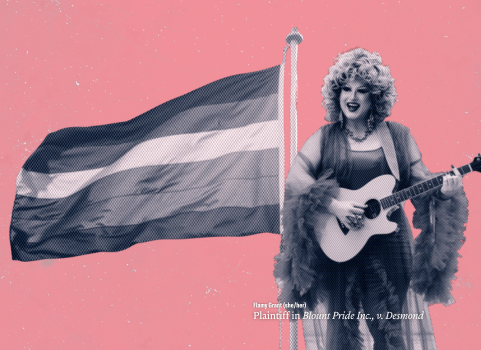
Those actions targeted an advertised event. In 2023, Blount Pride advertised a family-friendly Pride festival at Maryville College featuring local artists and drag performers. The ad showed Flamy Grant in drag, holding a guitar. Four days before the event, Desmond sent Blount Pride and local law enforcement officials a letter stating that his office would prosecute violations of Tennessee’s Adult Entertainment Act.
Three years later in Cincinnati, Stella Yarbrough, senior counsel with Herzfeld, Suetholz, Gastel, Leniski and Wall PLLC, built her argument for the plaintiffs around that letter. The ACLU of Tennessee; Herzfeld, Suetholz, Gastel, Leniski and Wall PLLC; and Horwitz Law PLLC represent Blount Pride and Flamy Grant. Yarbrough told the court the case “can be captured in a single sentence,” and that sentence is Desmond’s own. Before he sent the letter, he conducted, in his words, “a diligent search” of state law for a way to stop the festival before it happened. He found none.
Yarbrough argued that the letter itself shows its target. It came on official stationery, identified Blount Pride and its advertisement specifically, and listed every official who could help shut the event down. A neutral statement of the law would do none of those things, she argued.
Crisp, she told the court, moved even before the letter arrived. He contacted Maryville College the day before Desmond sent it and asked to review the college’s contract with Blount Pride. The lawsuit alleges that Crisp then warned Maryville College officials that they could face prosecution under the Act in connection with the festival.
Blount Pride went to court and won early protection. In 2023, the plaintiffs obtained a temporary restraining order protecting the festival from interference, and the court later entered an agreed preliminary injunction. Those orders allowed the festival to proceed. In October 2025, however, the district court dismissed the case on standing and other grounds. Standing is the legal test to determine whether there is a live, active controversy before the court. To ask a court to stop ongoing or future harm, a plaintiff must show that the harm could happen again.
Whether it could happen again became the central question during the Oct. 22 hearing. Yarbrough answered with an image. “Think of it like a chess board with all the pieces still in the same place since 2023,” she told the court. Blount Pride still holds Pride events in Blount County. Flamy Grant still performs. The district attorney and the police chief still hold their offices. And they have never disavowed their actions.
The defendants countered that Pride events have taken place since 2023 without enforcement. Yarbrough replied that Blount Pride moved its 2025 event out of Crisp’s jurisdiction, and she argued that the move shows the fear has not gone away.
The judge’s question cut to the heart of that dispute. If the officials have no plans to threaten protected speech again, a simple promise could help settle the matter. Desmond’s lawyer responded that prosecutors do not have to come into court and say they will never do it again. Yarbrough closed on that point. The defendants could tell the court they would only enforce the law as written. “They haven’t done so,” she said, “and I think that speaks volumes.”
Drag is free speech
The defendants’ refusal matters because the speech at stake is protected. Drag is live artistic expression, built from costumes, songs, and performance. As Yarbrough told the court, most speech is protected, and drag falls clearly within that protection.
The Sixth Circuit’s own decision in Friends of George’s recognized drag as arguably protected expression. “As the Sixth Circuit has made clear, the AEA [Adult Entertainment Act] does not even arguably prohibit family-friendly drag performances, which enjoy the First Amendment’s full protection,” Daniel Horwitz of Horwitz Law PLLC said when the plaintiffs filed their appeal brief in February.
Why this case matters
Government officials should not use threats of criminal punishment to chill protected speech. The ACLU of Tennessee maintains that Blount Pride and Flamy Grant have a constitutional right to advertise and perform family-friendly drag performances without unconstitutional government interference or retaliation. The appeal has implications for free expression throughout Tennessee, Kentucky, Ohio, and Michigan.
The three-judge panel will now decide whether Blount Pride and Flamy Grant get their day in court. The panel took the case under submission and will issue a written decision. The court has not set a date for its ruling. The plaintiffs are asking the Sixth Circuit to reverse the dismissal and send the case to the district court for further proceedings.
The First Amendment is a promise. Blount Pride and Flamy Grant are asking the court to make sure Tennessee keeps it.
Follow the case on our case page.